
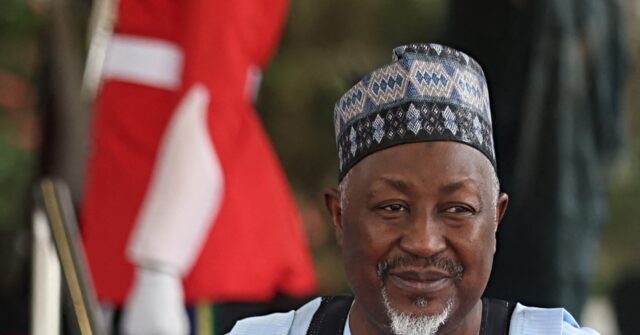
Nigerian Defense Minister Mohammed Badaru Abubakar tendered his resignation on Monday, the office of President Bola Tinubu confirmed, amid a growing wave of jihadist violence against Christians in the country.
Nigeria, whose population is nearly evenly split between Muslims and Christians, has faced over a decade of genocidal Islamic violence against Christians in both the Muslim-majority north and the Middle Belt, the informal border that connects the north to the Christian-majority south. In northern Nigeria, jihadist organizations such as Boko Haram engage in mass abductions of Christian girls as well as suicide bombings and other atrocities, while in the Middle Belt, heavily armed Fulani jihadists represent the biggest threat.
The Fulani attacks have displaced thousands of people and experts agree are intended to eliminate the indigenous Christian population of the Middle Belt. International human rights experts have recognized Nigeria for years as by far the deadliest place on earth to practice Christianity as a result of Islamic violence.
President Donald Trump placed Nigeria on the State Department’s list of Countries of Particular Concern (CPC) for religious freedom in October, suggesting he may consider sending troops “guns-a-blazing” into the “disgraced country” to protect Christians.
“The United States cannot stand by while such atrocities are happening in Nigeria, and numerous other Countries. We stand ready, willing, and able to save our Great Christian population around the World!” he announced.
President Tinubu responded to Trump’s declaration by denying that any religious discrimination exists in his country, dismissing the evidence of widespread persecution as general “instability.” Nigerian media regularly refer to the jihadists as mere “bandits” and omit the religious dimension of the violence, which Christians in the region say is a result of government pressure to suppress news of the crisis. Reports surfacing following Trump’s CPC designation in local media cited Christians who said government officials threatened to arrest them if they denounced the targeted attacks against churches and other Christian community centers.
Badaru, the defense minister, reportedly resigned on Monday. Few details have been made public about the reasons for the move, though a Tinubu spokesman claimed that Badaru resigned due to “health” reasons, according to the Premium Times.
“President Tinubu has accepted the resignation and thanked Abubakar for his services to the nation,” Bayo Onanuga, the spokesman, reportedly said.
Badaru was enthusiastically defending Tinubu’s governance as recently as this weekend, attending the Northwest Security Summit in the northern state of Kaduna and claiming that Tinubu was fully engaged in fighting the jihadist threat – without, of course, identifying it as such.
“The minister said the region has recorded measurable progress in tackling the menace of insecurity, noting that several key routes previously dominated by bandits have reopened,” the Nigerian Guardian reported. Badaru reportedly claimed to northern leaders that movement without fear in parts of the north had “improved significantly” and thanking local leaders for “countering misinformation.”
Badaru’s comments contrasted significantly with the address by Kaduna Governor Uba Sani, who described the crisis in his state as “vast in scale and constantly evolving,” not an improving situation.
“Today, our region faces an interlocking wave of violent activities—well-structured banditry, terrorism, mass abduction, illegal mining, gun-running, human trafficking, smuggling, and sectarian violence,” Sani explained. “These groups move seamlessly across state lines and international borders, often coordinating with criminal organisations beyond Nigeria’s frontiers. Our responses must therefore match their complexity.”
In another sign of diminishing confidence in the Tinubu government, the governors of 19 northern states and several “traditional rulers” met on Monday to advocate for the decentralization of the national police force so that they could properly address the jihadist threat without having to go through Tinubu’s government.
“Nigeria’s centralised policing model can no longer meet the demands of a nation with over two hundred million people with vast ungoverned spaces,” Sani, who hosted that meeting, asserted, according to the Nigerian newspaper Vanguard. “With fewer than four hundred thousand police officers nationwide, many rural communities are left without meaningful protection.”
Sani also claimed the governors of the north had established an “informal peer review mechanism” to work together without having to deal with the federal government.
In the immediate aftermath of Trump’s CPC designation, many of the country’s political leaders backed Tinubu, claiming that radical Islamic terrorism was a threat that also affected Muslims and was not inherently religious in nature.
“The characterisation of Nigeria as religiously intolerant does not reflect our national reality,” Tinubu had said a day after the CPC designation, “nor does it take into consideration the consistent and sincere efforts of the government to safeguard freedom of religion and beliefs for all Nigerians.”
As violence has intensified in the country, however, especially targeting Christian schools, Tinubu was forced to declare a state of emergency last week over the situation he denied a month prior. Tinubu’s major actions since have been to call for the shutdown of schools, leaving many Christians with no education, and canceling planned travel to South Africa for the G20 summit to address the allegedly non-existent jihadist violence.
Political opponents and even former allies have become increasingly emboldened in criticizing Tinubu. On November 24, the national publicity secretary of the opposition Peoples Democratic Party (PDP), Comrade Ini Ememobong, suggested Tinubu should resign.
“Normally, we have the international partners who can help. But if you do not invite them, you can become a local meddlesome interloper if you seek to help,” Ememobong said. “At any time, government is unwilling, unable, or incapable of executing this primary role, such a government must either ask for help (locally or internationally) or honourably resign, if it is sincere and responsible.”
Hakeem Baba-Ahmed, a former special adviser to the vice president in the Tinubu administration, urged Tinubu not to run for re-election on Monday.
When I left his administration, one of the things I told many people was, ‘I wish President Tinubu would not run again in 2027,’” he suggested. “I don’t think he has run the country well. The Tinubu we used to know, the Tinubu with all this brilliant intelligence for scheming, hasn’t shown that same hunger to fix things.”
“He should find a replacement within his party, a younger person, a healthier person, a more focused person, and make him his candidate,” Baba-Ahmed offered.