Researchers at Stony Brook University say they have developed a low-cost way to retrofit hundreds of thousands of aging septic systems across Long Island to drastically improve drinking water.
The team at the university’s Center for Clean Water Technology says it has come up with a solution to the region’s crisis of septic tanks leaking toxic nitrogen into groundwater used for drinking — not to mention the water in Long Island’s streams, rivers, and bays, lead researcher Thomas Varley told The Post.
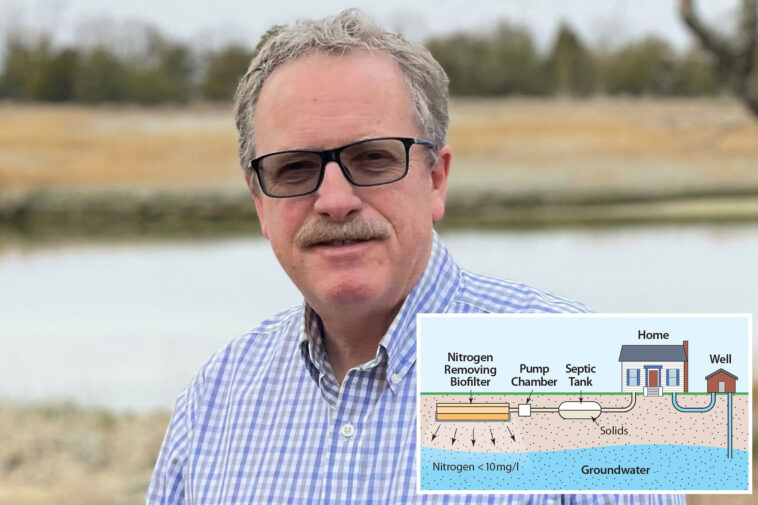
He said the scientists created a prototype that can be installed into existing tanks and features a never-before-seen chamber full of wood chips that aggressively strip nitrogen from the wastewater before it even has a chance to seep out.

“Whatever comes out of our septic tanks is going directly into the ground, which eventually gets into our drinking water and gets into our surface water bodies,” Varley said.
“You’re seeing the effects of that now with excess nitrogen — excessive algae growth, lower dissolved oxygen levels that can lead to fish kills, shellfish poisoning, and those blue-green algaes that form toxins.”
The breakthrough invention not only outperforms every currently available septic system on the market but also removes almost 10 milligrams of nitrogen more than the most advanced available tanks out there, according to Varley.
A conventional septic system can leak around 80 milligrams of nitrogen per liter, sometimes more, Varley said.

Suffolk County’s current standard for the more modern, low-nitrogen systems is at 19 milligrams per liter.
Stony Brook’s prototype solution has consistently tested at less than 10 milligrams per liter, according to the team.
“People don’t realize how much of an impact just one home can have — this could drastically reduce the nitrogen pollution leaking into the groundwater,” Varley said.
Conventional septic tanks are essentially underground holding tanks where solid waste settles, grease floats, and liquid waste flows out into a leaching structure, Varley said.
Low-nitrogen septic systems rely on a two-stage treatment process that requires removing the existing tank and installing new equipment underground.
The team’s prototype applies the same biology but retrofits what is already in the ground rather than forcing homeowners to excavate their properties to solve the issue, since the proposed system can be installed through a manhole cover.
Stony Brook’s prototype takes the existing tank and converts it into multiple chambers — the first being a treatment chamber, while wastewater is then routed into the second, which is filled with wood chips.
There, bacteria grow and remove a majority of the nitrogen during the second stage of treatment and kill it at the source, sharply reducing the pollution entering groundwater and nearby streams, rivers, and bays.
Suffolk County alone has about 360,000 homes that rely on septic tanks — roughly 75% of the county — opposed to about 35,000 in Nassau County, where 90% of homes are connected to sewers, according to Varley.
If the technology were to be widely adopted across Long Island, Varley believes the amount of nitrogen seeping into the water supply would decrease tremendously.

Before the prototype can qualify for local and state septic grants to speed along the process, it needs Suffolk County, which oversees the program that helps homeowners cover the cost of installing low-nitrogen systems — to sign off on the technology for grant eligibility. The cost of the newly invented system was not immediately clear.
County Executive Ed Romaine signaled he may be open to doing this.
“My administration is continuing to do everything possible to address the nitrogen issues facing our drinking water, bays, and rivers,” Romaine told The Post.
“I welcome discussion regarding these new findings and tech technologies.”