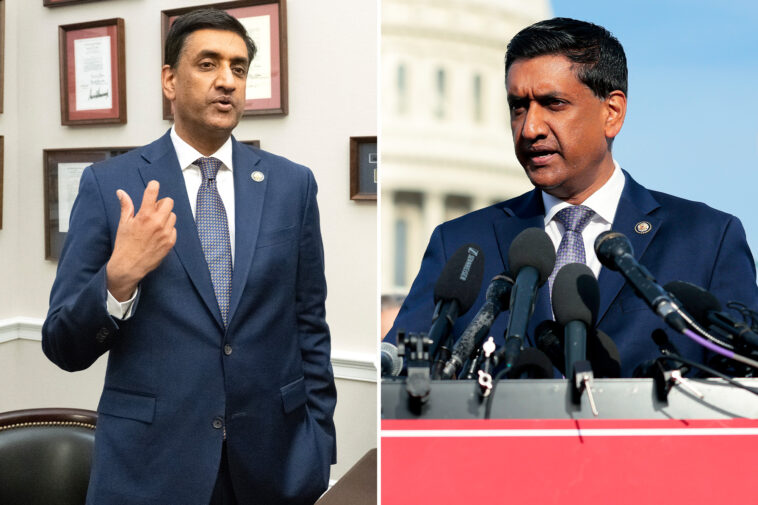
Open warfare has ignited between powerful Silicon Valley figures and a Democratic congressman who may be submarining his 2028 presidential chances before they even get off the ground thanks to a proposed billionaires’ tax in California.
In a social media post, Ro Khanna — who seemed to soft-launch a campaign this summer — took aim at venture capitalist Peter Thiel and other tech billionaires, such as Google co-founder Larry Page, who are reportedly considering an exodus from the Golden State in the event that California passes a wealth tax on billionaires to make up for a nearly $100 billion shortfall in healthcare funding.
Need West Coast news? The California Post is coming soon.
Get in early. Sign up for our weekly newsletter before our 2026 launch.
Thanks for signing up!
“I echo what FDR said with sarcasm of economic royalists when they threatened to leave, ‘I will miss them very much,’” Khanna wrote.
While the message from the Bay Area congressman — a co-chair of Sen. Bernie Sanders’s 2020 presidential campaign — may have played well with the left side of the social media echo-chamber, Khanna was met with a shrieking howl from tech entrepreneurs and investors.

David Friedberg, a South African entrepreneur and co-host of the popular All-In podcast, initially mocked the proposal on X, writing: “why stop with billionaires?! why stop at 5%?! keep going, ro, keep going!!”
But in a back-and-forth exchange with Khanna, Friedberg then elevated the complaint into a full-throated warning about government overreach.
“[Y]ou’re masking that you are proposing the creation of, for the first time in the 250 years of this American republic, an organized government seizure of private property from citizens,” Friedberg wrote.
The proposed tax — championed by labor union SEIU-United Healthcare Workers West — would impose a one-time, 5% assessment over five years on California’s wealthiest residents. Supporters view this as a vital solution to a $100 billion healthcare shortfall, while critics, including Gov. Gavin Newsom, warn it may drive innovation and jobs out of the state, deepening the opposing viewpoints at the heart of the tax debate.
“You can’t isolate yourself from the 49 [other states],” Newsom said in a past interview.
Garry Tan, CEO of San Francisco-based startup accelerator Y Combinator, warned flatly in a tweet: “Passing this tax will destroy innovation in California.”
Paul Graham, a co-founder of Y Combinator and thought leader in the tech world, accused Khanna of misleading voters by tying the tax to healthcare.
“It’s bullshit to say that the tax is to pay for a specific thing,” Graham wrote. “It’s all one pot. You know that. And yet you still say it.”

Coinbase CEO Brian Armstrong, who’s made his billions in crypto, pointed to Khanna’s broader political alliances.
“Yep,” Armstrong wrote. “Don’t forget that Ro Khanna supported Mandami [sic] — tells you everything you need to know.”
David Sacks, a longtime venture capitalist and former member of the PayPal Mafia who now serves as President Trump’s crypto czar, framed the backlash as overdue.
“After blindly funding the Left for years, Silicon Valley is finally realizing what time it is,” Sacks wrote. “Dinner time. And they’re on the menu.”

Khanna has previously opposed capital gains taxes on unrealized income, noted tech founder Sampriti Bhattacharyya, which to some made the congressman’s support for a wealth tax even more confounding.
“It is completely disingenuous to claim one position while campaigning for the opposite,” wrote Palmer Luckey, founder of Oculus VR and Anduril Industries. “You are fighting to force founders like me to sell huge chunks of our companies to pay for fraud, waste, and political favors for the organizations pushing this ballot initiative.”
But the criticism didn’t stop there.
Khanna even received pushback from fellow elected Democrats, such as state Sen. Josh Becker, whose district partially overlaps with Khanna’s, over a reference to corruption in state government.
“One fair critique is the lack of accountability and the corruption in Sacramento,” Khanna wrote. “The reports of $70 billion in fraud is appalling. We need anti-corruption measures and public excellence so the tax dollars go to healthcare, childcare, & education.”
Becker took issue with the tweet, saying there was “no rigor” behind the report’s claims.
“Why are you repeating that number?? There is no rigor behind it? Some vague accusation about Covid funds? And then lumping in the money spent on high speed rail? I’m no fan of that project but to call it fraud is way out of line,” Becker wrote.
Sarah Drory, a spokesperson for Khanna, said the congressman has been a “passionate supporter of technology and entrepreneurship,” and she pointed to his work on the Silicon Valley Bank bailout and his co-authorship of the CHIPS and Science Act.
“He has always supported a modest wealth tax on billionaires to deal with staggering inequality and to make sure people have healthcare,” she said in a statement, adding that Khanna’s intention isn’t to push companies and entrepreneurs out of California. “He has advocated for common-sense workarounds for startup founders whose companies are not profitable and who have illiquid stock.”