LOS ANGELES — Thousands of Pacific Palisades residents were left with nothing last year after a deadly wildfire ripped through the world-famous neighborhood and burned nearly 7,000 homes to ash.
Homeowners have spent the year in and out of hotels and apartments, spending endless hours fighting with insurance companies, contractors and city bureaucrats — all while listening to Mayor Karen Bass and other leaders pat themselves on the back for a speedy recovery.
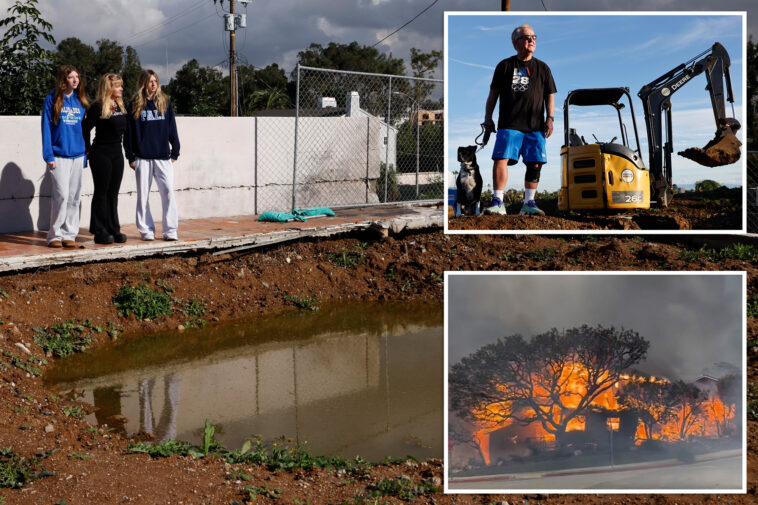
But one year later, most still have little but dirt plots where their homes used to be. Their once-vibrant neighborhood remains a ghost town, where wild coyotes roam the abandoned streets.


New building permits have been issued for just 646 new homes and businesses, according to city data, and a recent survey found that only 13% of homeowners have begun construction.
The Post spoke with homeowners struggling to rebuild one year after losing their entire community to the flames.
‘I’m paying a mortgage on an empty lot‘
Sara Trepanier’s new modular house — which is currently being assembled in San Francisco — will be one of the first homes on her block in the Palisades. Until it arrives, the street is completely empty.

But it will be no replacement for the rustic home that the flames turned to ash last year.
“My house before was a Spanish-style home with curved windows and curved walls. It was so beautiful. This house is literally a square box. Because that’s all my insurance would pay for,” she said.
The property had been a primary asset for the 57-year-old single mother: a retirement fund, something to leave to her four kids.


Now she says she may have to end up selling her new house and leaving the neighborhood to cover her mounting debts.
“I’m paying a mortgage on an empty lot, and taxes on an empty lot. It’s terrible.”
Trepanier says the damage is two-fold. First, the insurer undervalued her $3.5 million home, saying it was only worth $720,000.
But she says the city has done nothing to make rebuilding any less agonizing.
“All of these things they promised a year ago, that they would defer the fees, that they would lessen our taxes, they haven’t done any of it,” Trepanier said. “The city hasn’t shown that we’re a priority at all.”
‘They let us burn‘
“We have a mayor that will look directly into the camera and say, this is the fastest rebuild ever. That is not true,” said Jeremy Padawer, who has yet to even pour the foundation for his new home.
Padawar, 52, is an organizer for “They Let Us Burn,” a protest scheduled for downtown Palisades on Wednesday, on the anniversary of the fire.

The movement has a long list of demands, including greater transparency from local governments, tax breaks for people trying to rebuild and waived fees for rebuilding permits — all of which were already promised, Padawer said.
“Literally the day after the fire, you have people like our mayor and governor saying things like ‘natural disaster,’ ‘climate change.’ But it’s been an ‘unnatural disaster’ perpetuated by a lot of misdirection and gaslighting,” Padawer said.
He believes officials have used climate change as a convenient excuse to pass the buck for years of mismanagement and lack of preparation that allowed the fire to destroy his neighborhood.


Among other failures, the city let a critical reservoir run dry. It failed to extinguish the Lachman Fire, which later re-ignited into the Palisades inferno. And it failed to mobilize available equipment and personnel as the flames moved toward the city.
To add insult to injury, local governments will rake in revenue from sales taxes on building materials and higher tax rates on reassessed properties, Padawer pointed out.
“When the state and local government have significant accountability as to why that has happened in the first place, they should not take one dollar from that rebuild,” he said.

‘They didn’t even do the minimum‘
Legendary Palisades High School tennis coach Bud Kling is working to rebuild his Palisades home. What he can’t rebuild: A world-famous collection of Olympic memorabilia he spent 47 years putting together.
His collection included 19 Olympic torches and 180,000 commemorative pins.
“That all went up in smoke,” he said.

He has lived in the Palisades for 43 years and has no plans to leave, but he said the slow, expensive, chaotic process of rebuilding has driven many of his neighbors away for good.
Kling, 78, said it appears that the city has made the permitting process somewhat faster, but it still took him nearly a full year to get the all-clear from the city.
But had officials done their jobs in the first place, his home never would have burned, he said.
“[Officials] are sloppy and lazy, and they didn’t anticipate the worst-case scenario. And when the worst-case scenario happened, they didn’t even do the minimum.”

‘This abyss of unknown‘
When Kimberley Bloom discusses her struggle to rebuild her house, one moment comes to mind: An hours-long phone call with an insurance adjuster, giving a verbal, room-by-room tour of what had once been her dream home.
“I was having to prove that, yes, I had marble in my bathroom, I had crown molding in my living room. I had a freestanding porcelain tub,” Bloom said.

Bloom, 66, had spent years and untold sums upgrading and updating the 1940s dwelling, and it took her a full year of maddening negotiations before she could even negotiate a dollar amount from her insurance company.
Now she and her husband are finally ready to rebuild, but they may have to pay more than $100,000 on various city permits — despite Bass’ pledge to waive those fees.
“The fact that we have to pay the city of LA permit fees to rebuild our homes that burned down by no fault of our own is ludicrous,” Bloom said.


But she doubts the city can even afford to repave the roads and re-install the power lines, let alone make the rebuild affordable for fire victims.
“The city is now telling us they’re not going to replant the trees in the Parkway. The city of LA is so broke that they can’t even afford to replant trees,” she said.
“We just don’t know what they’re going to do. This whole last year has just been this abyss of unknown.”

‘We can’t build anything for pennies on the dollar‘
College professor Liesel Reinhart used to tell people, “If our house burns, a lot of other houses are going to have to burn first.”
That’s exactly what happened when the Eaton Fire torched more than 4,000 single-family homes in the neighborhood of Altadena as the Palisades neighborhood burned 50 miles to the west.
Reinhart’s house was built in 1912 by the same company that built the iconic Chinese Theater in Hollywood.

It had been used as a group home for older youth before the Reinharts purchased it and adopted two children from the same organization.
They had planned to leave the house to their kids — when it still existed.
Trying to rebuild in Altadena has presented many of the same challenges as victims from the Palisades: It took a year for Reinhart to negotiate a dollar amount from her insurer after an “embarrassingly low” initial estimate.
Meanwhile, she feels like she has earned “another degree” learning to navigate government red tape.

“Every day it seems like there’s something new. Right now, there’s a big issue with drainage. You can’t have runoff from your yard into somebody else’s yard. Well, Altadena is on a slope. I don’t even have a straight shot to do a drain in our lot that doesn’t go into someone else’s lot.”
She feels LA County officials have been doing about as good a job as they can, but nobody was prepared for the sheer scale of the devastation.
“Any time anything happens at scale like this, do you really want 6,000 homeowners all individually trying to solve the same problem?” she said. “Every single one of us has had to be educated this year on what it’s like to survive a disaster.”
‘Our neighbors are scattered‘
Miriam Engel was one of the lucky Palisades residents who still had a home after the fire — partly thanks to her husband George, who stood on their roof for six hours with a garden hose, spraying down the property as the flames crept closer.

But while she may have the house, Engel feels that she has lost her home.
“Our neighbors are scattered, our friends are displaced, and our children can’t just run down the street to each other’s homes anymore,” she said. “We were robbed of our homes, our safety, and our sense of community.”
Engel, 47, is one of the organizers for the “They Let Us Burn” protest.
“We named this demonstration ‘They Let Us Burn’ not only because the fire was preventable, but because our community has continued to be burned long after the flames went out by delays, silence, and lack of accountability from institutions meant to protect us,” she said.
Engel said the disaster has brought neighbors together across the political spectrum — because every political faction let them down.
“We are upset with our local and state leaders, but we are also upset with the federal government. Federal aid for survivors is stalled while billions are approved abroad. If the administration believes in ‘America First,’ Los Angeles should not be the last.”