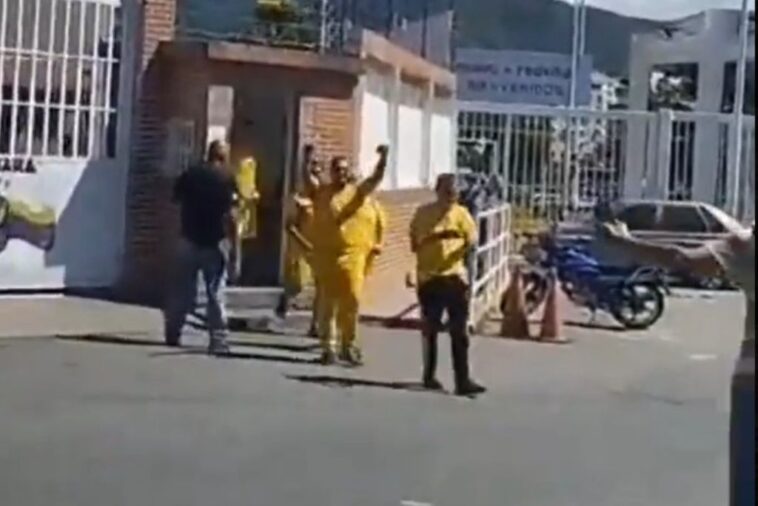

Venezuela’s interim government, led by Delcy Rodríguez, announced on Thursday, January 8, the release of a significant number of political prisoners—both Venezuelan and foreign nationals—.
The measure, described by authorities as an effort to “strengthen peace and peaceful coexistence,” comes amid deep political turmoil following the military operation that culminated in the capture of narco-tyrant Nicolás Maduro and his wife by the United States.
The announcement was made by Jorge Rodríguez, president of the Venezuelan National Assembly and brother of interim president Delcy Rodríguez, who assumed power after Maduro’s capture.
Rodríguez stated that “the Bolivarian government, together with state institutions, has decided to release a significant number of Venezuelan and foreign individuals,” though no exact figures have been specified.
Spain’s Ministry of Foreign Affairs confirmed that at least five Spanish citizens detained in Venezuela have been released under this process. Among them is human rights activist Rocío San Miguel, who held dual citizenship.
This is a clear sign that the measure includes foreign detainees in prisons such as El Helicoide and El Rodeo, facilities flagged by human rights organizations for arbitrary detention.
TRUMP DID IT AGAIN!!
all political prisoners in Venezuela are released all at one time 🎉pic.twitter.com/SQpo6RtIfe— Conservatron (@Conservatron1) January 9, 2026
Organizations such as Foro Penal estimate that Venezuela is currently holding at least 800 political prisoners, including military personnel, women, foreign nationals, and sick individuals who were detained without fair trials or legal guarantees.
The releases come after months of international complaints, economic sanctions, and demands from human rights groups urging Caracas to free individuals imprisoned for political reasons.
Although the government presents the action as progress, multiple sectors of civil society and experts have pointed out that it does not address the root problem: the ongoing lack of respect for human rights and the absence of an impartial justice system in Venezuela.
The regime seeks to improve its international image and ease economic sanctions through this gesture, rather than implement real structural reforms.
The release of political prisoners in Venezuela represents a symbolic step that many have long hoped to see, but it is not a definitive solution. The measure arrives in a country deeply repressed, shaken by an international military intervention and an economic crisis that seems endless.
While some view the act as a goodwill gesture, recent history shows that the regime prioritizes political and economic survival over genuine civil rights.
The international community must continue to demand transparency, the complete release of all political prisoners, and guarantees ensuring that this is not merely a temporary propaganda tactic, but the beginning of a true transition toward respect for human rights and democracy.
Stay informed with the most important news and reliable analysis!
Subscribe to our newsletter: https://gatewayhispanic.com/sl-newsletter
About The Author

Mariana Ramirez Medina
Mariana Ramírez es una joven nacionalista mexicana comprometida con la verdad y la excelencia en el periodismo. Con una sólida vocación por informar, su propósito es acercar a los lectores a la realidad de los acontecimientos con claridad, honestidad y sin manipulaciones.
Se distingue por su transparencia y su dedicación a la búsqueda de hechos verificables, convencida de que el periodismo debe ser un pilar de confianza entre la sociedad y la verdad.
También aspira a destacar como una periodista reconocida por la profundidad de sus investigaciones, su compromiso con la integridad y el respeto con el que aborda cada historia.
Impulsada por la misión de fomentar una sociedad más informada, consciente y crítica, Mariana trabaja para que la verdad sea el eje central de su labor periodística, contribuyendo con responsabilidad y rigor al debate público.