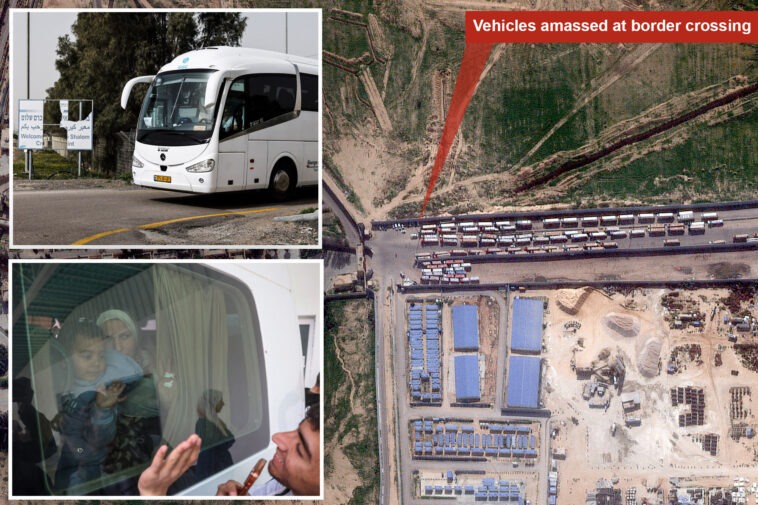
Gaza’s Rafah border crossing has finally reopened as the first phase of President Trump’s peace deal comes to a close on Monday.
The opening will allow for about 20,000 sick and wounded Palestinians to begin leaving the Gaza Strip for treatment, according to local health officials and the World Health Organization (WHO), with the full set of rules still unclear.
Despite the uncertainties, traffic through the border has begun as the first phase of Trump’s 20-point peace plan concludes, with the fragile cease-fire expected to face its biggest challenge yet as the next phase approaches.


The crossing between the Gaza Strip and Egypt has remained largely closed since May 2024, when it was captured by Israeli forces.
The border was meant to reopen during the hostage exchanges in the fall, but Israel refused to cede full control until every single captive was freed, which did not happen until last week, when the body of Ran Gvili was located.
The crossing will now be operated by supervisors from the European Union and by local Palestinian staff, with the Jewish state expected to conduct remote security checks, officials said.
Traffic is expected to be slow, with only 50 patients allowed to leave each day and another 50 allowed to return, according to Israeli reports.

The WHO is tasked with transferring patients from Hamas-controlled Gaza past the “Yellow Line” border controlled by the Israeli military, the BBC reported.
More than 30,000 Gazans who were outside the territory or who fled during the war have already registered with the Palestinian embassy in Cairo to be allowed to return to the Strip.
With the border crossing reopened, Trump’s peace plan is officially in its second phase, in which his so-called “Board of Peace” will take over the governance of Gaza until a group of Palestinian technocrats can be tapped to lead the enclave.

It remains to be seen how the Board of Peace will establish itself in Gaza after Trump expanded the group’s responsibilities beyond the Strip, leading many world leaders to reject the president’s invitation.
Hamas has also been unwilling to demilitarize as part of the second phase, with the terror group yet to present any detailed plan on disarmament.
Rather than disarm, Hamas has pitched including 10,000 of its police officers into the technocrat-led government, sources told Reuters, a demand opposed by Israel.
The Jewish state has warned that if Hamas does not agree to give up its weapons, the cease-fire would end and Israel would return to war.
With Post wires