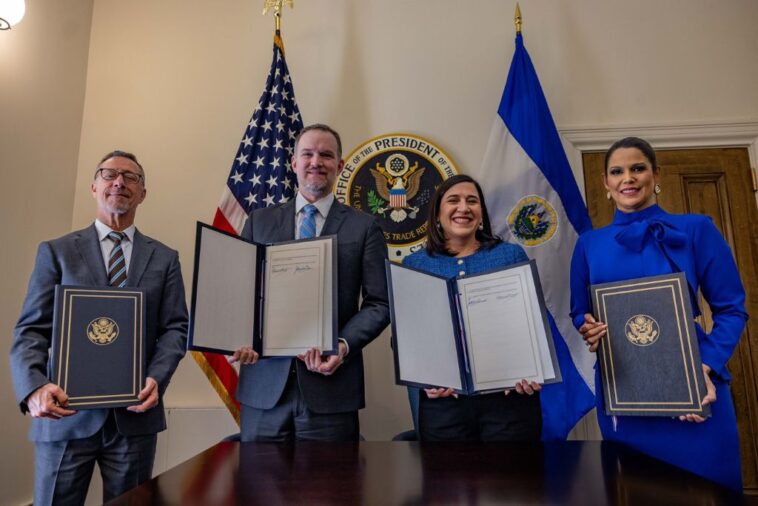

The United States and El Salvador have just marked a historic milestone. On January 29, 2026, both countries signed a Reciprocal Trade Agreement in Washington, officially described as the first of its kind in the entire Western Hemisphere.
Far from being a mere political announcement, the agreement is already backed by official documents and by coverage from major international media outlets.
The agreement was signed by the United States Trade Representative (USTR), Jamieson Greer, and El Salvador’s Minister of Economy, María Luisa Hayem, during an official ceremony held at the White House.
According to a statement from the U.S. government, the treaty aims to eliminate trade barriers, reduce tariffs, strengthen economic reciprocity, and expand access for Salvadoran products to the U.S. market.
What does the reciprocal trade agreement include?
According to the information available, the agreement includes:
- Elimination of the 10% tariff that affected certain Salvadoran products exported to the United States
- Reduction of regulatory barriers that hindered bilateral trade
- Strengthening of investment protection
- Harmonization of technical and commercial standards
- Greater access to the U.S. market for key sectors of El Salvador
The agreement does not replace CAFTA-DR, but rather complements it, consolidating El Salvador as a preferred strategic partner of the United States in the region.
For El Salvador, the agreement represents:
- Greater competitiveness for its exports.
- Attraction of foreign investment.
- Job creation.
- Consolidation of international confidence.
For the United States, the treaty reinforces its economic presence in a region where China, Russia, and Iran have sought to expand their influence, offering an alternative based on trade, clear rules, and cooperation.
This agreement is not just a diplomatic achievement; it is a clear political signal. While other governments in the region continue to bet on statism, confrontation with the West, or failed economic models, El Salvador chose cooperation, openness, and genuine reciprocity.
Prosperity does not come from ideological rhetoric, but from concrete agreements, clear rules, and strategic alliances with the world’s strongest economies.
The United States does not sign this type of agreement by chance. It does so when it sees trust, stability, and a willingness to comply. And El Salvador today positions itself as a regional example of how to move forward when governance is guided by pragmatism rather than slogans.
Stay informed with the most important news and reliable analysis!
Subscribe to our newsletter: https://gatewayhispanic.com/sl-newsletter
About The Author

Mariana Ramirez Medina
Mariana Ramírez es una joven nacionalista mexicana comprometida con la verdad y la excelencia en el periodismo. Con una sólida vocación por informar, su propósito es acercar a los lectores a la realidad de los acontecimientos con claridad, honestidad y sin manipulaciones.
Se distingue por su transparencia y su dedicación a la búsqueda de hechos verificables, convencida de que el periodismo debe ser un pilar de confianza entre la sociedad y la verdad.
También aspira a destacar como una periodista reconocida por la profundidad de sus investigaciones, su compromiso con la integridad y el respeto con el que aborda cada historia.
Impulsada por la misión de fomentar una sociedad más informada, consciente y crítica, Mariana trabaja para que la verdad sea el eje central de su labor periodística, contribuyendo con responsabilidad y rigor al debate público.