
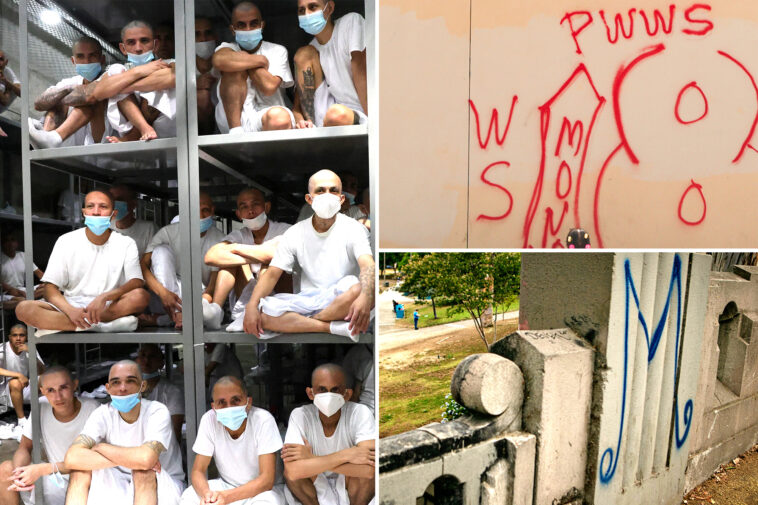
They say every man has his price, no matter how deep the hate.
For the two biggest beasts of the Los Angeles underworld, MS-13 and the 18th Street Gang, that hatred has spanned decades, fueled by revenge killings and brutal blood feuds.
That is why the Los Angeles Police Department is increasingly alarmed that the longtime rivals have stopped killing each other and started chasing pure profit instead.


The 18th Street Gang, also known as Barrio 18, is now a sprawling transnational organization that sprang from Los Angeles’ first Hispanic gang, Clanton 14, in the 1950s. From there, it spread across the United States before extending deep into Central America, particularly El Salvador.
In the 1980s, the gang gained a competitive edge by opening its ranks to members of all ethnic backgrounds, according to Insight Crime, a think tank that tracks organized crime. The strategy paid off, turning 18th Street into one of the largest gangs in Los Angeles, with tens of thousands of members.
Its long record of drug trafficking, extortion, and murder helped earn the gang a Foreign Terrorist designation from the FBI in 2025.


MS-13, meanwhile, also has deep roots in El Salvador, having formed in the 1980s among immigrants fleeing the country’s brutal civil war.
The California Post is here. Sign up for Morning Report.
Get the perfect blend of news, sports and entertainment delivered to your inbox every day.
Thanks for signing up!
Originally known as the Mara Salvatrucha Stoners, or MSS, the gang was once associated with heavy metal music, long hair, and marijuana use, according to Insight Crime. It quickly evolved into a bloodthirsty criminal enterprise notorious for murder and extortion, with a gruesome trademark of hacking rivals apart with machetes.
The Trump administration later designated MS-13 a Foreign Terrorist Organization.


Initiation rituals underscore the gangs’ brutality. Wannabe MS-13 members are beaten for 13 seconds, while gangsters trying to join 18th Street are viciously jumped for 18 seconds.
As U.S. authorities intensified crackdowns on gang violence, growing numbers of MS-13 and 18th Street members were deported to El Salvador, a country that became known as the murder capital of the world.
In 2016, there was a killing roughly every hour in El Salvador, a nation of just six million people, according to CNN.

That violence has since spilled back into Los Angeles. Cop killings, torched apartment buildings, racketeering schemes, and deadly shootings have rattled the City of Angels, where both gangs operate in overlapping territories and have long clashed in bloody street wars.
Download The California Post App, follow us on social, and subscribe to our newsletters
California Post News: Facebook, Instagram, TikTok, X, YouTube, WhatsApp, LinkedIn
California Post Sports Facebook, Instagram, TikTok, YouTube, X
California Post Opinion
California Post Newsletters: Sign up here!
California Post App: Download here!
Home delivery: Sign up here!
Page Six Hollywood: Sign up here!
But the old saying that money solves all things has proved true even among LA’s most ruthless criminals.
LAPD investigators began hearing whispers of a truce shortly after the COVID pandemic eased in 2022, after the Mexican Mafia, to whom both MS-13 and 18th Street had sworn allegiance, ordered the rivals to put aside decades of hatred because the violence was hurting profits.
Gang leaders are now playing politics, working together under a single umbrella known as the Sureños to cash in on drug trafficking and a booming underground casino trade.
While traditional street rivalries still flare, a new era is taking shape in Los Angeles’ underworld, one that police fear could pose the city’s most dangerous challenge yet.