
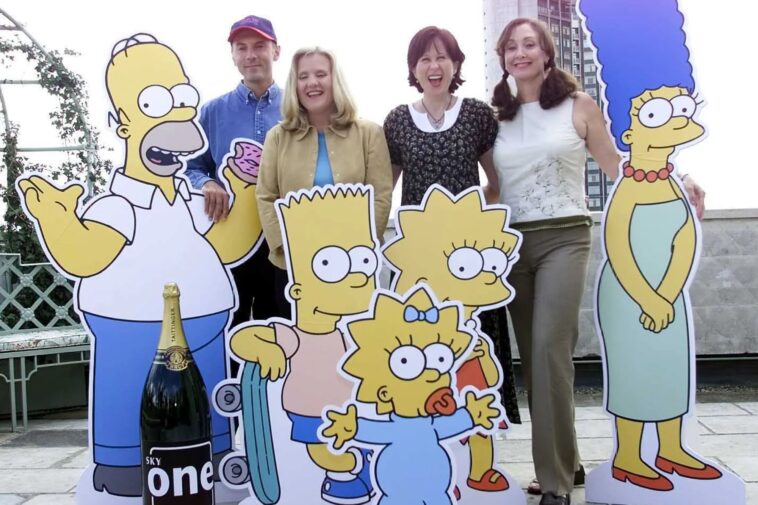
The 800th episode of “The Simpsons” airs this Sunday and, by now, has firmed up its place in popular culture for kids, parents and grandparents alike.
Into its 37th year on the air, the most successful animated series of all time’s highly dysfunctional titular yellow family still have Americans doubled over with laughter on Sunday nights.
The show is also one of the top US cultural exports, broadcast in around 200 countries in languages as diverse as Arabic, Czech and Luxembourgish.


But the adventures of Bart, Lisa, Homer, Maggie and the residents of Springfield —which, after much debate, creator Matt Groening finally revealed is based on its namesake in Oregon — started from much humbler beginnings.
Before earning 37 Emmy awards, “The Simpsons” was a wildcard idea that aired for a minute or so each week during “The Tracy Ullman Show” on Fox. There were 48 installments, from 1987 until 1989.
When it was plucked for a shot as a freestanding episode, prospects were thin.
“Nobody expected anything,” Mike Reese, a writer and producer who was with the show from the start but recently stepped down, told The Post.
“They couldn’t get anyone to work on the show. I only got on because my friends turned it down. It was joke writers, advertising men and sports writers.
“Conventional sitcom writers were not interested in working on ‘The Simpsons.’ We thought it would be a really fun summer job and maybe last six weeks.”


Even Fox, the show’s broadcaster, was skeptical. “The premier party was in a bowling alley,” Reese continued. “We watched the first episode on the screens where bowling scores get displayed. That showed Fox not thinking we were worth renting a restaurant for.”
But the show, out of the gate, surprised everyone. “Our publicist came in with reviews that had been faxed in from around the country,” said Reese. “Critics were going crazy for it and ‘The Simpsons debuted with the highest ratings in the history of Fox.”
The show’s long running success has meant the actors with magnificent voices which capture the squeal of Bart, courtesy of animation specialist Nancy Cartwright; the rasp of Marge, via sit-com veteran Julie Kavner; the sweet nasal-inquisitiveness of Lisa, emoted by former Broadway thesp Yeardley Smith; and the bellow of Homer, by one-time impressionist Dan Castellaneta, have laughed all the way to the bank.
Their pay is said to range from $300,000 to $400,000, per actor, per episode.
Asked if that is the current sum, a former executive on the series replied to The Post, “Right. Nobody on the show begrudges them that. They’re just so great.”


And that greatness takes a big bite out of each episode’s total cost. “I believe,” said the former exec, “that actors’ salaries now constitute half the budget of the show.”
And an episode of “The Simpsons,” according to Variety, ran $6.5 million in 2017.
Not only that, the actors have the luxury of being household names and instantly recognizable by their voices, yet rarely recognized in public and able to live surprisingly normal lives.
The cast are also very close, to the point Hank Azaria — who most famously plays Moe the bartender, though he also voices plenty of others — buying Castellenata’s Pacific Palisades home for $5.5 million in 2011, fresh from a round of pay negotiations for the stars.


In fact, when it comes to decisions like pay, “they negotiate as a group,” a Hollywood insider who worked with some of the actors early on told The Post. “That way, if [the network] says no, you basically lose your show. Maybe you can find someone to imitate Bart. But it would take a long time for them to get up to speed.”
Lucky for us, that has meant the cast has largely remained intact – though, in 2020, Hank Azaria put his Indian convenience store clerk Apu out to pasture, fearing it could be deemed as offensive.
Azaria has acknowledged that, if AI has its way, he and the other well-compensated actors could all go the way of Apu, if their voices were cloned from their earlier work and used to generate new episodes.
“I assume that soon enough, artificial intelligence will be able to recreate the sounds of the more than 100 voices I created for characters on ‘The Simpsons’ over almost four decades,” he told The Times.


“It makes me sad to think about it. Not to mention, it seems just plain wrong to steal my likeness or sound — or anyone else’s.”
The technology to replicate the show’s voices actually already exists. AI researcher Tim McSmythurs built voice modeling software which can replicate people or characters based on a few hours audio. Many similar products are already available on the market.
“You could certainly come up with an episode of ‘The Simpsons’ that is voiced by the characters in a believable way,” he told Wired.
But would it be legal? The issue remains complicated. From a copyright perspective, the person who owns the rights to “The Simpsons” (currently Disney) is allowed to reproduce the characters and content, including what is known in legal speak as “derivative works.”
However, it has long been acknowledged who the voice actors behind “The Simpsons” characters are, and should their voices be used elsewhere, such as to advertise a product, those actors could potentially make a legal claim, lawyers have said.
It would also depend on the terms of their contracts and how they are written. The actors also have the powerful actors union SAG-AFTRA on their side, which has been very active in protecting its members against AI versions of people, voices and characters.


Plus, as McSmythurs told Wired, The AI generated version “doesn’t sound as energetic as Homer” when by a human.
And since “The Simpsons” has stuck to a winning formula for so long, it most likely wouldn’t make financial sense to give it up, for either the actors of the network.
Plus, for the voicer actors, their job is actually kinda cushy.
“They are asked to come in for a half-hour to read the script as a group, then they come in for two hours per episode to read their lines and probably another two hours to do pickup,” said Reese. “They know their characters and don’t need to be together in a big room like it’s a radio show.”