
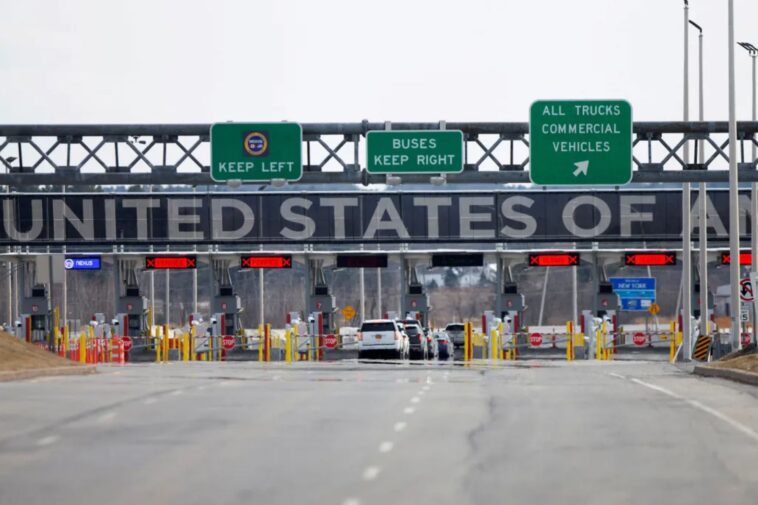
WASHINGTON – There is a staffing crisis at the country’s northern border that has diminished officials’ ability to monitor illegal crossings and sparked concern about the US Customs and Border Patrol’s effectiveness, a government report found.
CBP has not met its staffing goals when it comes to protecting the nearly 4,000 miles of land and maritime borders between the U.S. and Canada, according to a Government Accountability Office report released last week, despite the agency’s recent hiring surge.
And the “reduced agent staffing has affected its operations.”
U.S. Border Patrol pushed back, saying it has more staff on board than it’s had in the past four years and that it continues to hire new agents.

“Recruiters continue to work hard to meet the target of 25,000 agents with the assistance of hiring and retention incentives,” Tammy Melvin, a spokesperson for US Customs and Border Protection, told The Post.
The report found other flaws, however, including a lack of resources and the cold-weather failures of certain equipment, all of which challenged patrol and monitoring efforts.
New York’s Buffalo sector, which has six border stations and is responsible for the New York-Canada border, is struggling to have the equipment and facilities it needs to process the migrants they do catch.
Border agents from the Buffalo sector told GAO inspectors that one of the sector’s six stations does not have a designated processing space and uses its kitchen area to process migrants.
Additionally, officials don’t have reliable radar to detect vessels crossing Lake Ontario and lacks suitable ways to identify vessels trying to enter the U.S. via water ways.
Part of the blame for the shortages sits with the busy southern border.
“Mandatory temporary assignments to the southwest border” was the reason for part of the staff shortage, the report found. Overall, the staffing level along the northern border was 78% at the end of fiscal year 2024, compared to 90% along the southwest border, the report found.
But there are other factors at play, including dispatching agents to the interior of the country as part of the Trump administration’s push to remove illegals from the country.
One former agent told The Post that 80% of agents are assigned to the 1,951 mile U.S.-Mexico border while 20% are assigned to the northern border.

And traffic along the northern route into the country has grown.
In 2023, CBP agents apprehended nearly 190,000 individuals attempting to cross from Canada into the United States. That’s almost seven times more than in 2021, government statistics show.
Although, in contrast, agents encountered almost 2.5 million individuals on the southern border in 2023.
The agency has attempted to address the staffing problem. In 2024, it started an initiative to place newly hired agents directly into northern border stations. Prior to this, newly hired agents were only being stationed on the southwest border.
Border Patrol said it sends agents where they are needed.
“USBP deploys its resources based on operational needs. Those needs are determined by activity levels and intelligence analysis. Americans can feel secure that the Border Patrol is working diligently to secure all our borders; and we won’t stop until they have the safety and security that they deserve,” Melvin said.
The northern border of the country has long struggled to get the same amount of attention, staffing and funding as the southern border.

New York lawmakers have pushed for action.
Rep. Tim Kennedy, the Democrat who represents Buffalo, has proposed legislation that would require CBP to hire at least 1,000 new border officers every year, plus a new officer for every agent that leaves the force. And outgoing Rep. Elise Stefanik, a Republican, has championed legislation to deliver more resources to the north.
But patrolling the massive northern border – which includes forests, rough terrain, bad weather and numerous waterways – requires more than human bodies.
Surveillance technology – such as cameras, radar sites, and sensors – have become a key tool in the agency’s work to secure the border.
CBP, however, hasn’t hired enough specialists to review all the footage and data coming in from the feeds. Only 77% of surveillance specialist openings were filled at the end of fiscal year 2024.
“The staffing rate for this key position along the northern border has been below its target, and the agency does not have a plan with strategies to address the staffing gap. Developing such a plan could help Border Patrol better carry out its responsibility to secure the northern border,” the report states.
The Homeland Security Department, which houses CBP, said they would have a plan to address the staffing issues by April 30. President Trump’s One Big Beautiful Bill Act provided CBP with more than $2 billion to recruit and retain agents.
Overall, apprehensions of illegal migrants are on the rise in the north thanks to massive crackdowns in Minnesota and Vermont. But, in Buffalo, apprehensions are down 31% and they have decreased in four other sectors along the border with Canada.
One Minnesota lawmaker told The Post the crackdown on the southern border led to increased crossings on the northern side.

“For years, I’ve been warning that our northern border is one of our most unnoticed national security vulnerabilities,” Rep. Peter Stauber, R-Minn., whose district borders Canada, said.
“Now that President Trump has closed the southern border to illegal immigrants, the cartel leaders and human smugglers have taken note that Minnesota is open for illegal business and are taking full advantage of our northern border to get here. I hope our state leaders recognize that until they end their sanctuary policies, our northern border will be a hotspot for criminal activity,” he added.
CBP attributed those increased arrests to the overall work of Homeland Security agents.
“Increases in USBP apprehensions in places like Minnesota were largely from DHS surge operations that were taking place in the state in order to target criminal illegal aliens,” Melvin said.
Border agents told government auditors that the staff shortages have resulted in the inability to patrol certain zones and has brought increased stress on the agents who are on the job.
The fear is mass retirements are on the horizon. Many agents who came on the job in a 2007 hiring surge are reaching the age of 50, which makes them eligible for early retirement.