You can finally turn over a new leaf with your houseplant.
A mind-blowing biotech breakthrough called PlantGPT can translate your houseplant’s silent suffering into speech.
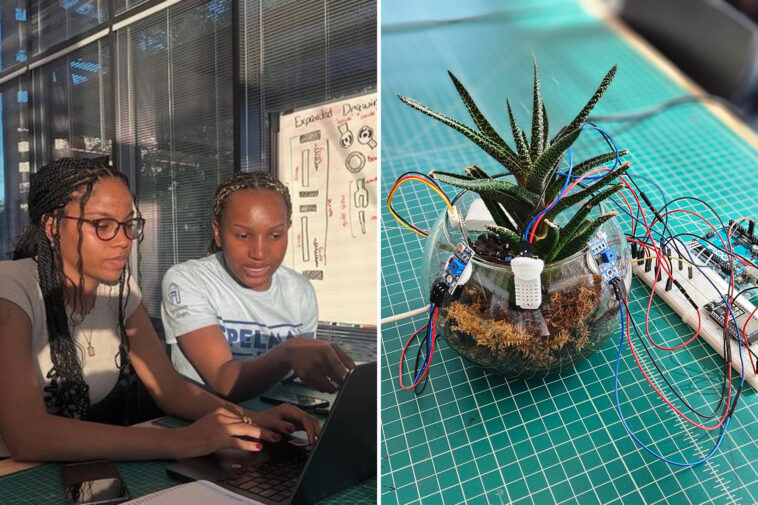
The new device, developed by a group of students at Spelman College in Atlanta, uses artificial intelligence to monitor and analyze plant health data, harvest the intel, then turn it into conversational, user-friendly language.
The fevered foliage can tell you exactly what’s wrong — and how to make it right.

For example: “So maybe it’s time for some fertilization to get me pumped up again,” or “Good heavens, I hope you’re not expecting me to thrive in these willfully inadequate conditions.”
And that’s in a polite female voice, complete with a very posh British accent.
Grace Burch, a 2025 graduate who seeded the project three years ago, told The Post: “I love nature and technology. To combine them was a dream come true. It’s small, everyday things you take for granted like taking care of a plant can be changed with a simple idea.”
In an Instagram video, team members Joy Rutledge and Temple Dees explained the practical uses of the futuristic gadgetry.
“PlantGPT is a way to be able to talk to your plants, so when your plant is dying, you need to know what type of information the plant needs or resources the plant needs, such as water, sunlight, or nutrients.
“So we basically created sensors and connected them to an AI. You’re able to get this real time data from your plant, then when it does notify you, you’ll be able to adjust the conditions of your plant.”


An Arduino, or circuit board, gathers the plant’s data and then zips it to AI model ChatGPT, which then generates the care recommendations through a text-to-speech gizmo.
As of now, it’s still a work in progress, but the team is hoping to make their plant-friendly device available to the public at an affordable price in the near future.
The students’ team — which also included advisor Phillip Thompson and classmates Jessica Obi and Devyn Washington — took first place in November at the 2025 AAAS & Innovation Showcase, which drew more than 100 participants from 19 teams in Washington, DC.
“The next step to this project is to expand it to small farms and urban gardens, ensuring local farmers can be able to detect their plant health and their crop. That way, we can ensure food security for the community,” Rutledge said.
The students are now looking forward to making brainwork available to not only houseplants, but outside gardens and farmers’ crops in the near future, said Burch, adding that she hopes more women will embrace science as a career because “you can change the world.”