
President Donald Trump is not starting another “forever war” in Iran. He’s ending one.
Many who are commenting on the missile strikes by U.S. and Israeli military have seized on the idea that in attacking Iran Trump is dragging America into yet another entanglement in the Middle East. On the most recent episode of The Drill Down, host Peter Schweizer and co-host Eric Eggers explore that allegation and pick the winners and losers.
“Shocking events in a lot of respects in the sense that Trump actually did what a lot of presidents have threatened to do over the course of decades,” says Schweizer. “It’s a nice change from the present tense to the past tense when discussing the Ayatollah,” adds Eggers.
But how is the military action in Iran “ending” anything? The answer is that the threats from Iran have long been a major expense and irritant – and a genuine threat — to the U.S. in various ways.
Washington Post columnist Mark Thiessen recently wrote, “the Iranian threat is a primary reason the U.S. has to spend billions on large deployments in the Middle East. If that danger is eliminated, and a new government – one whose mantra no longer is ‘Death to America’ – takes power in Tehran, the United States can finally draw down those forces, execute the long-promised ‘pivot’ to the Indo-Pacific and focus on defending American interests in our own hemisphere.”
The Trump administration had been in negotiations with the Iranian regime, trying to get a deal in which Iran would give up its ambitions to have nuclear weapons. But Iranian negotiators made a fatal error, Schweizer believes. “Part of what was going on from the Iranian standpoint is they were assuming Trump was going to handle it the same way every previous president had – which was to talk tough and not really act.” Clearly, Trump’s strike gave lie to that assumption, echoed in a clip of an Iranian general speaking of the U.S. as a “paper tiger” just before the bombs started falling.
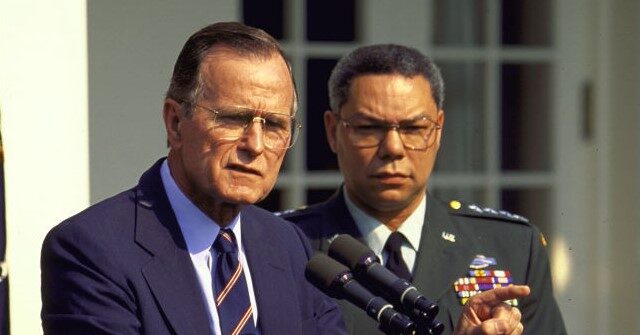
“We used to have what [former Secretary of State] Colin Powell called the ‘Pottery Barn Rule.’ If you break it, you own it. If you go in and invade a country, you need to rebuild it,” Schweizer says. “Well, guess what? Donald Trump walked into Pottery Barn, knocked a bunch of things over and said, ‘I’m not paying for anything.’”
The “Trump Doctrine” is to say, “we do not have an obligation to try to rebuild that country. We are eliminating the threat. We’re going to encourage the right people in Iran to win, but whether they step up and do that or not is their own internal business,” Schweizer says.
One big loser in all this? Iranian negotiating tactics.
A big winner, Schweizer believes, is Saudi Arabia and the other Gulf states. It was largely because of Iranian threats against Saudi Arabia that kept the Saudis from signing onto the Abraham Accords, Schweizer says, and the elimination of the Ayatollah and decapitation of his leadership of Iran’s proxies in Hezbollah, Hamas, and the Houthis in Yemen neutralizes that threat.
“The way we traditionally think about the Middle East is Arab and Israeli conflict. It’s not so simple anymore,” Schweizer says. “You had the Saudis that were apparently supportive of attacking Iran. You had the United Arab Emirates that was supportive. You had Israel that was supportive. When was the last time you got those three powers on the same side for aggressive action? So, this is further evidence that the Middle East is reconstituting itself.”
Eggers raises a growing conflict-of-interest in the region, however. Jared Kushner, Trump’s son in law, reportedly has a private equity fund called Affinity Partners whose largest investor is the Saudi Arabian Public Investment Fund, to the tune of $2 billion. Kushner will make $100 million plus from that relationship. Donald Trump Jr. also has massive financial interests in cryptocurrency in the Middle East.
“It’s a huge problem. This is not good,” Schweizer agrees. “What they are going to say is ‘we are different from Hunter Biden because we actually have a business,’ right?… But the problem is you’re still intermingling political power and influence with your business interests. It doesn’t matter if you had a legitimate business before.”
Another loser, the hosts add, is Iran’s failed assassination attempts against Trump and others, including Mike Pompeo, who was Trump’s Secretary of State during his first term. “Yeah. It’s one of the reasons why we ended up in this spot. The Iranian regime has attempted a number of terrorist attacks and assassination efforts on U.S. soil,” Schweizer notes. They tried to go after Mike Pompeo, and they allegedly were involved with plots that go after Donald Trump.”
Those failed but became part of the administration’s rationale for going after the Iranian regime.
Eggers quips, “The old saying was, ‘Speak softly and carry a big stick.’ Iran’s position has been ‘yell loudly and carry a twig.’”
For more from Peter Schweizer, subscribe to The DrillDown podcast.