
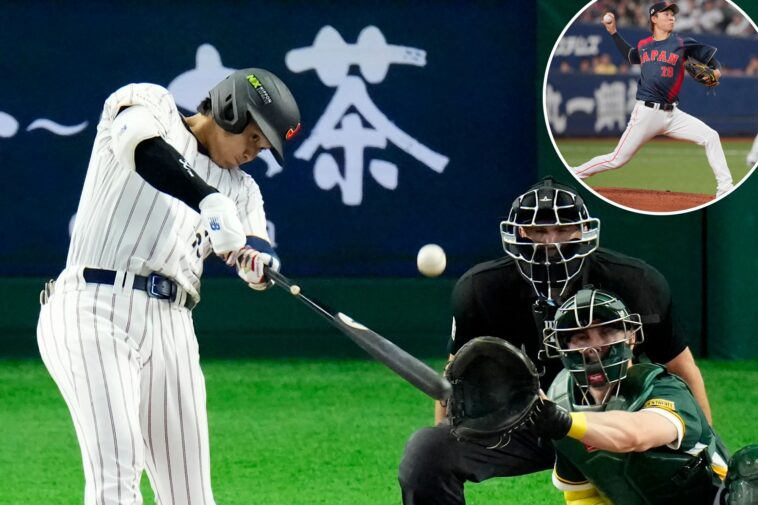
Three years ago, Samurai Japan fielded a team in the World Baseball Classic that might as well have been called the Future Dodgers.
Playing both ways was Shohei Ohtani, who was employed by the Angels at the time.
The rotation also included Roki Sasaki of the Chiba Lotte Marines, who was considered the most talented player the country had produced since Ohtani. Behind Sasaki was a two-time Pacific League MVP from the Orix Buffaloes, Yoshinobu Yamamoto.

The golden age of Japanese baseball was here, and the team captured the moment by winning the tournament.
Today, the three players mentioned above are Dodgers.
Ohtani is now a two-time National League MVP. Yamamoto was the MVP of the World Series last year. Sasaki became an October hero as the team’s last-resort closer.
The Dodgers have cornered the market on premium Japanese talent.
That’s obvious.
What’s less clear is how this development could help them in the future.
The current version of Samurai Japan doesn’t have another Ohtani (who does?) or Yamamoto. The team might not even have another Sasaki.

There was a time when Hiroto Takahashi looked as if he was next in line. He was electric when appearing in the previous edition of the WBC as a 20-year-old. Pitching in relief against Team USA in the tournament final, he struck out Mike Trout and Paul Goldschmidt in succession in a scoreless fifth inning.
Takahashi returned to the WBC stage on Tuesday, the now-23-year-old right-hander pitching 4 ⅔ innings in a 9-0 victory over Czechia in Samurai Japan’s last group-stage game.
He didn’t do anything wrong.
He struck out five. He allowed only two hits and a walk. He put up valuable zeroes that kept Japan in a game that remained scoreless until the eighth inning.
But there was something underwhelming about his performance. Nothing about Japan’s Next Big Export screamed potential frontline major league starter.
The problem wasn’t that Takahashi was worse than he was three years earlier. The problem was that he hadn’t improved as much as some observers anticipated.
“Hasn’t really taken that jump the last few years,” said a major league scout in attendance.

The same scout projected Takahashi as a No. 3 or 4 starter in the majors, saying he might be a touch better than Tatsuya Imai, who signed a three-year, $54-million contract this winter with the Houston Astros.
Something to keep in mind: Many teams’ No. 3 or 4 starters would have trouble making the Dodgers’ rotation.
Takahashi touched 96.8 mph with his fastball, but the scout described the pitch as lacking movement and that his command was just “OK.” While his forkball was lethal, his other breaking balls were described as “fringy” to “average.”
The expectations are that he will remain in Japan for another two or three years, as he will be classified as an international amateur until he turns 25. The designation will limit how much he can be paid, and, perhaps more important, how much his Japanese league team can receive as compensation for losing him.
A couple of other down-the-road possibilities were featured after Takahashi on Tuesday: left-handers Hiroya Miyagi, 24, and Yuneto Kanemaru, 23. Neither pitcher is viewed as a sure thing, as both of them lack prototypical size of a major league starter. Miyagi is 5-foot-7 and Kanemaru is 5-10.

There aren’t any locks on offense, either. This winter, the Dodgers weren’t interested in Munetaka Murakami, a two-time Central League MVP and former triple-crown winner. With major league teams concerned whether he could catch up to a major league fastball, Murakami settled for a two-year, $34-million contract.
If the Dodgers passed on Murakami, they figure to not have interest in Teruaki Sato of the Hanshin Tigers, the top non-MLB hitting prospect on the team. The 26-year-old Sato led NPB with 40 homers last year, but struck out 163 times in 597 plate appearances.
None of this is to say players such as Takahashi and Sato will never be major leaguers.
But whether they are the caliber of players for whom the Dodgers would engage in an all-out pursuit is an entirely different question. Because Ohtani, Sasaki and Yamamoto are different – not just here, but also back home.