
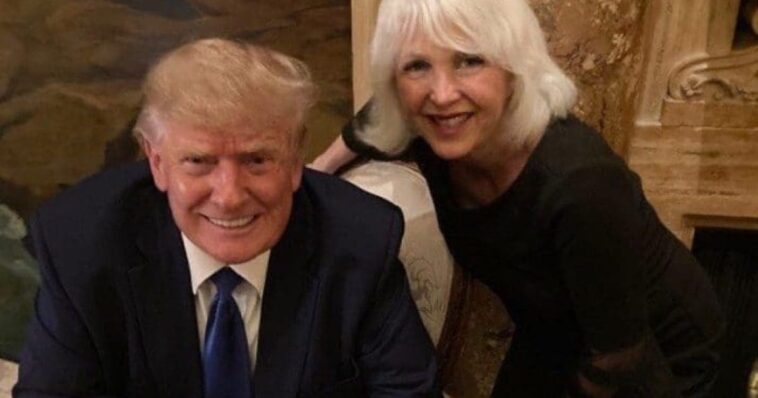

On December 11, 2025, only a few months ago, President Trump pardoned Tina Peters.
Per a post on Truth Social, President Trump shared:
For years, Democrats ignored Violent and Vicious Crime of all shapes, sizes, colors, and types. Violent Criminals who should have been locked up were allowed to attack again. Democrats were also far too happy to let in the worst from the worst countries so they could rip off American Taxpayers. Democrats only think there is one crime – Not voting for them! Instead of protecting Americans and their Tax Dollars, Democrats chose instead to prosecute anyone they can find that wanted Safe and Secure Elections. Democrats have been relentless in their targeting of TINA PETERS, a Patriot who simply wanted to make sure that our Elections were Fair and Honest. Tina is sitting in a Colorado prison for the “crime” of demanding Honest Elections. Today I am granting Tina a full Pardon for her attempts to expose Voter Fraud in the Rigged 2020 Presidential Election!
However, when attorneys representing Tina Peters showed up at the prison where Peters is being housed, President Trump’s pardon was ignored.
The prison officials took the law and the US Constitution into their own hands, refusing to release Peters. These prison employees refused to recognize the pardon.
Tina was sentenced to 9 years in prison in a kangaroo court for doing her job after the 2020 election and keeping records of her county’s election results. False charges were raised against her, and a corrupt, outright evil, and biased judge sentenced her to 9 years. This included sentencing Peters for a felony on a misdemeanor conviction.
There’s been some debate on whether President Trump could pardon Peters since she was convicted in a (corrupt) Colorado court. Here is one individual’s analysis of whether this was constitutional.
I have long accepted the conventional view that the President’s constitutional power to grant pardons extends only to federal offenses leaving violations of state law beyond his reach. This interpretation, drawn from longstanding Supreme Court precedent and modern constitutional commentary, seems straightforward at first glance, and well-established by precedent. However, when one examines the historical and textual record more closely, one begins to question whether this limitation truly reflects the original understanding at the Founding (1787–1789).
The U.S. Constitution grants the President the power “to grant Reprieves and Pardons for Offences against the United States, except in Cases of Impeachment” (Art. II, § 2, cl. 1). Conventional wisdom holds that this limits pardons to federal offenses, excluding violations of state law. Yet this interpretation does not seem to align with the original meaning…
…No Founding-era evidence suggests an intent to make the power inferior to the King’s. The Convention’s silence on such a limit—amid debates over treason, timing, and Congressional approval—supports this. If the Framers meant federal-only, why did they omit explicit language, given their familiarity with dual sovereignty?
Ex parte Garland (71 U.S. 333, 1866), in the mid 19th Century, still describes the power as “unlimited” (except impeachment), extending to “every offence known to the law” exercisable before, during, or after proceedings, without legislative fetter. It did not exclude state offenses. Not until Ex parte Grossman (267 U.S. 87, 1925)—addressing criminal contempt under federal Prohibition law—did the Court state that “Offences against the United States” was added by the Committee on Style “presumably to make clear that the pardon of the President was to operate upon offenses against the United States, as distinguished from offenses against the states.”
Note that the year when this interpretation finally appeared is 1925, and this is exactly the period when linguistic usage now shifted decisively towards treating “the United States” as a singular, and thus an entity separate from the states, as we can see from Google’s Ngram Viewer, which shows the now-changed pattern of linguistic usage. Data from Google’s Ngram Viewer confirms plural dominance from 1780–1860, peaking around 1820–1860, then declining post-Civil War, until it reached its nadir around 1925..
An originalist reading thus must question whether the power to pardon is limited to Federal crimes. The Framers’ plural conception of “the United States,” combined with the prerogative’s historical breadth and the delegates’ silence during the founding Convention, suggests no necessary exclusion of state offenses. The King pardoned colonial crimes; why would the Framers—rejecting monarchy but vesting executive pardon in one person—impose a restriction never discussed?
To conclude, then, we can state the following with reasonable certainty:
- The presidential power to pardon granted by the Founders was modeled precisely upon that of the King’s.
- The King’s power to pardon was delegated to the governors of the colonies, but remained with him, and could be exercised by him in the individual colonies despite his delegation.
- The office of governor of the King’s colonies is the historical antecedent of the governor of a state.
- Therefore, the presidential power to pardon, if it mirrored the King’s, should extend to the states.
- Supporting this view, the phrase “United States” was clearly viewed at the Founding as plural, and thus, by implication, the presidential power to pardon extends to the states.
Not until 1925, when the “United States” had become treated as a singular, and thus to mean Federal power alone, did the presidential power to pardon become limited only to Federal offenses.
If, therefore, Originalism means anything, the courts should reconsider their modern interpretation of Article II.
—Anthony Tye Rodrigues, [email protected] , 02/03/2026