
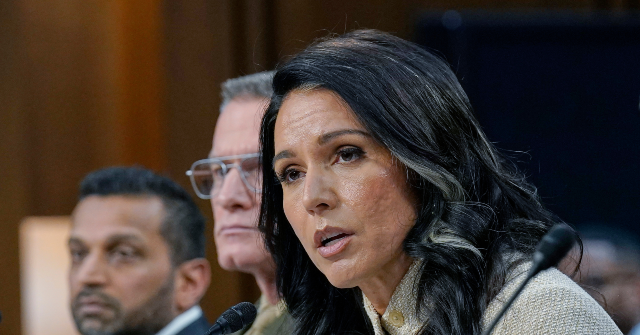
Director of National Intelligence Tulsi Gabbard shared the intelligence community’s assessments on Operation Epic Fury, China, drug cartels, artificial intelligence, and more while presenting the 2026 Annual Threat Assessment (ATA) in the U.S. Senate on Wednesday.
Along with the directors of the Central Intelligence Agency (CIA), Defense Intelligence Agency (DIA), Federal Bureau of Intelligence (FBI) and National Security Administration (NSA), the DNI shares a risk analysis with the Senate Intelligence Committee each year.
Moments before the hearing, White House Press Secretary Karoline Leavitt was asked on Fox News if President Donald Trump has full confidence in Gabbard.
“He does, yes, and we look forward to watching the director’s hearings today,” Leavitt said
At the beginning of her remarks, Gabbard noted that her testimony “conveys the intelligence community’s assessment of the threats facing U.S. citizens, our homeland, and interests, not my personal views or opinions.”
Praising the success of the Trump administration’s “strict enforcement” of security at the U.S.-Mexico border, Gabbard revealed that this January’s monthly encounters were down 83.8 percent compared to January 2025, and that encounters have declined 79 percent compared to 2024:
The drivers of migration, however, are “likely to continue,” she added, citing instability in countries like Cuba and Haiti and transnational criminal organizations (TCOs) continuing to traffic drugs into the U.S.
Gabbard stated that American fentanyl overdose deaths have seen a 30 percent decrease from September 2024 to September 2025, adding that the potency of the deadly substance has also decreased, likely due to disruptions to the production supply chain.
The government has also been working to prevent the flow of fentanyl’s precursor chemicals, or building blocks, from coming to the U.S. — with Gabbard noting that there is more to be done on that front.
Highlighting TCOs like the Mexico-based Sinaloa Cartel and El Salvador-based MS-13 as being particularly dangerous, the DNI said, “These and other TCOs present a very tangible and individualized risk of violent crime to everyday Americans and contribute to regional instability,”
While acknowledging that counterterrorism operations in the Middle East and North Africa and stricter U.S. border enforcement have degraded the capabilities of Muslim terror groups like al-Qaeda and ISIS to harm Americans, she stated that the spread of radical Islamist ideologies “poses a fundamental threat to freedom and foundational principles that underpin western civilization” and that there are “increasing examples of this in various European countries.”
On military enemies, Gabbard said, “The intelligence community assesses that Russia, China, North Korea, Iran, and Pakistan have been researching and developing an array of novel, advanced, or traditional missile delivery systems with nuclear and conventional payloads that put our Homeland within range.”
“The IC assesses that threats to the Homeland will expand collectively to more than 16,000 missiles by 2035, from the current assessed figure of more than 3,000 missiles,” she stated.
Saying artificial intelligence in the wrong hands poses “serious risks,” Gabbard said China is the “most capable competitor in this field and aims to displace the U.S. as the global AI leader by 2030.”
Towards the end of her remarks, Gabbard shifted focus to Operation Epic Fury’s updates in the U.S.-Israeli war with Iran.
“The IC assesses that Operation Epic Fury is advancing fundamental change in the region that began with Hamas’s attack on Israel on October 7, 2023, and continued with the 12-Day War last year resulting in weakening Iran and its proxies,” Gabbard said, before saying that the Iranian regime “appears to be intact, but largely degraded.”
Taking the already-tense population of Iran and bleak economy into account, the DNI said if the current regime survives, “It will likely seek to begin a yearslong effort to rebuild its military, missiles, and UAV [Unmanned Aerial Vehicle] forces.”
Prior to Operation Epic Fury, Iran was “trying to recover from the severe damage to its nuclear infrastructure sustained during the 12-Day War and continued to refuse to comply with its nuclear obligations with the IAEA, refusing them access to key facilities,” Gabbard stated.
She concluded her opening remarks by saying the intelligence community remains “committed to providing the president and policymakers with timely, unbiased, relevant intelligence to inform decision making, and to ensure the safety, security, and freedom of the American people.”
The full ATA can be read here.
Olivia Rondeau is a politics reporter for Breitbart News based in Washington, DC. Find her on X/Twitter and Instagram.