
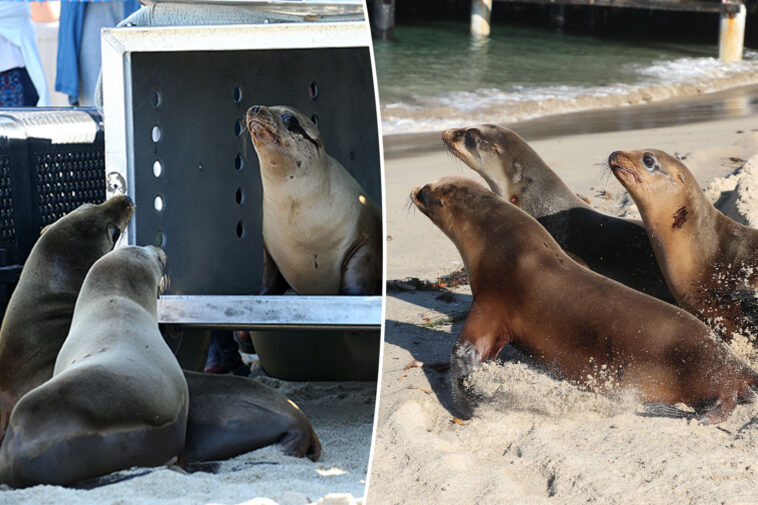
A trio of adorable sea lions pups was released back into the sea off Redondo Beach Friday after weeks in the care of rescuers who discovered them separated from their mother.
The three pups — Knoxie, Happy and Halfpipe — were found emaciated when rescuers from the Marine Mammal Care Center found them at Manhattan Beach, Dockweiler Beach and Will Rogers State Beach in late January and early February.
“They’re more or less rediscovering the ocean today,” Marine Mammal Care Center Executive Director John Warner told The Post. “To them, it looks scary.”

And there’s reason to be afraid — as the sea lions are returning to increasingly dangerous territory.
The animals have been found shot and maimed in what veterinarians warned is a growing pattern of violence.
Sign up for the California Morning Report newsletter
California’s top news, sports and entertainment delivered to your inbox every day.
Thanks for signing up!
The Post first reported that sea lions have been washing up across Southern California with bullets lodged in their skulls, pellets in their hearts, their jaws blown apart and spines snapped.
The cases stretch across the coastline, from Redondo Beach and Santa Monica to Marina del Rey and the Port of Los Angeles, and investigators believe the violence is not isolated.

Now, there’s a growing fear that the very animals released Friday could become the next victims.
“What we don’t want is the three animals released today actually come back before a year because they encounter the same fate,” Warner said.
Download The California Post App, follow us on social, and subscribe to our newsletters
California Post News: Facebook, Instagram, TikTok, X, YouTube, WhatsApp, LinkedIn
California Post Sports Facebook, Instagram, TikTok, YouTube, X
California Post Opinion
California Post Newsletters: Sign up here!
California Post App: Download here!
Home delivery: Sign up here!
Page Six Hollywood: Sign up here!
To combat the violence, the Marine Mammal Care Center is offering a $10,000 reward for information leading to a successful prosecution. It is also launching what Warner calls a “marina watch,” urging boaters, dockworkers and coastal residents to stay alert and report suspicious activity.
“Someone is doing this,” Warner said. “And the only way to stop it is to make them afraid of getting caught.”


At the event on Friday, state Sen. Laura Richardson also announced new legislation to designate the California sea lion the official state pinniped, a move aimed at boosting recognition and protection for the iconic marine animals.
The designation would not automatically increase penalties for perpetrators of violence against sea lions, but Warner said it could shift public perception and make crimes against them even harder to ignore.
“There’s not necessarily greater legal protection tied to the designation,” he said, “but it does make the crime even more egregious.”


The push comes at a time when sea lions are already under pressure from every direction.
Warner pointed to warming ocean temperatures, toxic algae blooms and declining food sources as ongoing threats. In recent years, those conditions have triggered mass strandings and widespread malnutrition among young sea lions.
“These animals have been through hell the last five or six years,” he said, adding that his group is rehabilitating 5,000 sea lions a year. “Every time you start a new year, there’s something new hitting them.”