
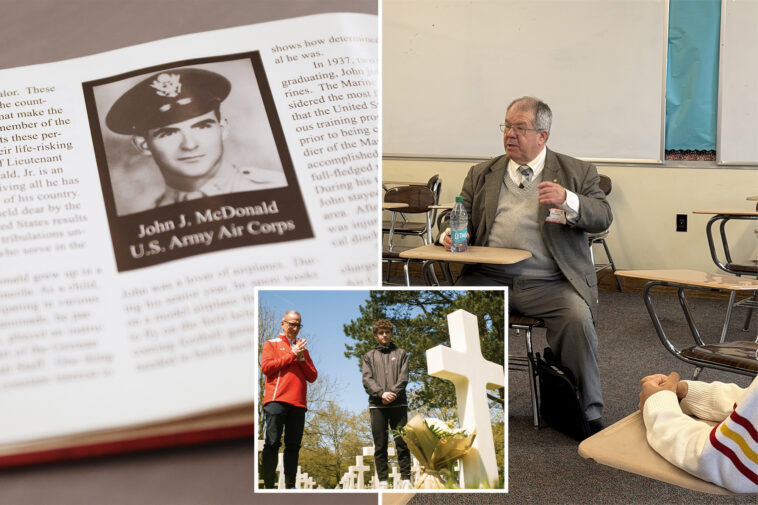
An expert uncovered new details about the mysterious life of a forgotten Long Island hero killed in World War II after an article in The Post inspired him to cement the soldier’s place in history — but one big question mark remains.
The story of Albertson-born First Lt. John Joseph McDonald, who was killed in Normandy, had been largely lost to time until a recent story about his heroics as an Army Air Corps bomber sparked newfound interest.
The story caught the eye of military historian John Plotkin, who spent two months researching McDonald to find out more about his upbringing and his valor in the face of deadly battle.

“If I hadn’t seen the article, I would never have known he existed,” Plotkin said. “He’s like the hundreds of thousands of others who didn’t come home.”
Unfortunately, he also came up against some nagging mysteries that still surround his life, which ended during the Great Crusade. The story of his marriage — and identity of his wife — is still a mystery, for now.
Plotkin, a Decatur, Georgia, native, first read the article in June that described a group of Chaminade High School students who had prayed at the battlefield grave of McDonald, who graduated from the Mineola Catholic school in 1935.
Chaminade president Brother Thomas Cleary had very limited information about McDonald at the time, but said several people came forward to help fill in the gaps of McDonald’s life since the story was first published.

“They read the article in The Post, and it just caught people’s imagination,” Cleary said. “He’s poured back into our lives.”
Plotkin traveled to Long Island on Monday to speak with the students who visited the grave.
He told them that McDonald, whose B-26 plane was fatally shot down on D-Day plus two — June 8, 1944 — had a highly “unusual” upbringing in Nassau County.
McDonald was the only child of an Irish immigrant family, and his father, also John, made a living by acquiring horses for wealthy tycoons like the DuPonts and the Belmonts, for whom the Triple Crown horse race is named.
His dad later became a New York City cop, and the younger McDonald was known as Jackie to easily identify one from the other, according to information someone else relayed to Cleary.
Jackie first enlisted in the Marines right out of school in 1936, which was also distinguishable for the time, Plotkin said.

“He’s unusual in that he went into the service in the 30s,” said Plotkin. “Most people did not.”
McDonald, who became a bandsman in the Corps, was eventually stationed in Peking, China, where the private first class contracted an undisclosed illness that sickened the soldier for almost a year in 1940.
“It obviously was a legitimate disease,” Plotkin said. “Nothing shameful, because he was given a good conduct discharge, and his character was rated as excellent.”

McDonald bravely re-enlisted in the Army a year later and flew tons of perilous bombing raids on German infrastructure in Europe, deliberately drawing the enemy’s air force into the sky.
“The real game was to force the Luftwaffe to rise up and attack them. They were bait so that the American fighters could chew up the German air force,” Plotkin said.
“He received the Air Medal with 11 oak leaf clusters — that translates into at least 22 or 23 missions.”

The 387th bomber group member was also awarded the Purple Heart and the Distinguished Flying Cross before being killed in action.
Start your day with all you need to know
Morning Report delivers the latest news, videos, photos and more.
Thanks for signing up!
Plotkin did reach one dead end on McDonald’s life filled with nerve and courage — details on the soldier’s wife, whom he wed while on leave in 1943.
She is identified in records as only “Mrs. JJ McDonald.”
“I searched up and down, back and forth,” said Plotkin, adding that the woman wasn’t even listed as next of kin.
“I could not find anything indicating who this lady was … I am not giving up. I intend to dig.”