
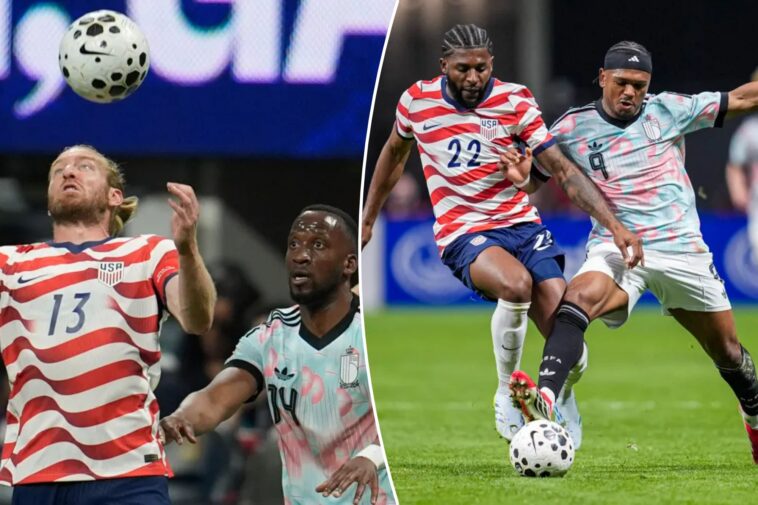
MARIETTA, Ga. — So Brazil national team coach Carlo Ancelotti postulated Monday that the World Cup winner will be the team that concedes the least, not the one that scores the most. That does not sound like good news for the United States.
“Very interesting reflection,” U.S. coach Mauricio Pochettino said. “Players need to listen to that.”
Because, you may have heard, central defense is the position where the Americans are least settled. They just gave up five goals to Belgium and an outsized portion of the conversation heading into Tuesday’s friendly — sorry, unofficial match — against Portugal was about how to ensure that doesn’t happen again.
The Portuguese, ranked sixth in the world by FIFA, bring a squad to Atlanta that is without Cristiano Ronaldo, but likely more talented than the Belgians anyway, including the likes of Bruno Fernandes, Vitinha, Rúben Neves, Gonçalo Ramos and João Félix.
It will be telling, extremely so, whether Pochettino sticks with the four-at-the-back look that seemed too easily picked apart Saturday, or reverts to the 3-4-3 formation that brought the U.S. success in the fall.

To quickly clarify the difference: a 3-4-3 features three center backs with two wingbacks pressing up the field. Playing with four at the back — the U.S. has generally employed a 4-2-3-1 when doing so — would mean two center backs with the outside backs having more defensive responsibilities in addition to getting upfield.
Pochettino and Tim Ream downplayed the differences between the two, but Chris Richards — who is available to play after missing Saturday’s match with a balky knee — noted that more tactical discipline is needed to play four at the back, where the U.S. struggled to get help to its outside backs Saturday.
“You probably need to play more central and protect the middle [with four],” Richards said. “It becomes different in these moments, but I think also here with the national team, it’s tough because we do switch sometimes here and there. But I think the No. 1 thing is make sure you protect the middle. We’re center backs, we’re in the center. Protecting the goal is our No. 1 job.”

Richards is one of two center backs likely penciled into the starting XI at the World Cup, alongside Ream, who played all 90 minutes Saturday.
If there is a third starting spot to be had, it’s likely between Mark McKenzie, Miles Robinson and Auston Trusty, with an outside shot for Joe Scally, Alex Freeman or Tanner Tessmann to move out of their natural positions, or for Noahkai Banks to both declare for the U.S. and be invited to the World Cup squad without a senior cap to his name.
McKenzie played 90 unimpressive minutes Saturday. Robinson is in camp, but dealing with a groin injury and won’t play. Trusty didn’t get on the field Saturday and should be in line for an audition against Portugal.
Important as it is to get the tactics right, though, it’s even more critical for the U.S. to operate with a level of desperation that was missing for whole chunks of the second half Saturday. They do not have the talent to beat elite opposition doing anything else.

“When you think of the best defenders, you think of guys who want to run through a brick wall,” Richards said. “I think that’s something we can add to our game. There’s moments here and there where you’ve seen that kind of toughness. Sometimes, like the other day, we let in a few soft goals. Something I think we can bring, too, is just this toughness.
“… I think it takes time [to build]. I know we don’t have that much time left, but I know when we’re able to play in these high-level games, I think when you’re able to get good performances and results against high-level teams, it gives you confidence.”
Alternatively, if the conversation leaving this camp is centers on the United States’ inability to maintain its level for 90 minutes, it’s going to be a long and pessimistic two months leading into the program’s biggest-ever tournament.
“It’s about making not just the first [effort], the second, the third, the fourth. And sometimes that doesn’t happen,” Ream said. “And that’s just, again, something that is a nonnegotiable, really. And it’s something that we were doing really well in the fall last year and it’s something we have to get back to.”