
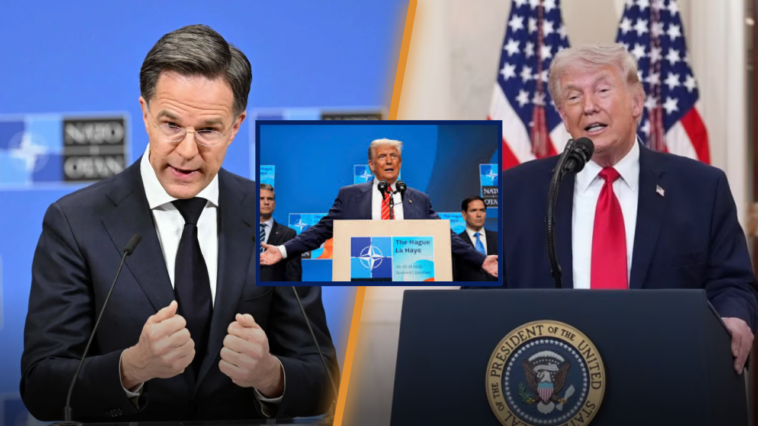
WATCH: 77 Years Ago Today, NATO Was Created to Defend the West—But Is It?
77 years ago, on April 4, 1949, the NATO treaty was signed. The alliance, known as the North Atlantic Treaty Organization, was created to deter Soviet expansion and ensure collective security among Western nations.
For decades, it succeeded in that mission. However, today’s geopolitical landscape raises a more complicated question: not whether the United States should leave NATO, but whether the alliance, in its current form, still serves American interests fairly.
Recent tensions surrounding Iran have exposed a persistent imbalance. While the United States continues to provide the backbone of NATO’s military power, many European allies remain reluctant to fully support American-led operations that fall outside a narrow interpretation of Article 5.
That hesitation is not entirely surprising. NATO’s collective defense clause applies when a member is attacked, not necessarily when the United States engages in offensive or preemptive actions.
Still, the broader issue is reciprocity. The United States maintains extensive military infrastructure across Europe, provides advanced defense capabilities, and has historically underwritten the alliance’s security umbrella. In return, Washington expects more consistent strategic alignment.
As previously reported by The Gateway Pundit, President Donald Trump is reportedly considering withdrawing from NATO, reflecting growing frustration within parts of the American political establishment.
However, leaving the alliance is neither simple nor likely. Legislation passed in 2024 requires a two-thirds vote in the Senate to approve any withdrawal, making unilateral action effectively impossible.
This legal reality underscores an important point: the debate is not truly about exit, but about leverage and reform.
It is also important to acknowledge that NATO has not always been a one-sided arrangement. The alliance invoked Article 5 for the first and only time after the September 11 attacks, leading European allies to support U.S. operations in Afghanistan.
Thousands of allied troops were deployed, and many lost their lives alongside American forces. That history matters. It demonstrates that NATO can function as intended when the threat is clearly defined within its framework.
At the same time, structural imbalances have persisted. For years, many NATO members failed to meet the agreed-upon benchmark of spending 2% of GDP on defense. While recent pressure—particularly during the Trump administration—has pushed more countries toward that target, disparities remain.
The United States continues to account for a disproportionate share of total NATO defense spending, raising legitimate concerns about burden-sharing.
Reform, therefore, should focus on three key areas. First, enforceable defense spending commitments must become the norm rather than the exception. While this has largely been the case under Trump, it remains unclear how NATO allies will respond under future administrations.
NATO should also clarify expectations for allied support in operations that, while not strictly defensive, still serve broader Western interests.
Finally, the alliance must adapt to modern threats, including cyber warfare, economic coercion, and strategic competition with powers such as China, rather than remaining overly focused on its Cold War structure.
Leaving NATO would create a vacuum that adversaries such as Russia and China would quickly exploit. The alliance provides the United States with forward operating bases, intelligence coordination, and strategic depth that cannot be easily replicated.
Of course, European nations would likely bear the greatest immediate consequences if the United States were to leave NATO. However, that does not mean withdrawal would be the right decision.
Trump is known for following through on his positions, but that does not preclude negotiation. The same principle applies to NATO: the goal should not be abandonment, but a recalibration of the alliance to better reflect mutual responsibility and shared interests.
The Patriot Perspective has recently switched its main platform from YouTube, and we would greatly appreciate it if you subscribed to us there. [HERE]
Have a question for the show? Like the video and comment your question, and we will be sure to answer it in our next episode’s letters segment. [HERE]
Ad block users: Some site features may not work correctly while an ad blocker is enabled, because they break scripts and content this website depends on. If you can’t see comments below, for example, please disable your ad blocker.