
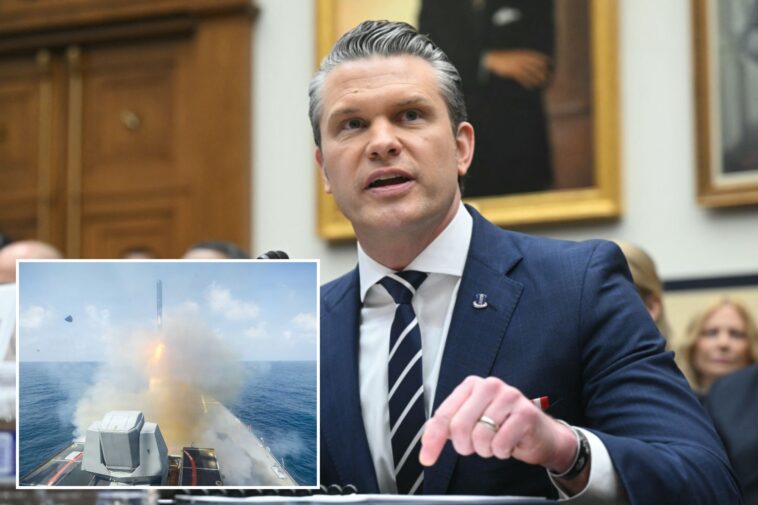
WASHINGTON — Secretary of War Pete Hegseth unloaded a preemptive attack on congressional critics of the Iran war, as the Pentagon revealed the current estimated cost of Operation Epic Fury is $25 billion.
“The biggest adversary we face at this point are the reckless, feckless and defeatist words of congressional Democrats and some Republicans two months in,” Hegseth said in his opening remarks at a House committee hearing.
“Lest I remind you, and my generation understands, how long we were in Iraq, how long we were in Afghanistan, how long we were in Vietnam. [We are] two months in on an existential fight for the safety of the American people. Iran cannot have a nuclear bomb. We are proud of this undertaking. I am proud that President Trump has had the courage to do it.”

Hegseth called Trump the “best negotiator in the world” before taking questions from congressmen.
Rep Adam Smith (D-Wash.), however, panned Trump’s claims that Iran has given in to his core war demands — only for Tehran to publicly deny it — saying the commander in chief appeared to be relying on “Jedi mind tricks.”
“It is worth noting that every president prior to this one, including Trump in his first term, also prevented Iran from getting a nuclear weapon without actually having to go to war in Iran,” Smith told Hegseth.
“It’s worth noting, of course, that the [Strait of Hormuz] was open before the war started. Now we’re negotiating to get back to status quo, and Iran’s most recent offer is to say we’ll talk about nukes later,” Smith said.

“So what is the plan to actually turn all of this lethal, kinetic action into an improvement in the nuclear situation?”
Hegseth slammed former President Barack Obama’s Iran nuclear deal and said Trump’s strategy is to force the Iranians into a complete relinquishment of ambitions.
“You have to stare down this kind of enemy who’s hell-bent on getting a nuclear weapon and get them to a point where they’re at the table, giving it up,” he said.

“President Trump saw Iran at its weakest moment.”
The $25 billion price tag, mostly for munitions, was revealed at the hearing by Pentagon chief financial officer Jules Hurst III, coming on the heels of reporting that the Trump administration might seek a supplemental of up to $200 billion for the war.
A three-week cease-fire has dramatically reduced the cost of waging the war during that period, though US consumers are paying more for fuel due to a spike in global oil costs.

The relatively low cost of current war expenditures could reduce Congress’s leverage to enforce a 60-day limit on conflicts without its approval.
The 60-day limit, established by the War Powers Resolution of 1973, historically has not been enforced by courts, which have deferred to Congress to use its power over spending to address alleged violations.
The war started on Feb. 28 — 61 days ago.