
Republished with permission from AbleChild.
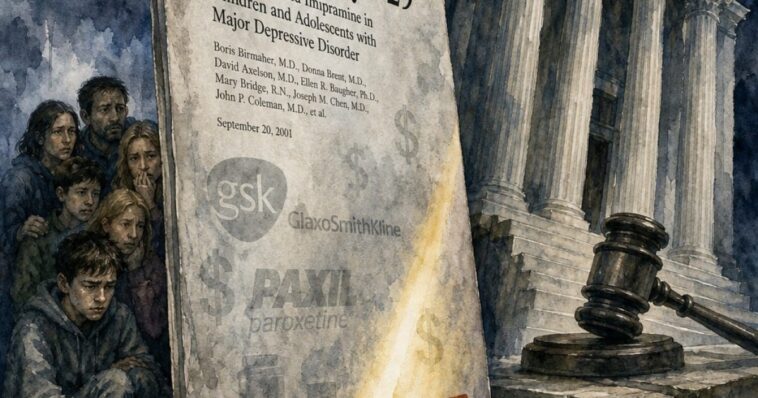
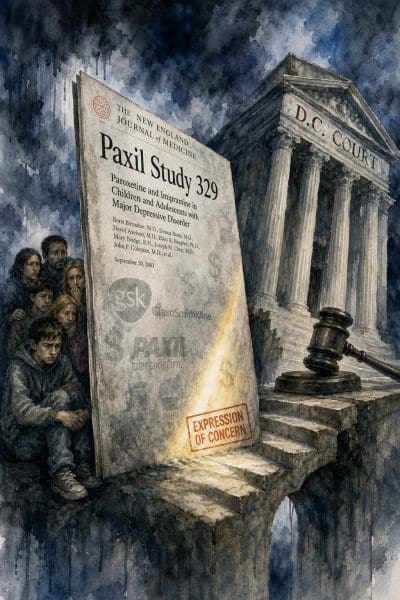
A D.C. judge just sided with a long‑discredited Paxil study instead of the kids it was used to sell drugs to. GlaxoSmithKline has already paid $3 billion for fraud that included how it pushed Paxil for children and supported this very study, yet the article still stands in the medical record. Those who rush to always defend psychiatry as “experts” of the human condition should really look at the bigger picture.
According to the lawsuit, that study falsely claimed Paxil was safe and effective for depressed teens, even though the company’s own trial data did not show real benefit and did show serious safety concerns, including suicidal thoughts and behavior. The case explains why lawyer George Murgatroyd went after the journal and its publisher for continuing to publish and sell the article, how the court’s ruling let psychiatry’s publishing system avoid full accountability once again, and how consumers were left with only a small warning label on the paper instead of the clear retraction many believe is needed.
At the center of this case is attorney George W. Murgatroyd III, a product‑liability lawyer who has represented families whose children died by suicide after taking Paxil. Murgatroyd sued the American Academy of Child and Adolescent Psychiatry and the publisher Elsevier, arguing they were still “publishing, distributing, and selling a fraudulent scientific article” that misleads the public and endangers adolescent mental health, while charging readers to access it. He asked the D.C. Superior Court to treat that article as a deceptive practice under the District’s consumer‑protection law and to order a full retraction.
In March 2026, Judge Robert Okun dismissed his case. The judge did not say Study 329 was honest or reliable. Instead, he ruled that Murgatroyd lacked legal standing and that a journal article is not a “consumer good or service” under that particular law, so the court could not use that statute to force a retraction. In practical terms, the decision shields the journal and publisher: they keep the article online, charging for access, under the protection of free‑speech arguments rather than being treated like sellers of a defective product. For an industry already tied to a historic fraud settlement over this very drug and trial, it is another escape.
Murgatroyd’s work still produced one real gain for the public. After he filed his complaint, JAACAP finally attached an “expression of concern” to Study 329 in 2025, warning readers that serious issues have been raised about the article and that further review is underway. That warning label stays with the paper and marks it as disputed rather than trustworthy, a change that likely would not have happened without Murgatroyd pushing. In a landscape where a flawed study helped justify giving a risky drug to teens, naming him and his effort matters: he forced at least a small, visible sign of truth into the official record, even as the larger fight for justice and a full retraction continues.
AbleChild is a 501(3) C nonprofit organization that has recently co-written landmark legislation in Tennessee, setting a national precedent for transparency and accountability in the intersection of mental health, pharmaceutical practices, and public safety.
What you can do. Sign the Petition calling for federal hearings!
Donate! Every dollar you give is a powerful statement, a resounding declaration that the struggles of these families will no longer be ignored. Your generosity today will echo through generations, ensuring that the rights and well-being of children are fiercely guarded. Don’t let another family navigate this journey alone. Donate now and join us in creating a world where every child’s mind is nurtured, respected, and given the opportunity to thrive. As a 501(c)3 organization, your donation to AbleChild is not only an investment in the well-being of vulnerable children but also a tax-deductible contribution to a cause that transcends individual lives.