
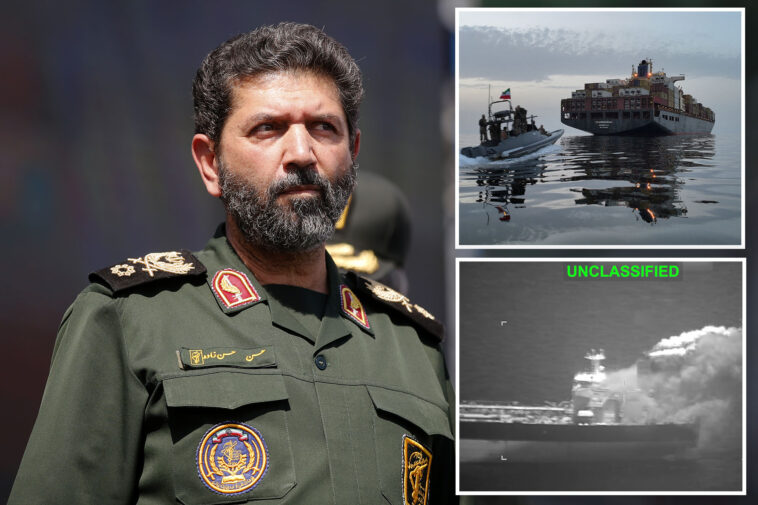
WASHINGTON — An ugly internal power struggle in Iran is muddying mediation talks with the US, as pro-war and pro-deal factions battle it out over whether Tehran should ever surrender, sources familiar with mediation efforts tell The Post.
Though Iran’s political elites — including its president, foreign minister and parliamentary speaker — have been at the center of efforts to hammer out peace terms, regional sources told The Post that it’s Iran’s military leadership that ultimately has the power to accept or reject any agreement.
“One faction there right now is at its highest point ever in its history — the IRGC,” a source told The Post. “The nationalist feeling (that comes with war) gives them the highest pedestal.”
As a military force, the IRGC’s power surges in times of conflict — and with the group at the helm, some within Tehran have an interest in seeing the war continue, sources familiar with the negotiations told The Post this week.

The split helps explain why Iran has repeatedly tested US patience — launching attacks that provoke American retaliation without fully shattering the fragile cease-fire.
President Trump himself has shied away from defining what level of attack, exactly, would warrant a return to full-scale war, cryptically telling a reporter this week that “you’ll find out” when he determines a strike reaches the level of breaking the cease-fire.
Those tests came to a head on Friday, when the US launched airstrikes targeting three empty Iranian-linked tankers that tried to barrel through the US blockade of Iranian ports, according to US Central Command.
A US Navy F/A-18 Super Hornet disabled two tankers attempting to break past the American blockade on Tehran’s ports “after firing precision munitions into their smokestacks,” CENTCOM said in a post to X.
The ships — the Iranian-flagged M/T Sea Star III and M/T Sevda — were attempting to breach the blockade to reach an Iranian port in the Gulf of Oman.
The strikes stopped the ships from reaching port, as video showed thick black smoke rising from the vessels after the strikes.
A third ship was also stopped when an F/A-18 Super Hornet “disabled the unladen oil tanker’s rudder by firing several rounds from a 20mm cannon gun,” the combatant command said.

The US has roughly 15,000 troops enforcing the blockade, which took effect April 13, and CENTCOM said Friday that American forces are currently preventing more than 70 tankers from entering or leaving Iranian ports.
“These commercial ships have the capacity to transport over 166 million barrels of Iranian oil worth an estimated $13 billion-plus.”
Analysts have warned that mounting tensions over the blockade could accidentally trigger a return to full-scale war, but the US appears determined to avoid that outcome.
The US has avoided formally ending the cease-fire despite multiple skirmishes in recent days, including retaliatory strikes Thursday evening that Trump downplayed as a “love tap” after Tehran targeted three US warships in the strait.
It’s not only US vessels that have come under Iranian attack as Tehran considers the strait under its sovereignty — demanding tolls for ships to pass and attacking those that threaten its grip.
On Monday, Iran attacked a Chinese-owned oil products tanker near the Strait of Hormuz off the United Arab Emirates coast. Chinese Foreign Ministry spokesman Lin Jian on Friday acknowledged the attack and said Beijing would continue pushing for peace talks and de-escalation.
“China is deeply concerned that a large number of vessels along with their crew have been caught in the conflict and stranded in the strait,” Lin said.
On Friday, Iran also seized a Barbados-flagged tanker sanctioned by the US that was carrying Iranian oil in the Gulf of Oman, according to the Islamic Republic’s army.
The ship, called the Ocean Koi, was stopped and forced back to the southern coast of Iran following an alleged attempt to “harm and disrupt oil exports … by exploiting regional conditions,” Tehran’s military said.

The US on Monday launched a short-lived mission, Project Freedom, to escort ships through the strait, but Trump called it off Tuesday following requests by Pakistan, Saudi Arabia and “other countries.”
“We have mutually agreed that, while the blockade will remain in full force and effect, Project Freedom … will be paused for a short period of time to see whether or not the Agreement can be finalized and signed,” Trump wrote on Truth Social.
While the cease-fire remained in effect Friday, so too did the maritime blockade, which CENTCOM commander Adm. Brad Cooper said the US would continue enforcing.
“US forces in the Middle East remain committed to full enforcement of the blockade of vessels entering or leaving Iran,” he said in a statement. “Our highly trained men and women in uniform are doing incredible work.”
Iran has previously refused to hold peace talks while the blockade remains in place. The Trump administration has blamed competing factions in Iran for the slowness of dealmaking. Chairman of the Joint Chiefs of Staff Gen. Dan Caine said this week that the regime “is led by the IRGC” [Islamic Revolutionary Guard Corps], who are “effectively attempting to hold the entire global economy hostage.”

With both sides at a standoff, mediators fear the conflict is quickly turning into a matter of who can outlast the crisis longest despite the push to return to the negotiating table.
As of Friday evening, the US was still awaiting a response from Iran to its latest peace deal talk offer. One diplomatic source suggested avoiding timelines in the future altogether.
“The more space you give them, the more likely they are to come along,” the person said of Iran. “If the US stops saying, ‘We expect a response in two days,’ they may actually get a response.
“If you say two days, you are likely to get it in four or five,” the source added.