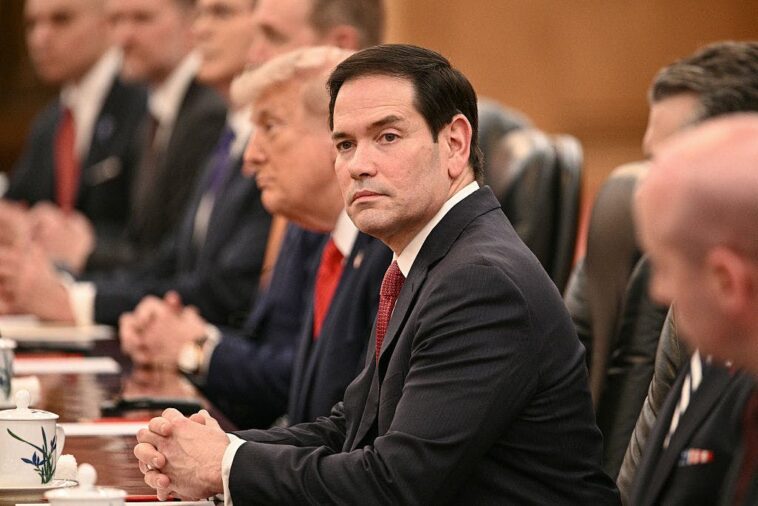
For most high-ranking diplomats, a misprinted nameplate would be a minor annoyance or a subtle dig. For Marco Rubio, it’s a victory.
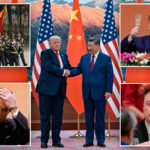
When the Secretary of State joined President Donald Trump for Thursday’s bilateral meeting with Chinese President Xi Jinping, his last name was slightly misspelled. The reason? Beijing has twice sanctioned Rubio and effectively barred him from entering the country. But Rubio is America’s top diplomat, and Trump would not have undertaken such a high-stakes state visit without him. So, the Chinese Communist Party devised a linguistic workaround to allow Rubio entry without formally lifting the sanctions.
Chinese Embassy spokesman Liu Pengyu said this week that the sanctions targeted Rubio’s “words and deeds when he served as a U.S. senator concerning China.”
According to Garrett Exner, those words and deeds comprise a “remarkably clear-eyed” assessment of the CCP’s faults.
“Likely because of his Cuban background, Rubio sees communism for the evil it is and has no issue calling it out,” Exner, a fellow at the Hudson Institute, told The Daily Wire. “It is a win for President Trump that he forced China’s hand in changing their own rules to bring his Secretary of State.”
As a senator, Rubio was a leading critic of Beijing’s treatment of the Uyghur minority in the Xinjiang region and an outspoken supporter of pro-democracy protesters in Hong Kong. For that and more, China brought the hammer down on Rubio in 2020 — something the then-Florida senator met with humor.
“Last month China banned me,” Rubio wrote at the time. “Today they sanctioned me. I don’t want to be paranoid but I am starting to think they don’t like me.”
Rubio’s joking tone in no way belies an unserious approach to China. While traveling to China aboard Air Force One, Rubio described Beijing as America’s top geopolitical rival and warned that it seeks to displace the United States as the world’s dominant power.
“It’s both our top political challenge geopolitically and it’s also the most important relationship for us to manage,” Rubio said. “It’s a big powerful country and it’s going to continue to grow.”
Rubio added that the United States and China will inevitably have conflicting interests but argued the relationship must still be managed carefully to avoid military conflict.
“We’re going to have interests of ours that are going to be in conflict with interests of theirs; to avoid wars and maintain peace and stability in the world, we’re gonna have to manage those,” Rubio said.
Years earlier, Rubio contrasted China with Russia, arguing that Chinese ambitions posed the more serious long-term threat.
“Under Putin, Russia is trying to undermine the U.S.,” Rubio wrote in 2019. “But Xi aims for China to displace us. Putin efforts must be addressed. But in the big picture Xi challenge is a far bigger threat.”
In another 2019 X post, Rubio wrote: “Problem isn’t people of China — it’s Xi govt economic cheating & stealing & human rights abuses.”
Rubio has also repeatedly singled out Chinese President Xi Jinping personally, arguing that Xi’s leadership has damaged China’s global standing through aggressive foreign policy, human rights abuses, and COVID-era secrecy.
In a 2020 post, Rubio wrote that “history will say Xi’s aggressiveness backfired & inflicted tremendous damage on China globally,” citing the mass detention of Uyghurs, “Coronavirus coverups,” and the rise of China’s so-called “Wolf Warrior Diplomats.”
Rubio’s Long Campaign For Uyghurs
One of the primary reasons Beijing sanctioned Rubio was his outspoken criticism of China’s treatment of Uyghurs and other Muslim minorities in the Xinjiang region, which has included accusations of mass surveillance, persecution, arbitrary arrests, torture, forced labor, sexual violence, forced sterilization, and genocide. China has denied such abuses have taken place.
In 2020, Rubio declared that China’s actions amounted to “a systematic state sponsored crime against humanity.”
He later pushed the State Department to formally determine whether Beijing’s actions constituted genocide.
Rubio additionally introduced the Uyghur Forced Labor Prevention Act, which was signed into law in 2021. The law blocks goods made with forced labor in Xinjiang from entering American markets.
Rubio also has a history of calling out American corporations he believed were benefiting from Chinese forced labor practices, criticizing Nike in 2021 for selling products made by “600 Uyghurs in forced labor at the factory in Qingdao.” But the treatment of Uyghurs is not the only venue for Rubio’s vehement criticism of China.
Rubio Supported Hong Kong Pro-Democracy Protesters
Rubio emerged as one of the most vocal supporters of the pro-democracy protests in Hong Kong in 2019 and 2020, which were met with a brutal crackdown from the Chinese government.
At the time, Rubio repeatedly accused the Communist Party of violating its international commitments and dismantling the territory’s promised autonomy.
In May 2020, Rubio blasted Chinese officials after they accused him of placing “unjustifiable pressure” on China.
“Wrong,” Rubio responded. “China’s Communist Party is breaking its international commitments to respect Hong Kong’s autonomy & democracy.”
Rubio also introduced the Hong Kong Human Rights and Democracy Act, legislation authorizing sanctions against Chinese and Hong Kong officials responsible for undermining freedoms in the territory. The bill received near-unanimous support in Congress.
In 2019, Rubio wrote that Hong Kong was “a cautionary lesson for anyone thinking about any deal with them.”
“They signed a treaty promising autonomy & democracy for Hong Kong,” Rubio said. “They will agree to anything to get a deal. But they have no intention of keeping those promises.”
In 2020, Rubio warned that the Chinese Communist Party “should never be trusted to keep any international agreement they enter into,” arguing that Beijing “will lie to get any deal” before ultimately doing “whatever they want” once it serves their interests.
Rubio Repeatedly Defended Taiwan
Throughout his career, Rubio has never shied away from one of the most contentious issues between the United States and China: Taiwan. Rubio has consistently defended Taiwan and rejected Beijing’s territorial claims over the self-governing island.
In 2020, Rubio warned that China would attempt to intimidate Taiwan through propaganda and psychological pressure.
“But they will fail,” Rubio wrote. “Taiwan will not be scared into surrendering their liberty & America stands with them.”
Rubio also pushed for stronger U.S. diplomatic engagement with Taiwan, including urging the Trump administration in 2019 to send a high-level American official to events marking the anniversary of the Taiwan Relations Act.
“Taiwan faces unprecedented threats from China,” Rubio wrote. “The U.S. must make our support clear.”
After Russia’s 2022 invasion of Ukraine, Rubio also argued that the international community should support Taiwanese independence if China was willing to recognize Russian-backed separatist territories.
“Since China supports recognizing the independence of Russian puppets in Ukraine maybe it’s time the world supports the independence of the legitimate government of Taiwan,” Rubio wrote days after the invasion.
In October, Rubio reassured Taiwan supporters by saying the Trump administration would not negotiate away Taiwan’s future in exchange for a trade deal with Beijing.
“I don’t think you’re going to see some trade deal where, if what people are worried about is we’re going to get some trade deal or we’re going to get favorable treatment on trade in exchange for walking away from Taiwan,” Rubio said. “No one is contemplating that.”
Rubio Fought For Truth On COVID
During the COVID-19 pandemic, Rubio emerged as one of the leading voices demanding accountability from Beijing and investigating the origins of the virus.
In 2020, Rubio accused the Communist Party of politicizing the pandemic and exploiting the crisis “for publicity and profit.”
“It proves how they politicize everything because everything, even public health, is subservient to the party,” Rubio wrote.
In a lengthy report released in 2022, Rubio pointed to evidence suggesting Chinese authorities may have known about a dangerous outbreak well before publicly acknowledging it in December 2019.
The report also argued there were signs of a possible “serious biocontainment failure or accident” involving the Wuhan Institute of Virology during the second half of 2019.
In a 2023 Fox News interview, Rubio said that China does not want the world to know how COVID started.
“This probably was a lab leak accident. Someone got infected, it has now spread across the world and the totalitarian Communist government in China doesn’t want the world to know about it.”
In an op-ed the same year, Rubio argued that the COVID origins controversy was only one example of broader Chinese infiltration efforts targeting American institutions and corporations.
“The Chinese Communist Party is dangerous, deceptive, and self-serving,” Rubio wrote.
Rubio pointed to reports claiming CCP members were embedded inside major Western companies and called for legislation targeting Chinese influence operations, espionage efforts, and military cooperation loopholes.
Rubio Warned About Chinese Espionage In America
Rubio has repeatedly warned that the Chinese government was using students, researchers, and businesses to advance Beijing’s military and intelligence capabilities.
In 2020, Rubio praised moves targeting Chinese students allegedly involved in stealing American research.
“Good move to address China using some students at our universities to steal research & advance military capabilities,” Rubio wrote regarding Chinese graduate students being expelled if they have ties to China’s military schools.
At the same time, Rubio warned Americans not to direct hostility toward ordinary Chinese citizens.
“This must be addressed in a targeted way while rejecting xenophobia,” Rubio added. “Remember, China’s govt often entraps its own people into this.”
Rubio also pushed legislation aimed at exposing Chinese influence operations inside American universities.
In 2018, Marco Rubio introduced the Foreign Influence Transparency Act, which sought to require organizations such as Confucius Institutes to register under the Foreign Agents Registration Act if they promoted the political agenda of a foreign government.
“This legislation aims to bring greater transparency to the activities of foreign governments operating in the United States,” Rubio said at the time, arguing the bill would strengthen foreign funding disclosure requirements for colleges and universities while closing loopholes that allowed Chinese government-linked entities to operate on more than 100 American campuses.
With even Trump stoking speculation as to whether his Secretary of State will run for president in 2028, it’s clear that Rubio isn’t going anywhere. No doubt Beijing is thinking a lot about that.