The White House revived diplomacy efforts with Iran in February to solve the long-running dispute over its uranium enrichment capabilities, with the West fearing the country could develop a nuclear weapon and Iran insisting its program was peaceful.
The negotiations came against a backdrop of deadly nationwide protests over the country’s collapsing economy and its corrupt regime that began in late December, with President Trump telling protestors “help is on the way” as he built up US forces in the Middle East, raising fears of a military strike.
The two countries first met on Feb. 6 in Muscat, Oman, for mediated talks.

While Iranian officials claimed talks were a “good start,” but at home dismissed the prospect of diplomacy in their Friday prayers sermons, lambasting the negotiations as just part of “America’s political game” – a message that came from then Supreme Leader Ayatollah Ali Khamenei.
Iran insisted touching its ballistic missile program was an absolute no go, and on Feb. 17, Khamenei publicly rejected the negotiation conditions set out by Trump in an address to his people.
On Feb. 20, Trump gave Iran a 10-day deadline to reach a deal, and Iranian Foreign Minister Abbas Araghchi stated a “historic” agreement with the US to avert military conflict was “within reach,” ahead of renewed talks in Geneva on Feb. 26.
But Iran rejected a proposal that called for a civilian nuclear program with US investment, in exchange for dismantling its own, according to the White House, and on Feb. 27 President Trump admitted he was “not happy” with the Geneva negotiations.
The next morning, the first US and Israeli strikes killed Supreme Leader Ayatollah Ali Khamenei in his Tehran compound and launched the war, with the Islamic Republic threatening there was “no red line” after the cleric’s death and all US targets in the Middle East were fair game.


Close to a dozen nations had to close their airspaces, with retaliatory Iranian strikes hitting US allies like Dubai, sending tourists and expats fleeing.
After weeks of fighting that led to the near complete choking of the Strait of Hormuz and sent global oil prices through the roof, the Trump administration started laying the groundwork to resume talks with Iran in late March, but the regime repeatedly denied it was coming to the table.
Part of the issue was figuring out whether Iran’s new supreme leader, the late Khamenei’s disfigured and probably gay spawn, Mojtaba Khamenei, was truly in charge, or who was, given the bad hit he suffered in the strikes that took out his father.

On March 25, Pakistani mediators passed on a “15-point proposal” from the US to Iran, that included dismantling its nuclear program, missile limits and restrictions on Iran’s support for armed groups in exchange for sanctions relief. But the Iranians rejected the proposal.
By April 6, a 45-day ceasefire was put on the table. Iran declined, claiming it wanted a permanent solution instead.
Then on April 7, Trump threatened, “a whole civilization will die tonight, never to be brought back,” if Iran did not reach a deal with the US, and the two countries announced a two-week ceasefire that evening.

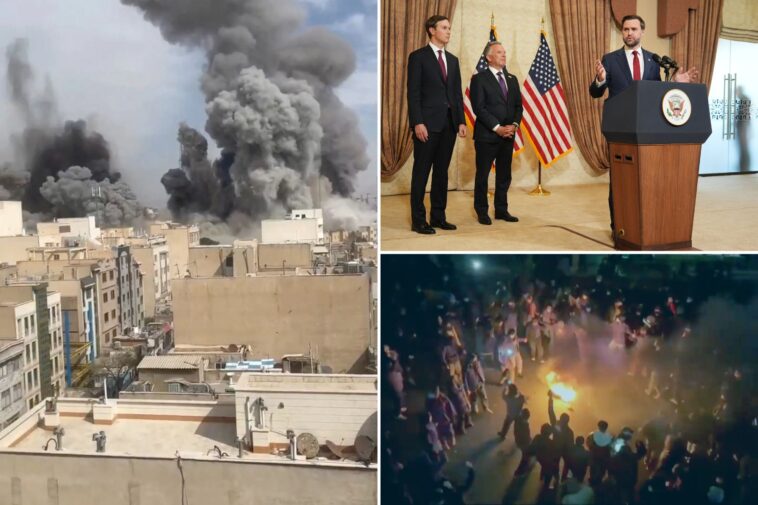
That paved the way for in person high-level talks to resume for the first time since the war started. They took place in Islamabad, Pakistan, on April 11 between Vice President JD Vance, Special Envoys Steve Witkoff and Jared Kushner and Iranian Foreign Minister Abbas Araghchi.
No progress was made and Trump announced a US naval blockade of Iranian ports on April 13.
By April 30, Khamenei rejected Trump’s peace terms via a statement read on state media and vowed to keep Iran’s missile and nuclear program intact.

On May 18, Tehran submitted a revised 14-point peace plan to Pakistani mediators, after Trump said, “the clock is ticking, and they better get moving fast, or there won’t be anything left of them.”
On May 20, Trump said negotiations were in the final stages, and on May 23, a Pakistani official helping the negotiations said an agreement was being “fine-tuned.”
A few hours later, the president said a deal to end the war was said to be “largely negotiated” after a frenzied day of negotiations.