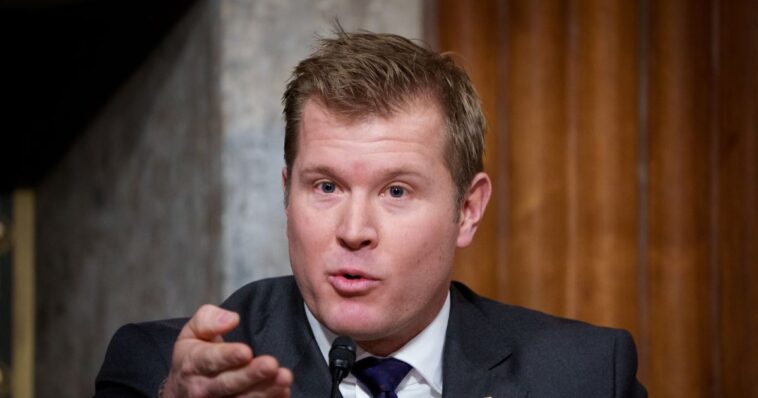
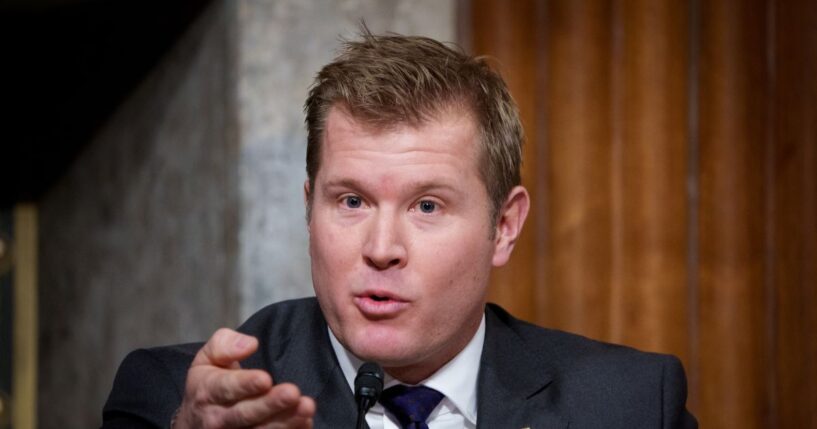
Sen. Tim Sheehy questions President Donald Trump’s nominee for Secretary of Defense Pete Hegseth during a Senate Armed Services confirmation hearing on Capitol Hill on Jan. 14, 2025, in Washington, D.C. (Andrew Harnik / Getty Images)

By Bryan Chai May 31, 2026 at 6:00am
In the seminal 2002 horror film “28 Days Later,” an apocalyptic zombie plague devastates the world — and it all began with a batch of sickly monkeys in a lab.
While zombies (likely) aren’t real, that hasn’t stopped at least one lawmaker from sounding the alarm about what just happened in sleepy Montana.
According to Politico, “a renowned federal research lab” in Big Sky Country saw a situation where an infected lab monkey bit an employee.
The incident occurred in November at a National Institutes of Health facility, and the culprit was a monkey infected with Crimean-Congo hemorrhagic fever.
Thankfully, the worker was promptly treated for the bite, and never picked up the lethal tick-borne illness. The employee was soon able to return to work.
While the story may have ultimately had a happy ending, the circumstances surrounding it require much deeper investigation, according to Montana Republican Sen. Tim Sheehy:
We don’t want Montana to be the next Wuhan. Montanans and Americans deserve answers over concerning reports out of Rocky Mountain Laboratories.
Read my letter to the HHS Inspector General ⬇️ https://t.co/nWebJE3k02
— Tim Sheehy (@TimSheehyMT) May 26, 2026
Sharing a post from Trump ally Laura Loomer, Sheehy revealed that he had sent a letter to the Department of Health and Human Services about the matter.
He included a straightforward — if not ominous — caption: “We don’t want Montana to be the next Wuhan. Montanans and Americans deserve answers over concerning reports out of Rocky Mountain Laboratories.”
Sheehy further elaborated on his concerns in the letter.
“Rocky Mountain Laboratories (RML) is a federal National Institutes of Health (NIH) research facility in Hamilton, Montana, that conducts studies on some of the world’s most dangerous infectious diseases,” Sheehy wrote. “The seriousness of the work conducted at RML means that even small lapses can carry real risks for the staff and surrounding community.”
Indeed, warnings about “real risks” carry quite a bit of weight, especially given that, per Loomer, the RML facility had been doing work with the Ebola virus.
Given the seriousness of Ebola, Sheehy’s letter to HHS included a four-pronged request.
First, Sheehy wanted a thorough investigation into the basics, including what happened, what pathogens are being used, and biosafety regulations.
Second, Sheehy also wanted a thorough analysis of RML’s safety procedures, and how they can be improved.
Third, Sheehy wanted HHS to dig deeper into RML’s “personnel management practices, including background checks, oversight, and clearance processes for staff.”
Finally, Sheehy wanted a further debrief on NIH’s protocols for employees who are under investigation for whatever reason, including what sort of facility access they have.
(One of the figures at the center of this controversy appears to be Dr. Vincent Munster, who allegedly brought unmarked vials back from a study trip to Africa.)
Sheehy, for his part, appears to already have quite a bit of support in this endeavor.
Iowa Republican Sen. Joni Ernst, for instance, told Politico that this facility had been on her radar for some time now.
“I have been asking about this NIH lab and the research that happens there for years and years,” Ernst said. “We can never allow another Wuhan to occur, especially within our own borders.”
Advertise with The Western Journal and reach millions of highly engaged readers, while supporting our work. Advertise Today.
Bryan Chai has written news and sports for The Western Journal for more than five years and has produced more than 1,300 stories. He specializes in the NBA and NFL as well as politics.
Bryan Chai has written news and sports for The Western Journal for more than five years and has produced more than 1,300 stories. He specializes in the NBA and NFL as well as politics. He graduated with a BA in Creative Writing from the University of Arizona. He is an avid fan of sports, video games, politics and debate.
Birthplace
Hawaii
Education
Class of 2010 University of Arizona. BEAR DOWN.
Location
Phoenix, Arizona
Languages Spoken
English, Korean
Topics of Expertise
Sports, Entertainment, Science/Tech