

On May 30, U.S. Africa Command and the Nigerian Air Force conducted a precision strike on Arege in Kukawa Local Government Area of Borno State, after U.S. AFRICOM satellite imagery and signals intelligence fused with Nigerian reconnaissance confirmed 21 armed terrorists assembled in a concealed staging area along a major Islamic State West Africa Province (ISWAP) logistics corridor linking Nigeria, Niger, and Chad.
Three of those killed were mid-level commanders believed to have coordinated attacks in Monguno, Damasak, and surrounding communities in northern Borno State. The strike was the fifth U.S.-Nigerian joint operation against Islamic State-affiliated militants since Christmas 2025 and reflects a campaign that has accelerated sharply since mid-May.
That campaign began on December 25, 2025, when Trump announced via social media that U.S. forces had struck ISIS targets in northwest Nigeria at his direct order. “Tonight, at my direction as Commander in Chief, the United States launched a powerful and deadly strike against ISIS Terrorist Scum in Northwest Nigeria, who have been targeting and viciously killing, primarily, innocent Christians,” Trump wrote.
“I have previously warned these Terrorists that if they did not stop the slaughtering of Christians, there would be hell to pay.” The strikes involved Tomahawk missiles executed jointly by the U.S. Navy, U.S. Air Force, and Nigerian Armed Forces, targeting the Islamic State Sahel Province, the Lakurawa group, and affiliated bandits in Sokoto State, with reported casualties ranging from 155 to 200+ militants killed and 200 additional militants listed as missing. The United States subsequently deployed 200 troops to Nigeria to train its armed forces in coordinating airstrikes and ground operations.
The May 2026 campaign corrected that focus. On May 16, U.S. and Nigerian forces launched a joint operation against ISWAP and Boko Haram in northeastern Nigeria, combining special forces raids with multiple rounds of airstrikes, killing ISWAP senior leader Abu-Bilal al-Minuki alongside several other senior commanders. Al-Minuki, described as the second-in-command of IS, was struck at his compound in the Lake Chad Basin. Before pledging allegiance to IS in 2015, he had been a prominent Boko Haram leader, and the Nigerian army said he oversaw key IS operations across the Sahel and West Africa.
Follow-up strikes on May 17 targeted a convergence of militants in the Metele area of Borno State, killing more than 20 ISWAP fighters with no U.S. or Nigerian casualties. A third round on May 18 brought the cumulative toll to approximately 175 ISWAP and Boko Haram militants killed, with Nigeria’s Defense Headquarters describing the operations as a “devastating blow” to terrorist networks.
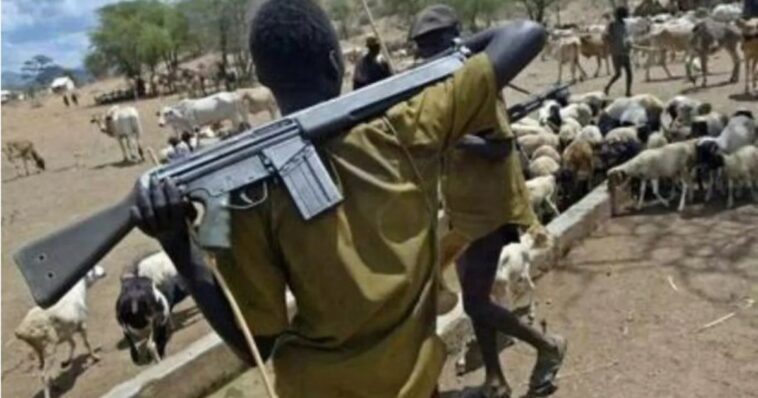
All five strikes have targeted Islamic State-affiliated groups, ISWAP, Boko Haram, and Lakurawa. None has addressed a separate and, by the U.S. government’s own measure, deadlier threat: Fulani militant violence against Christians in Nigeria’s Middle Belt.
In May 2026, the U.S. Commission on International Religious Freedom (USCIRF) released its most detailed treatment of that threat to date, a dedicated report titled Nonstate Violators of Religious Freedom in Nigeria: Fulani Militants. The report examines armed actors from a Fulani ethnic background who have “perpetrated some of the most notorious, visible, and deadly attacks on religious communities in Nigeria, often but not exclusively against Christians,” and maintains USCIRF’s recommendation for Nigeria’s ongoing designation as a Country of Particular Concern.
The report estimates approximately 30,000 Fulani militants operating across Nigeria in clusters ranging from 10 to 1,000 members, with attacks intensifying across the Middle Belt and increasingly into southern Nigeria.
The report’s most significant finding is a direct comparison of lethality: “Violence by Fulani militants caused the highest number of deaths among all religious communities in Nigeria over the last year as compared to attacks by organized insurgent groups and criminal gangs.”
According to the Open Doors 2026 World Watch List, of the 4,849 Christians killed worldwide for their faith during the reporting period, 3,490 were Nigerian, making Nigeria the deadliest country for Christians globally.
The USCIRF report documents specific atrocities. Fulani militant attacks have forced at least 1.3 million people in the Middle Belt off their land and into “overcrowded, unsanitary, and unsafe conditions in displacement camps,” with attacks carried out at night “eliciting terror as a way to force victims to quickly leave and to achieve greater control of desired land.”
A June 2025 attack in Benue State killed at least 200 people, including internally displaced persons living at a Catholic mission. The Yelwata massacre in Benue State killed more than 200 Christians, described as “mostly sleeping women and children,” displacing over 3,000 residents. On Easter Sunday 2026, Fulani militants killed five worshippers at two churches in Kaduna State while abducting 31 others.
USCIRF acknowledged conflicting interpretations of what drives the violence, noting that “some observers have argued that environmental and economic factors are the driving force behind Fulani militants’ acts of violence, while others have suggested that these actors are engaged in a concerted campaign of outright genocide against non-Muslims, especially Christians,” and concluded that “multiple and overlapping factors, including religion in many cases, likely spur Fulani militants to attack communities.”
Open Doors documented field accounts of Fulani attackers telling victims “We will destroy all Christians” and Boko Haram captors telling kidnapped Christians “If you were Muslim, you would not be tortured like this.”
There are signs that Washington has begun to recognize the Fulani threat at the policy level. When Trump redesignated Nigeria as a CPC in October 2025, Secretary of State Marco Rubio specifically cited the actions of “Fulani ethnic militias,” a departure from prior U.S. framing focused almost exclusively on Boko Haram and ISWAP. Congress named the Fulani explicitly in H.Res.860, commending Trump for holding Nigeria accountable for persecution by “radical Islamists, such as Boko Haram and Fulani terrorists,” and calling on the State Department and Treasury to impose targeted sanctions including visa bans and asset freezes under the Global Magnitsky framework.
A House Appropriations delegation that visited Nigeria concluded that “Fulani militants are seizing farmland,” that the Nigerian government had “failed to confront both the scale and the intent of these atrocities,” and that “the most meaningful changes in years have come from President Trump’s CPC announcement.”
Although the Trump administration recognizes the Fulani as a primary threat to Christians in Nigeria, it has not utilized Global Magnitsky sanctions related to religious-freedom violations in its second term, meaning no Fulani militant commanders or financiers have been sanctioned. No U.S. military strikes have targeted Fulani armed groups.
This is likely because the Fulani threat operates within a different legal framework from ISWAP, and Fulani militant groups have not been officially designated as terrorist organizations. Previous policy inaction may also stem from prioritization, whereby ISWAP and Boko Haram pose a transnational threat to U.S. policy objectives not only in Africa but also in the Middle East and, potentially, beyond, whereas the Fulani problem is more localized and largely limited to Nigeria.
Whether the May USCIRF report signals a shift in policy and more aggressive interventions against the Fulani going forward remains to be seen.
Ad block users: Some site features may not work correctly while an ad blocker is enabled, because they break scripts and content this website depends on. If you can’t see comments below, for example, please disable your ad blocker.