President Trump said Tuesday the US ‘must respond’ after Iran shot down an Apache attack helicopter in the Strait of Hormuz Monday evening, leaving a two-month-old cease-fire hanging by a thread after Trump claimed a deal was just “two or three days away.”
“I have just been informed by our Great Military that last night the Iranians shot down one of our highly sophisticated Apache Helicopters while patrolling over the Strait of Hormuz,” the president wrote on Truth Social.


“There were two pilots involved, both are safe and uninjured. Nevertheless, the United States must, of necessity, respond to this attack,” he added.
Iran’s parliamentary speaker, Mohammad Bagher Ghalibaf, warned Trump that the Islamic Republic would respond in kind to whatever approach the US takes next.
“We prefer the language of diplomacy, but we speak other languages far more fluently. Break your commitments, and we’ll switch to what we speak best,” Ghalibaf said in a statement.
“You ride the horse you saddled!”
The shootdown took place one day after Iran and Israel exchanged volleys of missiles and just before the president insisted a long-term peace deal remained close. Hours before the helicopter incident, a US F/A 18 Super Hornet jet also “disabled” an oil tanker in the Gulf of Oman that attempted to run the Navy’s blockade of Iranian ports.

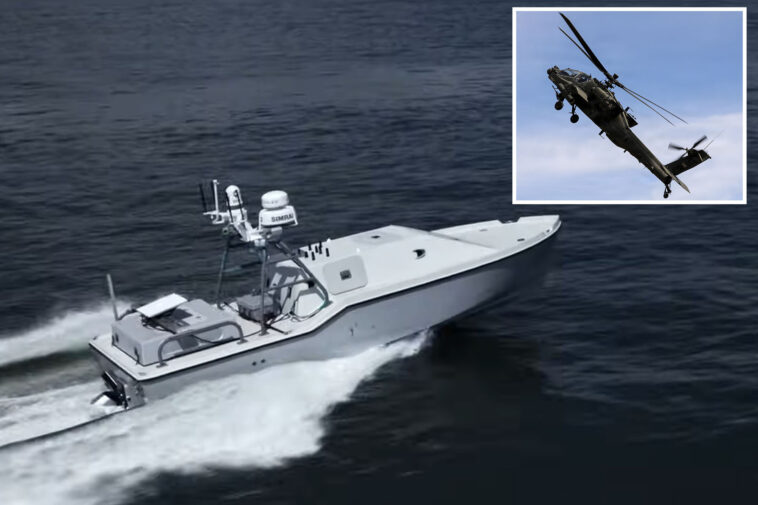
The helicopter went down with its two-person crew at around 7:30 p.m. ET Monday while on patrol near the coast of Oman. The pilots spent up to two hours in the water before they were rescued by an unmanned drone boat, according to US Central Command.
The operation marked the first time a high-tech US Navy drone deployed to the Middle East was used to conduct a rescue mission.
Trump’s Tuesday announcement comes as CENTCOM commander Adm. Brad Cooper is in Washington to brief lawmakers on “military operational priorities in the Middle East,” according to the combatant command.
AH-64 Apache helicopters, which cost more than $35 million apiece, have been operating around the Gulf of Oman and Strait of Hormuz to enforce the US blockade.

The helicopters have also been used by the United Arab Emirates to shoot down Iranian drones during the height of the war with Iran.
Tehran has maintained that the US cannot enforce its embargo, with additional skirmishes erupting in recent weeks.
CENTCOM has disabled seven ships since the blockade went into effect on April 13.
Despite the high tensions and close combat, Trump said he remained optimistic about the chances for a peace deal with Iran to end the war.

“We’re very close to having a very, very good, strong, powerful deal. If we go and bomb, which we can do very easily if we want, and we spend another two or three weeks bombing, they’ll have nothing left whatsoever,” Trump told reporters on early Tuesday at JFK Airport.
“But you won’t have the strait open for months,” he added. “If we do the bombing, a lot of people are going to be killed. Who wants to do that? I don’t.”
Trump’s optimism that a deal would manifest shortly came after Iran’s joint military command said Monday it was halting its latest offensive against Israel following tit-for-tat attacks caused by the Jewish state’s campaign in Lebanon against Hezbollah over the weekend.

“They were going back and forth [with strikes], and now they both agreed, through me, to stop, and now we’re in the final throes of what will be a very, very good deal,” Trump claimed early Tuesday, adding that any agreement “will not allow [Iran] in any way, shape, or form nuclear weapons … And the strait [of Hormuz] will open up, they’ll open up immediately upon signing.”
With Post wires