
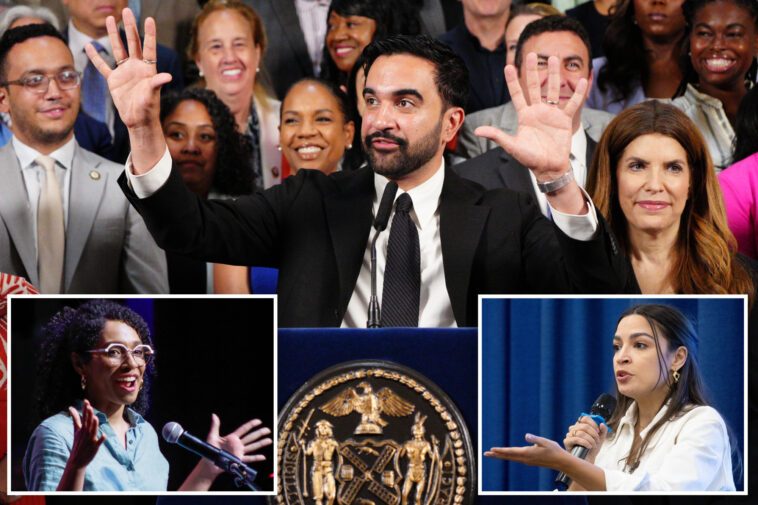

WASHINGTON — Nearly one-third of Democrats say they want to see democratic socialists in office, according to a new poll released as far-left candidates rack up victories in New York City and Colorado.
A firm 32% of Democrats indicated they like democratic socialist pols, compared to just 11% who don’t and 56% who have no strong opinions on them, according to a survey from Pew Research.
Predictably, among self-described liberal Democrats, 52% like politicians who identify as democratic socialists, while 4% dislike them and 43% don’t have an opinion.

Moderate and conservative Democrats were more split, with 17% inclined to dislike socialists, compared to 15% who liked them, and 66% with no opinion.
Democratic socialists had the highest support from white, younger, upper-income, and college-educated party members — despite their claim of standing against the elites of society and for the working class.
White Democratic support for the socialist wing (40%) is nearly double that of black (21%) and Hispanic Democrats (20%).
Four in 10 upper-income Democrats also say they like democratic socialists, compared to 34% of middle-income Dems and 24% of low-income Dems.
The left flank of the party has racked up a series of victories in Democratic primaries over recent weeks, largely in safe blue districts.

More than three dozen Democratic Socialists of America (DSA)-backed candidates have won their primaries so far this year, including a trio of New Yorkers endorsed by Mayor Zohran Mamdani and Melat Kiros — who defeated 15-term incumbent Rep. Diana DeGette in Colorado Tuesday.
Still, data from Pew Research indicates that the broader American public is skeptical of the DSA.
Overall, 38% of Americans dislike self-described democratic socialist politicians, compared to 15% who like them, while 43% are indifferent, per the poll.
The highest disapproval rate came from Republicans (69%), though 3% of GOPers claimed to like democratic socialists and 27% were indifferent.

Pew Research sampled 8,512 Americans Jan. 20-26.
The survey had a margin of error of plus or minus 1.4 percentage points.