
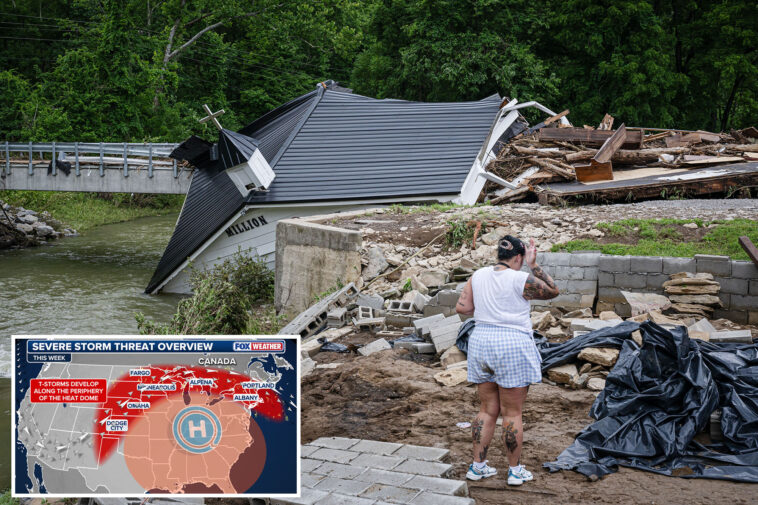

A volatile midsummer weather pattern is taking shape across the central and northern United States as an expanding, high-amplitude heat dome brings dangerous, life-threatening temperatures while colliding with cooler northern air currents.
This “Ring of Fire” setup will trigger multiple days of severe storms, spanning a vast corridor from the Central Plains through the Great Lakes and into the Northeast.
The threats kicked off Tuesday as severe weather rocked portions of Upstate New York and New England, knocking down numerous trees and power lines.
Through Friday, the daily threat of severe storms will continue to loom across the region, with extreme temperatures acting as the catalyst.
Strong southerly winds are pumping intense heat and deep tropical moisture northward. When this highly unstable airmass interacts with mid-level atmospheric disturbances riding the edge of the heat dome, it creates an ideal environment for explosive thunderstorm development.


These setups are notorious for producing ridge rider storms—fast-moving, long-lived Mesoscale Convective Systems (MCS) which can efficiently generate widespread, damaging straight-line winds.
Along with the destructive winds, these severe storms will be capable of producing large hail, with a few isolated tornadoes possible. Additionally, repeated rounds of rain over the same areas could lead to localized flash flooding.
Following Tuesday’s storms, Wednesday’s severe weather risks increase to a Level 3 out of 5 threat for the Upper Midwest and Great Lakes, encompassing Minneapolis, Green Bay, and surrounding areas, as storms are expected to re-fire later in the afternoon fueled by daytime heating.

The primary threat of these storms will be destructive winds as fast-moving storm complexes race around the heat dome.
According to the FOX Forecast Center, wind gusts exceeding 85 mph are possible from Minnesota across the Great Lakes and into northern Michigan.
Given the substantial atmospheric wind shear, a few isolated storms could also produce tornadoes across southern Minnesota into central Wisconsin by late Wednesday afternoon.


In the Northeast, severe storms will once again slide out of Canada, riding the eastern periphery of the ridge.
Wednesday brings a renewed threat of damaging wind gusts to those same areas hit on Tuesday. Some of these storms are expected to reach portions of the I-95 corridor, sustained by high levels of deep moisture and atmospheric instability.
Heading into Thursday, severe storms will once again fire up in the Upper Midwest and track southeastward into the same regions impacted earlier in the week, with damaging wind gusts remaining the primary hazard.

Beyond the immediate threats of wind and hail, localized flash flooding is a distinct danger, the FOX Forecast Center said. Because these storm complexes frequently “train”—moving repeatedly over the exact same geographic tracks like train cars—pockets of excessive rainfall are expected along their paths, particularly where storm boundaries stall.
As a result, a Level 1 out of 4 flash flood risk is in effect through Saturday across the Plains and Upper Midwest.
A widespread 2 to 3 inches of rain is anticipated from southern Minnesota through Wisconsin, with localized amounts possibly exceeding 3 inches.