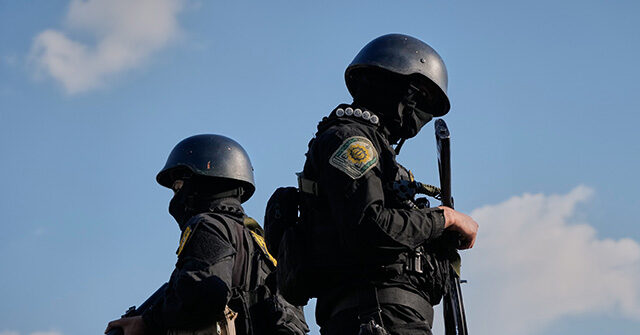
Iranian state media reported on Tuesday that two members of the Islamic Revolutionary Guard Corps (IRGC), a designated terrorist organization, were killed in a “terrorist and cowardly act” by “anti-government and separatist agents.” Two other people were injured in the attack.
The Times of Israel (TOI) suspected this was an oblique reference to Kurdish separatist groups, as the scene of the crime was the city of Paveh, close to the border of the Iraqi Kurdistan region.
A later report from another state media outlet, the IRGC’s media network Sepah News, claimed a team of saboteurs working for separatist groups entered Iran through its northwestern border – the border with Iraqi Kurdistan – and were intercepted and killed by IRGC troops. The report included blurry photos of the four people who were killed.
Tuesday’s incident was the latest in a string of attacks on Iranian security personnel, mostly in the Kurdish-heavy western region of the country. Four Iranian operatives were killed in two different armed attacks on Tuesday, in addition to the Paveh murders, while in the city of Baneh a gunman killed two police officers at a security checkpoint.
Tuesday brought a claim of responsibility for the killings in Paveh by a new Kurdish militant group called Xore Heva, or “Sun of Hope.” The group said its goal is to “promote political awareness, strengthen Kurdish national identity, and confront the policies of the Islamic Republic of Iran.”
Xore Heva said the attack was an act of retaliation for the Iranian government murdering protesters during the “Women, Life, Freedom” uprising of 2022. The uprising began after Iran’s notorious “morality police” abducted a young Kurdish woman named Mahsa Amini, allegedly because she was not wearing her mandatory Islamic headscarf properly. Amini died while in the custody of the morality police.
Another militant group called the East Kurdistan Defense Units (YRK) vowed revenge on Tuesday for the death of four fighters during clashes with the IRGC in the Iranian province of West Azerbaijan.
The YRK said its fighters “resisted until the very last drop of their blood and were heroically martyred.” The group insisted it did not start the fight.
“We have not taken the side of any power, nor have we launched any attacks against the Iranian regime,” the YRK said, alluding to rumors that the United States or another foreign power was helping the Kurds to fight the IRGC and organize an uprising.
The Hengaw Organization for Human Rights, a Norway-based group focused on Kurdish humanitarian issues, said Iran has launched at least 50 missile and drone attacks against the headquarters and homes of Kurdish opposition parties since the U.S.-Iran peace deal was struck on June 17. Most of the targets were located in Iraqi Kurdistan, not Iran.
“According to Hengaw’s legal assessment, the attacks have specifically targeted densely populated camps and residential areas housing the families of Peshmerga members. At least three female Peshmerga fighters and one 17-year-old civilian have been killed, while at least 20 others have sustained serious injuries,” Hengaw said.
On Monday night, Iranian state television reported a man and his daughter were killed in the southeastern province of Sistan and Baluchistan by “Zionist-American mercenaries.” Hengaw said the victims were actually an IRGC member named Amirhossein Arbabi and his wife, slain as they were leaving IRGC headquarters in the city of Saravan.
Also on Monday, an IRGC Navy political officer named Mohammad Akbarzadeh died in a car accident in the southeastern province of Kerman. Iranian state media said the incident is under investigation, and is not presently being treated as an assassination.
Akbarzadeh was a spokesman for the IRGC Navy who frequently issued statements about Iranian control of the Strait of Hormuz. He has been under European Union sanctions since June 8 for supporting Iran’s efforts to restrict freedom of navigation in the strait.