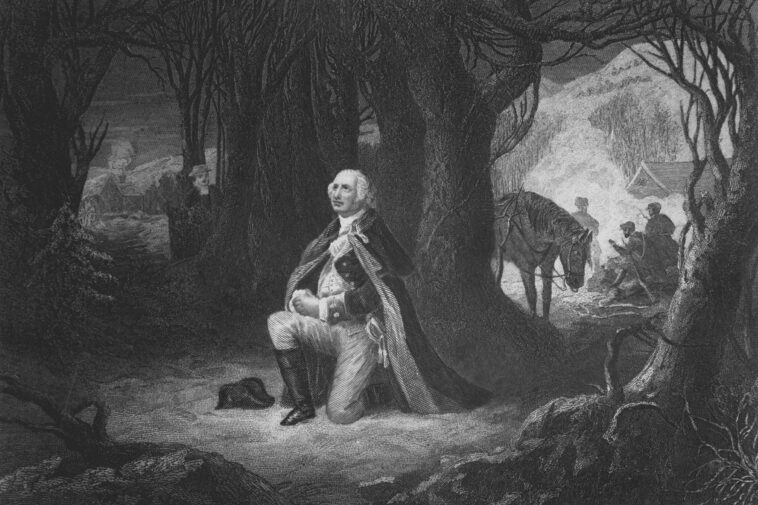
It is the quintessential imagery of a desperate man, drained of all earthly strength and power, who’s come to the end of his own knowledge and wisdom. He takes a knee in humbleness to God.
This is the portrait of then-General George Washington at Valley Forge, praying for guidance when the fight for America’s independence seemed lost.
The iconic painting, “Prayer at Valley Forge,” was created 50 years ago by artist Arnold Friberg in honor of America’s bicentennial. Now, it’s the centerpiece of the Museum of the Bible’s exhibit celebrating the nation’s 250th anniversary.
Carlos Campo, Ph.D., CEO of the Museum of the Bible, says, “Washington is most powerful on his knees. That’s what he knows, because he is bowing to a greater power who can infuse him with true leadership.”
The image is a snapshot of “a man carrying a burden that feels too heavy to bear — and the quiet place he goes when everything is on the line.” It takes place during the brutal winter of 1777-1778.

America’s founders had already declared a break from Great Britain’s rule on July 4, 1776.
Now, the “fragile army” of colonists needs to fight to secure it. Washington is their leader. But America at this juncture is more a dream than solid reality.
Washington’s soldiers are freezing in the harsh snow and cold. Many of them are without shoes or warm clothing.

The painting and the DC-based museum show how fidelity to God and belief in the omniscient power of an Almighty God are real powers that helped create the United States of America. They are not lofty philosophies written in founding documents, but living realities tested on a literal battlefield.
As America celebrates its 250th year, much of Washington, DC, is turning red, white and blue to exalt this nation’s strength through its noble founding documents, the Declaration of Independence, the Constitution, the Bill of Rights — all now taking center stage. Yet the greater influence, Campo believes, on America’s self-governing sense of law, justice and mercy is found at the Museum of the Bible, where the famous portrait of General Washington in prayer headlines the museum’s exhibit.
Campo told Fox News, “While other influences aided in the founding principles of our nation, nothing — and there’s not even a close second — had the influence as the power of scripture.”

Even so, Dr. Ben Carson wants us to know there was something in the man himself that was divinely ordained. He quips that it’s a story about a young Washington that public schools tend to leave out of their history lessons.
Carson, the former US secretary of Housing and Urban Development and, before that, a highly accomplished pediatric surgeon, is making sure younger generations hear the story through his Little Patriots Learning. In July 1755, a 23-year-old Washington escaped a harrowing death at the Battle of the Monongahela.
He was shot at by an expert marksman and survived. In a letter to his younger brother John, the future first president wrote, “By the all-powerful dispensations of Providence, I have been protected beyond all human probability and expectation; for I had four bullets through my coat, and two horses shot under me, yet escaped unhurt, although death was leveling my companions on every side.”

Carson says, “He realized that God had saved him for a reason. And years later, he was in the same area… before he became president… and one of the Indian chiefs who had been involved in the war heard about it and asked [to be brought] to where Washington was. When he reached Washington, he said, ‘Sir, I just needed to meet you because I’m an expert marksman and I shot you 17 times and my men shot you, and pretty soon I told them to stop wasting their bullets, because this is a man who’s protected by the great spirit above. And I just wanted to see you before I died, knowing that you would become the father of a great nation.’”
Added Carson, “That used to be in all of our history books.”
Here’s the latest on America’s 250th Anniversary:
- George Washington’s prayer for America still resonates 250 years later
- Where to play and party like it’s 1776 this weekend
- Trump Accounts launch July 4, giving newborns $1,000. Here’s what to know
- Mamdani to deliver America’s 250th speech hours ahead of Trump
- Dunkin’s America 250 eagle cup sparks frenzy as fans race to snag one
There were no videos or phone cameras back then, of course — just historical accounts. Putting the future in the hands of a man who believes wholeheartedly in the power of prayer seems a bit risky. But Washington and America’s subsequent thriving should be proof enough.
The museum, though, has made the portrait of “Prayer at Valley Forge” come alive with a one-man show in its theater.
Actor James Denton portrays the general, not as an alabaster statue whose portrait graces the $1 bill, nor the proud picture of confidence as the president of the United States, but as the man “at his most vulnerable” facing what all men and women face at some point in life: a crisis. Except that this crisis would affect not just him, but chart the course of history.

So Washington did what he knew was demanded by Scripture: to “pray without ceasing.” And to know these words of Scripture: “If my people, who are called by my name would humble themselves … I will come and heal their land.”
The die was cast. Decades later, Abraham Lincoln would take up the mantel of prayer. He faced another crisis, a civil war. While Washington’s prayer came to help birth our nation, Lincoln’s prayer was to sustain it, to keep it together.
He famously said, “I have been driven many times upon my knees by the overwhelming conviction that I had nowhere else to go. My own wisdom and that of all about me seemed insufficient for that day.”

If America were to survive and become something of a global beacon on a hill, for the good of the world, it had to survive its own internal conflicts. It must live in truth “e pluribus unum” — out of many, one.
Today, we sometimes take prayer for granted, even mock its worth. Thoughts and prayers get downgraded to mere words with no action. But prayer has power.
That is why the churches call men and women who take to their knees as prayer warriors.
Says Campo, “Washington may not have been the most orthodox believer, [but] he certainly understood the sovereign power of God and that, in that moment, it was the thing he had to call upon for the true power that he needed.”
This Fourth of July, as we celebrate America’s 250th, we should also realize that power is still available to us.