
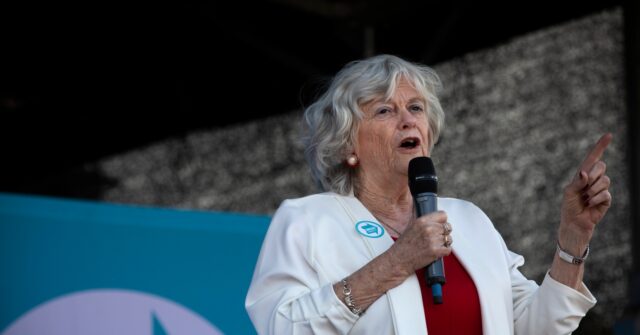
The suspect in the alleged murder of Brexit warrior and former government minister Ann Widdecombe reportedly had far-left literature in his home, as police have been forced to belatedly admit that there may have been a political motive in last week’s killing.
UPDATE 1640: Police say “targeted attack”
We’re getting a little more detail from police now from a statement given on the steps of Scotland Yard, with Counter Terrorism Police saying of the killing of Brexiteer Ann Widdecombe: “It is clear this was a targeted attack. We are still working to understand the extent of any planning or preparation, and the motivation that sits behind that attack.”
The police spokesman added that the force had been granted authorisation for extra questioning time for their suspect, and again chided the public for speculating over the case, something the government’s own counter-terrorism expert had previously criticised as “patronising”. The officer said: “I do not intend to address every bit of speculation we have seen but I would like to use this opportunity to remind the public that investigations of this type are complex and new information can emerge as officers progress their enquiries… think before sharing any unverified information”.
The original story continues below
Searches of the so-far publicly unidentified 28-year-old “white” male suspect reportedly revealed that he owned “Russian communist literature” and “items of political ideology” in his home.
According to a report from the Daily Mail, the discovery was followed by counter terror police taking over the investigation into the alleged murder of Widdecombe, a strident conservative who, unlike many on the so-called British right-wing, publicly opposed abortion, gay marriage, mass migration, and who stood as one of the nation’s leading Brexiteers and political allies of Reform UK leader Nigel Farage.
The admission of a political motive behind the killing came after the local Devon and Cornwall Police were quick to attempt to downplay the possibility that it was either a terrorism-related incident or was politically motivated.
Assistant Chief Constable Matt Longman went on to urge the public to refrain from “speculation” over the motive behind the killing, describing it as “unhelpful” to the investigation and claimed that it was “distressing to the family and friends of Ms Widdecombe.”
This followed public comments from Nigel Farage, who said that he believed the killing to have been a “premeditated murder” and lamented that for “people now in public life, especially in politics, the world is very much more dangerous than it’s ever been, whatever the outcome of the motives of the killer”.
The Reform UK leader, who laid a wreath for Widdecombe over the weekend, has faced widespread media criticism in recent weeks over a £5 million gift he received from billionaire Christopher Harborne to pay for the Brexit champion’s personal protection detail, which he has claimed is necessary due to the public attacks from leftists he has suffered and the frequent death threats made against him.
The police response has come under heavy criticism, with many claiming that it appears the messaging surrounding the investigation was intended to manipulate public opinion rather than relay the truth.
The government’s independent terrorism watchdog, Jonathan Hall KC, said that the police “probably broke one of the golden rules of investigations, which is not to comment on live investigations in case new facts emerge.”
“I don’t understand why Devon and Cornwall Police were steering the public away from the idea that this was a terrorist case and I don’t know why they didn’t simply say they had an open mind as to the motivation,” he said.
Similar sentiments were shared by Reform UK board member Gawain Towler, who said of the police response: “In the past, they’d have said all avenues of investigation are open, but this time they tried to close out avenues of the investigation. In a time when trust in the police is at an all-time low, this just plays into that they are trying to massage public opinion.”
Meanwhile, the legacy media has also come under heavy criticism, including the Times of London, which ran an article quoting former Tory MP Harvey Proctor, accusing Mr Farage of using the death of his longtime friend for “propaganda” purposes. Reform UK deputy leader Richard Tice has called for an apology for their “appalling” headline.
Commentator for the Mail on Sunday, Dan Hodges, has also faced pushback for his assertion that Farage and Reform were attempting to use the death of their party spokeswoman to deflect attention from the supposed scandal involving gifts given to Farage before he became an MP.
Hodges, a former communications adviser for the hard-left cancel culture group Hope Not Hate, has previously admitted to using “dirty, underhand, low down, unscrupulous” methods to undermine political opponents.