
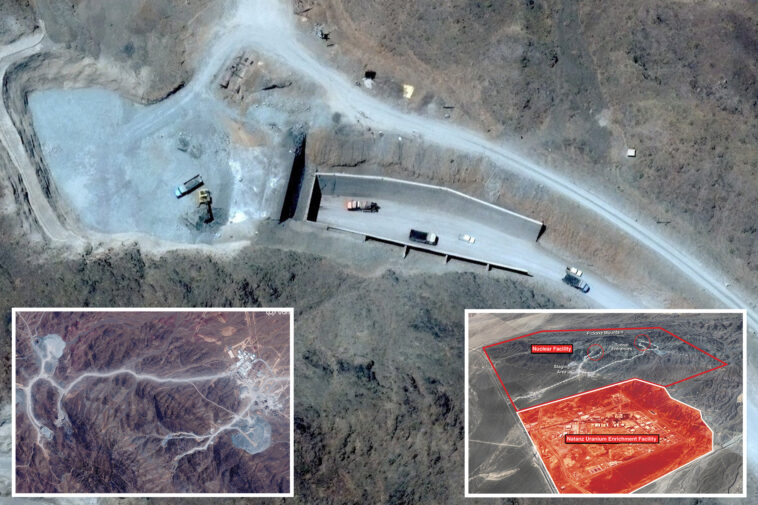

Israeli intelligence officials believe Iran moved thousands of centrifuges used to enrich uranium deep inside the so-called “Pickaxe Mountain” site this past fall, raising fears that the Islamic Republic can quickly reconstitute its nuclear program.
The intelligence has been passed to the US, the Wall Street Journal reported Tuesday, though it is unclear what, if any, action will come from it.


In an interview with conservative radio host Hugh Hewitt last week, President Trump called Pickaxe Mountain “a possible target for a nice, big, fat shot right in the front door. And I think that you’ll — maybe you’ll see that.”


The deeply buried installation is just minutes from the Natanz nuclear facility, one of three hit by US airstrikes in June 2025. The Wall Street Journal, citing experts, reported that the complex is between 300 and 450 feet beneath solid rock, with enough room to accommodate several nuclear-related facilities.
David Albright, president of the Washington, DC-based Institute for Science and International Security, told the Journal the Israeli assessment was “plausible” — noting that nonstop activity has continued around Pickaxe Mountain for 15 months.
International Atomic Energy Agency (IAEA) Director Rafael Grossi said in March that Tehran had announced its “intention to have nuclear activity” at Pickaxe Mountain in 2021, but has provided no details since.
Iran is believed to have produced close to 1,000 pounds of 60% enriched material, near weapons-grade levels.
“A covert breakout is the worst-case scenario,” said Nate Swanson, a former National Security Council director for Iran during the Biden administration, using the term for when Iran achieves nuclear weapons capability.
“We don’t know what Iran’s intentions are, but the fact that we can’t verify this site underscores how problematic the status quo is,” Swanson added. “We have to have the IAEA in there to inspect these things.”
The WSJ report emerged as the US carried out a 10th consecutive day of airstrikes on Iran, with Central Command (CENTCOM) saying Tehran’s “military command centers, maritime capabilities, missile and drone launch sites, and air defense systems” were targeted to “degrade Iran’s ability to continue attacking commercial vessels flowing through the Strait of Hormuz.”