
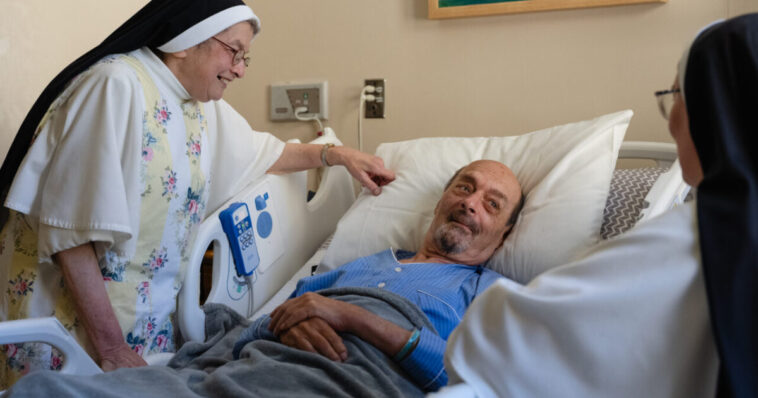

Four orders of Catholic nuns and several Catholic healthcare ministries filed a federal lawsuit against New York on July 17, arguing the state’s new assisted-suicide law forces them to participate in ending patients’ lives in violation of their faith. The case, Carmelite Sisters for the Aged and Infirm v. James, was filed in the U.S. District Court for the Northern District of New York against Attorney General Letitia James. The plaintiffs are represented by the Becket Fund for Religious Liberty.
The 13 plaintiffs include the Carmelite Sisters for the Aged and Infirm, the Dominican Sisters of Hawthorne, the Missionary Sisters of St. Benedict, the Little Sisters of the Poor, the Benedictine Sisters, Bishop John O. Barres, the Diocese of Rockville Centre, and Catholic Health, a network of five Long Island hospitals.
At issue is New York’s Medical Aid in Dying Act, which Governor Kathy Hochul signed into law on February 6. The law takes effect on August 5. It allows a mentally capable adult New York resident with a terminal diagnosis and a prognosis of six months or less to request and self-administer life-ending medication. A doctor may prescribe the drug but may not administer it.
The signed legislation includes a five-day waiting period between prescription and filling, a requirement that the patient’s oral request be recorded by video or audio, a mandatory mental health evaluation, a bar on financially interested parties serving as witnesses, an in-person initial physician evaluation, and an opt-out for religiously oriented home hospice providers. A violation is classified as professional misconduct under the Education Law.
The plaintiffs argue the law’s opt-out does not go far enough. According to the complaint, cited by Becket, a healthcare provider who declines to prescribe the medication could still be required to inform terminally ill patients of their option to obtain it, help them satisfy eligibility requirements, and refer them to a willing provider.
The complaint states that refusal could expose providers to fines, license revocation, or criminal penalties. The plaintiffs argue that this framework conflicts with the First Amendment, federal healthcare conscience protections, and Catholic teaching on the sanctity of life.
That teaching, invoked throughout the complaint, rests on the premise that human life is a gift from God rather than a possession to be disposed of at will. Under this view, a person is the steward of his or her life rather than its owner. The Catechism of the Catholic Church classifies both suicide and euthanasia as violations of the Fifth Commandment, “You shall not kill,” and describes assisted suicide as “morally unacceptable” regardless of a patient’s consent or suffering.
The Church distinguishes between withholding or withdrawing extraordinary medical treatment, which is permitted when treatment is futile or disproportionately burdensome, and directly administering or providing a lethal agent, which is never permitted. The first allows an underlying illness to run its course, while the second actively causes death.
Human dignity, in this framework, is intrinsic and does not diminish with age, illness, or disability. As a result, suffering is to be accompanied through palliative and hospice care rather than ended by ending the patient’s life.
The U.S. Conference of Catholic Bishops’ Ethical and Religious Directives for Catholic Health Care Services extend this prohibition to institutional cooperation. They bar Catholic facilities from actively helping a patient obtain assisted suicide, including through referral, while still permitting a patient to leave the facility or transfer their own records.
The Act’s own text, however, shields providers who decline to participate. Under § 2899-l of the law, a provider “shall not be subject to civil, administrative, or criminal liability or penalty or professional disciplinary action” for refusing to act. This exemption does not extend to negligence, recklessness, or intentional misconduct.
The dispute instead centers on a separate requirement that an opt-out provider transfer the patient to another provider willing to assist. According to the complaint, even that referral violates the Ethical and Religious Directives for Catholic Health Care Services issued by the U.S. Conference of Catholic Bishops. The directives hold that “suicide and euthanasia are never morally acceptable options” and bar a facility from “actively” aiding a patient in reaching another facility for such treatment, while still permitting the patient to leave or transfer records on their own.
Hochul’s signing statement separately confirmed that a violation of the Act is classified as professional misconduct under the Education Law. According to the plaintiffs, that consequence is tied to the transfer and disclosure duties rather than to the refusal to prescribe the medication itself.
Part of the plaintiffs’ argument rests on the Medical Aid in Dying Act’s interaction with New York’s existing Palliative Care Information Act, which already requires physicians and nurse practitioners to inform terminally ill patients of their end-of-life options. Because assisted dying is now one of those recognized options, the complaint contends providers must raise it with patients even absent a request, according to reporting on the filing. That reporting also states the religious exemption is narrower than in most other states that permit assisted dying, and that the Missionary Sisters of St. Benedict facility would receive no exemption because it is not classified as a healthcare facility.
Mark Rienzi, president of Becket and lead attorney for the plaintiffs, said New York is “conscripting the nuns who care for them into its suicide cult on pain of crushing fines and professional ruin,” calling it “unconscionable and unconstitutional.” Mother Mary Rose Heery of the Carmelite Sisters for the Aged and Infirm said the law “strikes at the heart” of their vocation of ensuring no resident dies alone.
Mother Marie Edward of the Dominican Sisters of Hawthorne, whose Rosary Hill Home has cared for roughly 45,000 low-income cancer patients over more than 125 years, said the order’s calling is “to offer comfort, prayer, and loving medical care… not death.” Bishop Barres said the ministries “will never submit to New York’s culture of death.”
Asked for comment, Hochul told Fox News Digital that the administration could not discuss pending litigation but that “participation is entirely voluntary, and religious facilities have the right to opt out if they choose to do so.”
When she signed the bill in February, Hochul described it as a matter of bodily autonomy. She said New Yorkers “deserve the choice to endure less suffering, not by shortening their lives, but by shortening their deaths.”
The Attorney General’s office had not responded to requests for comment as of the initial reporting on the lawsuit, according to the Catholic Courier.
Becket has said the plaintiffs plan to file a motion for a preliminary injunction against the state “in the coming days.” No injunction motion or court ruling had been issued as of this writing.
Ad block users: Some site features may not work correctly while an ad blocker is enabled, because they break scripts and content this website depends on. If you can’t see comments below, for example, please disable your ad blocker.