
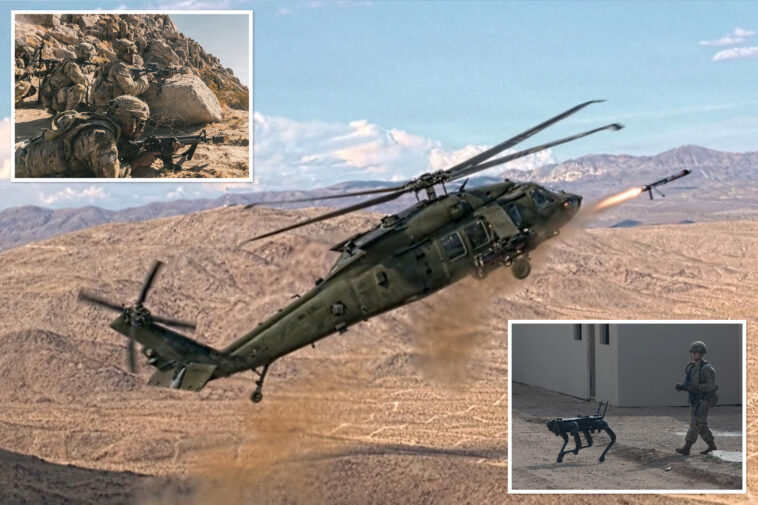
The US Army’s vision of tomorrow’s battlefield was put to the test in California’s scorching desert — where thousands of troops trialed futuristic weapons and artificial intelligence systems that military leaders believe could transform the way wars are fought.
The latest Project Convergence Capstone 6 exercise took place at Fort Irwin in the High Mojave Desert, where soldiers spent nine days at the end of July testing more than 90 technologies in one of the military’s largest experimentation events to date.
While leaders hailed the exercise as a success, some troops struggled with connectivity problems and overheating equipment in the blazing sun, according to Axios.


The centerpiece was the Army’s new Next-Generation Command and Control (NGC2) system, which is designed to connect troops, sensors, drones and weapons across the battlefield so commanders can make decisions faster while constantly on the move.
Unlike traditional command posts, the system uses AI and a network of battlefield sensors, reconnaissance drones and communications equipment to instantly gather information about friendly and enemy positions.
That information is shared in real time, allowing commanders to identify threats, coordinate long-range strikes and direct whichever unit is best positioned to respond.


Among the technologies tested were autonomous robots working alongside soldiers on foot, specialty reconnaissance drones known as “launched effects” that locate targets for long-range fires, advanced battlefield sensors, contested logistics systems and communications networks built to link forces operating on land, at sea, in the air, in space and in cyberspace.
Military leaders say the technology is intended to let dispersed units continue fighting while moving, instead of relying on fixed headquarters, making them harder to target while dramatically speeding up battlefield decision-making.
“What really worked was the common visualization: our ability to see where the soldiers were on the battlefield, where we perceived the enemy to be on the battlefield, and then that enabled us to bring fires to bear, to maneuver forces faster,” Maj. Gen. Patrick Ellis, commander of the 4th Infantry Division, said after the exercise.
Sign up for the California Morning Report newsletter
California’s top news, sports and entertainment delivered to your inbox every day.
Thanks for signing up!
The effort is part of the Pentagon’s broader Combined Joint All-Domain Command and Control, or CJADC2, initiative, which aims to seamlessly connect every branch of the US military so the right information reaches the right force at the right time, regardless of where it is operating, reported C4ISRNET.
If successful, military leaders believe the system will fundamentally change warfare by allowing forces to rapidly share intelligence, coordinate attacks across multiple domains, react faster than adversaries and ensure the best-positioned and best-equipped unit takes the first shot.
But the futuristic battlefield did not perform perfectly. Some soldiers battled connectivity issues during the exercise, while others dealt with overheating equipment as temperatures soared across the Mojave Desert.
“It does not replace what a commander has always had to do and will always have to do — but it enables them to do it on the move and while distributed, which is incredibly important,” Gen. Christopher LaNeve, the Army’s vice chief of staff, said.

The Army’s push to modernize comes as military leaders monitor conflicts overseas and prepare for future threats from countries including Russia and China while trying to avoid the failures of previous modernization efforts that never reached widespread deployment.
Project Convergence began as a relatively small Army experiment in Arizona in 2020 before expanding the following year to include the Air Force and Navy. In 2022, allied militaries joined the effort, with Australia and the United Kingdom participating directly while other nations, including Canada, observed.
Army Secretary Christine Wormuth later questioned whether holding the event every year gave officials enough time to analyze the enormous amount of information generated.
“Digesting all of that data and analyzing what it really meant was a major undertaking,” Wormuth said, adding that she worried officials might be “rushing through this.”

Rather than holding one massive demonstration every year, the Army shifted toward smaller experiments throughout the year before culminating in larger capstone events. That approach also allows defense companies to test new equipment in realistic battlefield conditions before the military purchases it.
More than 60 companies, including Anduril Industries and Lockheed Martin, contributed technology to this year’s exercise.
Across the broader Project Convergence program, more than 100 defense companies have participated, including Northrop Grumman, whose Integrated Battle Command System has been evaluated during previous events.
“It’s always useful to have a real warfighter kick the tires on your capability,” Northrop Grumman Vice President Adil Karim said. “That’s always been true in exercises.”

Project Convergence is now conducted in two phases.
One phase takes place at Marine Corps Base Camp Pendleton and focuses on the Indo-Pacific, where troops practice coordinating operations across air, sea, space and cyberspace domains while improving offensive and defensive fires and ensuring battlefield sensors deliver information to the right forces.
The second phase is centered at Fort Irwin, where the Army focuses on land combat and trains alongside foreign troops.
Lt. Gen. Ross Coffman, deputy chief of Army Futures Command, said the lessons learned extend far beyond California.
“This is an Army effort, and it’s going to take the entire Army, the joint force and our coalition partners to really learn the lessons that we need to so that we can transform together and win on future battlefields,” Coffman said. “The lessons we learn are applicable globally. They can be applied to Europe. They can be applied to Africa. They can be applied to the Pacific.”
Army leaders said Next-Generation Command and Control will soon begin being distributed to larger Army formations, with Washington state’s I Corps next in line to receive the technology after testing by the 4th and 25th Infantry Divisions.
The Army has requested nearly $4 billion in its latest budget to continue developing and fielding the system, with officials saying technologies that prove successful during Project Convergence often move into larger military exercises before eventually becoming part of the Army’s operational force.
Download The California Post App, follow us on social, and subscribe to our newsletters
California Post News: Facebook, Instagram, TikTok, X, YouTube, WhatsApp, LinkedIn
California Post Sports Facebook, Instagram, TikTok, YouTube, X
California Post Opinion
California Post Newsletters: Sign up here!
California Post App: Download here!
Home delivery: Sign up here!
Page Six Hollywood: Sign up here!