
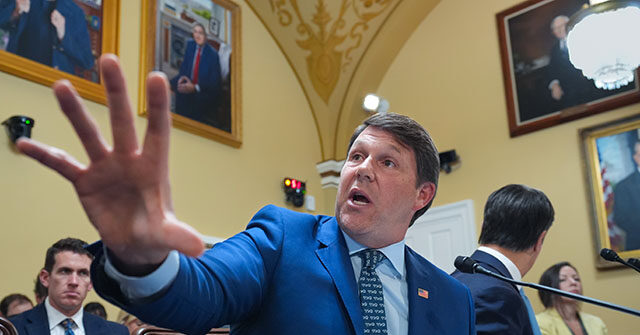
House Budget Committee Chairman Jodey Arrington (R-TX) told Breitbart News that fraud across the federal government has reached what he considers a crisis, saying Congress needs to give investigators more personnel, modern technology, and authority as he pushes legislation investing $28 billion to combat fraud in Medicare and Medicaid.
“The more I dig into it, the more we focus on what reforms are necessary to stop it, and the more I talk to Dr. Oz and folks at the White House involved in the fraud task force, the more I’m convinced it is at a crisis scale,” Arrington told Breitbart News in an exclusive interview. He said it was “mind blowing that we’ve allowed our federal coffers to be looted over the years at the scale that it’s happening.”
Arrington joined Health Care Task Force Chair Blake Moore (R-UT), Reps. Mike Carey (R-OH), Glenn Grothman (R-WI), Addison McDowell (R-NC), Jay Obernolte (R-CA), and Vice Chair Lloyd Smucker (R-PA) in introducing the Anti-Fraud Fund Act of 2026. The legislation would increase funding for the Health Care Fraud and Abuse Control Program by $7 billion annually for fiscal years 2027 through 2030, totaling $28 billion. Arrington said the legislation was developed as officials confront what he called “a $275 million a day problem” involving CMS.
The July 22 press release announcing the legislation said the $28 billion would support attorneys, agents, technology, and other resources used by the Department of Health and Human Services and its partners to prevent and pursue Medicare and Medicaid fraud. The Health Care Fraud and Abuse Control Program, established in 1996, coordinates work by the Justice Department, CMS, and HHS Office of Inspector General. Rep. Moore described it as a joint DOJ-HHS program with “a 7:1 return for dollars saved for every dollar spent.”
The release says the Congressional Budget Office preliminarily estimates the investment would produce at least $168 billion in net savings over ten years, with an average return of $7 for every $1 invested. Arrington said the broader purpose is to give agencies enough resources to stop fraudulent payments before they leave the Treasury rather than attempting to recover them later.
Arrington said the problem extends well beyond health care, citing what he described as a Government Accountability Office estimate of “upwards of $500 billion a year” in federal fraud. Over a ten-year budget window, he said, the total is “over $6 trillion” with interest.
“But then the biggest piece of this fraud is where we’re spending the most money, and that’s in healthcare,” Arrington said. He said the Centers for Medicare and Medicaid Services budget exceeds $1.5 trillion, saying “it’s where the money is” and therefore “where the fraudsters spend most of their time.”
Arrington said $500 billion amounts to “a million dollars every minute of every hour of every day for an entire year,” while stressing that he was referring specifically to criminal fraud rather than other erroneous payments. “This category is just criminals who are stealing from the U.S. Treasury and our taxpayers,” he said.
“The fraud fund concept was worked on with Dr. Oz and his team, some folks from the Department of Justice, and then our colleagues at the Congressional Budget Office,” Arrington said. He said resources devoted to fighting fraud have not kept pace with the scale of the problem.
Arrington said the federal response needs to center on three areas: “people, technology, and authority.” On personnel, he said agencies need “prosecutors” and “investigators,” while on technology, he argued CMS must modernize antiquated IT systems and employ tools including artificial intelligence “so that we can identify and catch these people before we even send out one penny of taxpayer money.”
The current system, Arrington argued, relies too heavily on what he called a “pay and chase model,” in which money leaves the government before officials later discover possible criminal activity and attempt to recover it. “The better way to do it is to move from pay and chase to stop and caught,” he said, arguing that doing so requires “the latest in technology tools like AI and other software application.”
The third component, according to Arrington, involves increasing accountability for states administering federal programs. CMS needs authority to ensure “states are held accountable for the same levels of program integrity,” he said, including identity verification and eligibility reviews involving income and assets. Because significant federal funding flows through states, Arrington said, “we need the states to be held accountable.”
Arrington pointed to changes Republicans made to the Supplemental Nutrition Assistance Program in the Big Beautiful Bill as a model, saying states with higher improper-payment rates can be required to bear a greater share of costs. “The higher their improper payment rate, the higher they have to pay as a shared cost,” he said. “So they have skin in the game.”
Asked why Congress should devote an additional $7 billion annually to the effort, Arrington said the administration’s current work shows a substantial return. “What we found is that right now, the work that Kim Brandt, who is the fraud czar at CMS, and Dr. Oz, their team has collected $22 in savings and recovered tax dollars that were being defrauded for every $1 that they’re spending to address the fraud itself,” he said, describing it as a “22 to one” return on anti-fraud efforts.
“That money is money that we don’t have to borrow from our children,” Arrington said. He pointed to annual federal deficit spending of roughly $2 trillion and said savings from fraud prevention could instead help reduce the deficit or make the programs more sustainable. “This helps us with sustainability,” he said.
Arrington said the alleged healthcare fraud takes a variety of forms. “It’s all across the board,” he said, pointing to “reimbursement schemes,” durable-medical-equipment provider shell companies, and fraudulent hospice providers. He cited California as one example, saying Los Angeles County had roughly 1,800 hospice providers and that 900 “were determined to be fraudulent.”
“In California, for example, there were more hospice providers in L.A. County than all of the state of Texas,” Arrington said. He also said Medicaid spending in California had increased 66 percent in one year, which he described as “more than twice the national average in terms of increase in Medicaid.”
In South Florida, Arrington said, there are “20 times more durable medical equipment providers than McDonald’s franchises.” He also cited an improper-payment rate exceeding 20 percent for durable medical equipment in fiscal year 2024, describing the figures as evidence that the system is “horribly mismanaged” and vulnerable because of a “gaping lapse in fiscal controls.”
He also pointed to what he described as “the largest fraud bust in U.S. history,” involving roughly 450 individuals across all 50 states and approximately $6.5 billion in alleged fraud. Arrington said Oz and Brandt are “totally committed to this,” but argued officials “just don’t have the resources” or authority to hold states accountable without congressional action.
When asked if spending $28 billion would face resistance from fiscal conservatives, Arrington said he believes “most of my Republican colleagues, even the most conservative fiscal hawks,” recognize the need to invest in anti-fraud infrastructure. “I think that the fiscal hawks that I know are convinced that this is a good investment with an exponential return to the taxpayer,” he said.
Arrington compared his approach to the Department of Government Efficiency effort, saying, “I liken it to the DOGE efforts, where there were DOGE offices within every department.” He said the government should replace what he called “the DEI and ESG sort of woke police” in federal departments with an anti-fraud office and ensure such offices have sufficient resources.
However, Arrington said funding alone would not be enough. “There are other reforms that we need to be doing alongside of spending money to save money in this fraud fund concept,” he said, arguing that attaching structural changes could make the proposal “more palatable politically for Republicans.”
One example Arrington cited was the Earned Income Tax Credit, which he described as “a welfare program in the tax code.” He said the program has “a 30 percent improper payment rate” and argued that straightforward eligibility checks could reduce that rate to “well under 5 percent.”
“We don’t need a fraud fund to do that,” Arrington said. “We just need to put the program integrity measures in place.” He argued that such requirements should be codified in law so a future administration could not reverse them.
“We’re not off the hook by simply just giving resources to offices, departments, and agencies like CMS,” Arrington said. “We have to do more of the structural reforms that we did in Medicaid and SNAP.” He said those changes produced more than $1 trillion in savings over a ten-year budget window, or “over $100 billion a year.”