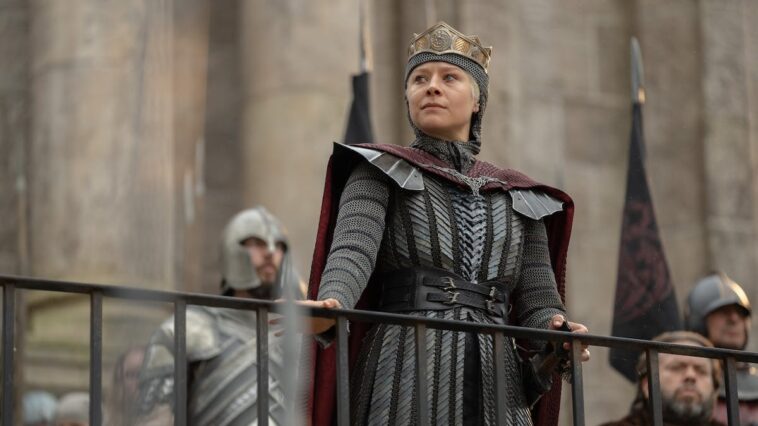
For fans of “Game of Thrones” dismayed by the expository second season of “House of the Dragon,” the spinoff’s third and penultimate season has just wrapped with a great deal more drama. Though this latest season, and the series more broadly, has never soared in the same rarefied air as its predecessor, even in its middling moments, “House of the Dragon” boasts a sense of scale and escapism that dwarfs most of what is on television.
We return to an unstable Westeros, ravaged by the whims of rival claimants to the crown. Bolstered by her new dragon riders and having dispensed with delusions of a pacifist ascent to power, Rhaenyra Targaryen (Emma D’Arcy) swiftly takes King’s Landing and finally assumes the Iron Throne.
Among my gripes with this franchise is its broad lack of favorable characters to root for. Daemon Targaryen (Matt Smith) remains an obvious favorite antihero, though this is more a testament to Smith’s arresting charisma than to anything the screenwriters have given him.
The series also has a curious knack for pushing women into positions of immense power only to have the weight of the crown scramble their senses — Daenerys, Cersei, now Rhaenyra — much like whoever runs the WNBA.
And Alicent Hightower (Olivia Cooke) is somehow even more vexing. Even from captivity, she continues playing her own children like pieces on a chessboard, though her motivations become increasingly difficult to follow. Early in the season — slight spoiler — she helps engineer Rhaenyra’s capture of King’s Landing, manipulating Aemond Targaryen (Ewan Mitchell) into flying to Harrenhal and leaving the capital vulnerable. She presents the betrayal as an attempt to avert further bloodshed and salvage what remains of her family, only to spend much of the season thereafter conspiring against the very children she professes to protect.
The prevailing wisdom that proximity to power maddens and corrupts continues to writhe through the series. In business school, we had a popular elective called “Power and Influence,” devoted to understanding organizational structures, individual motivations, and how people accumulate enough leverage to get their way. Westeros would make for a fine case study. Authority here is almost entirely relational: kings depend on dragons, dragon riders depend on armies, armies depend on lords, and every alliance lasts precisely as long as the incentives holding it together.
Late in the season, one of Rhaenyra’s powerful new allies is wooed by the enemy after discovering that, under her rule, he cannot simply wander off to the pub for a pint during work hours. The particulars of his 401(k) are not discussed onscreen. The show is set in a fantasy realm a thousand years in the past, but competitive benefits remain an unwavering means of poaching talent.
The season’s most intriguing practitioner of this game is Ormund Hightower (James Norton), portrayed with chilling psychopathy as he grooms the young Daeron Targaryen (Benjamin Evan Ainsworth) into a pliable Hightower claimant to the Iron Throne. After conquering Tumbleton, a trading town loyal to Rhaenyra, Ormund strategically embeds his forces among the civilian population, effectively daring the queen to unleash dragon fire and massacre scores of innocents along with his army.
It is only reasonable to assume that Hightower’s great military inspiration is Yasser Arafat. I will spare the particulars for those who have yet to watch, but to drive the point home, the culminating battle finds bound and captive children lining the fortress walls as human shields.
This also underscores the folly of Rhaenyra’s reluctance to intervene decisively once the Hightower incursion becomes clear. Throughout the season, Ormund orchestrates stabbings and murders among Rhaenyra’s command in King’s Landing. Even when Daemon captures one of his operatives, the prisoner apathetically invites Daemon to kill him, warning that they “will never stop.” Ormund’s strategy is simple: keep escalating until Rhaenyra either responds on his terms or loses control altogether. A “Hightower Intifada,” if you will.
This is also where “House of the Dragon” can become maddening. Otherwise clever characters periodically lose all strategic sense when the screenplay needs another reversal. Rhaenyra repeatedly ignores obvious opportunities to exploit her overwhelming advantage in dragons, while supposedly seasoned political operators make decisions whose principal justification appears to be that another episode remains.
Despite her intentions, Rhaenyra’s restraint does not prevent bloodshed; it merely postpones it, while allowing her enemies to make the eventual confrontation considerably worse. By the time she acts, Ormund has entrenched himself among civilians and transformed Tumbleton into precisely the humanitarian catastrophe she hoped to avoid.
Here, George R. R. Martin’s fantasy politics become remarkably grounded in reality. Foreign policy rarely affords leaders the luxury of choosing between violence and peace; more often, the choice is between exercising force now and confronting considerably greater violence later. Deterrence works only when an adversary believes there are consequences for crossing the line.
Rhaenyra approaches her foes with something of Neville Chamberlain’s logic that restraint today might purchase peace tomorrow. Instead, her adversaries treat every hesitation as permission to escalate — a timely lesson in geopolitics she will have to carry into the fourth and final season of “House of the Dragon.”
Peace is not always preserved by the ruler most reluctant to fight. Sometimes it is preserved by making it sufficiently clear that the fight will not end well — or, in more contemporary parlance, would-be assailants can “f— around and find out.”
***
Harry Khachatrian (@Harry1T6) is a film critic for the Washington Examiner. He is a software engineer, holds a master’s degree from the University of Toronto, and writes about wine at BetweenBottles.com.
This article is part of Upstream, The Daily Wire’s new home for culture and lifestyle. Real human insight and human stories — from our featured writers to you.