
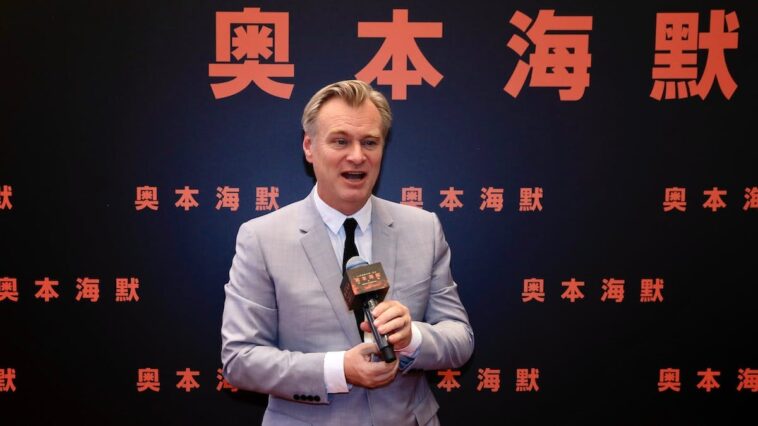
Somewhere on the press tour for “The Odyssey,” director Christopher Nolan appeared with Jimmy Fallon and watched his cast play Cyclops beer pong. Then he went to Beijing, sat down with a political philosophy Ph.D. student named Zhong Shu, and was asked a series of questions about his interpretation of Homer and whether he was a “bard for a civilization at dusk.”
The viral Beijing interview was so much more than a well-read academic finally giving Nolan an intellectual challenge. It was a snapshot of the new story “arms race” that’s been quietly brewing between the U.S. and China — a narrative cold war where each civilization is grappling with its relationship to the guiding stories of the past in an effort to determine which culture will lead the world in the future.
The interview with Nolan ran nearly 20 minutes and instantly went viral in the West for good reason. Zhong asked thoughtful questions about hubris by way of Thucydides and the fall of Athens. She asked whether the gods in the film were merely projections of the human psyche and if Nolan had intentionally “Christianized” Homer in any way. She challenged Nolan on whether a story that originally celebrated Odysseus as a cunning, noble king had to be refitted into a story that demands greatness and must repent.
“We turn greatness into privileges and we demand apologies for it. That’s a fact of Hollywood,” Zhong stated before asking Nolan if he agreed. Nolan told the young Chinese intellectual that, in a democratic age committed to equality, storytellers have to manage the audience’s built-in resistance to greatness. Do we have to apologize for that greatness? “And the answer is yes, we do,” he said, or the audience rejects it. He did not demur or deflect. He wasn’t defensive. He described it the way an engineer describes a load-bearing wall: This is simply how the mechanism works in our culture today.
The West’s most prominent living filmmaker calmly conceded that his civilization can no longer receive a story about greatness unless greatness acknowledges wrongdoing first. This admission — delivered in Beijing to an educated Chinese classicist who came prepared with provocations from our own civilization’s foundational myths and stories — revealed a deeper civilizational conflict over what guiding story and set of values are most suited to lead the world. How we relate to Homer, the stories of the Bible, Dante, and even our modern mythological heroes such as Superman matters, and the Chinese know this. The line of inquiry in that interview was not incidental.
For years — and with very little media attention — China has been quietly engaged in a narrative arms race with an American culture and the broader Western world that it believes is in decline. There’s a belief within the Chinese government that the modern West abandoned its own inheritance by deconstructing its foundational myths and values, and that now is the time to build where we have faltered. So for years, the Chinese have been mining the “classics” of Western Civilization for the insights that once gave us a civilizational advantage.
In November 2024, Beijing hosted the first World Conference of Classics: 600 participants and scholars, a congratulatory letter from Xi Jinping read aloud by the CCP’s propaganda chief, and a new Chinese School of Classical Studies established in Athens. Over the past decade, Peking University and Renmin have built classical studies programs too.
A key figure in China’s modern fascination with Western classical education is political philosopher Liu Xiaofeng, who spent the 2000s importing “Great Books education” into Chinese universities at precisely the moment Western universities were more focused on critiquing, subverting, and deconstructing these stories. Three of his students now run a classics division inside the Chinese Academy of Social Sciences. While there is no evidence of any direct relationship between Liu Xiaofeng and the viral interviewer Zhong Shu, Zhong’s own approach and line of questioning were clearly influenced by Liu’s philosophy.
Here in the U.S., we too are reexamining our relationship to the stories of old and grappling with their importance. Even if Nolan’s interpretation of Homer’s epic myth is a matter of contested debate, the fact that he believed it was the right time to return to a 2,800-year-old story means something.
Hollywood has been in a confused state of nostalgia for quite some time. Prequels, sequels, and reboots have dominated our narrative landscape. Oftentimes, they’re revisiting classic fairy tales or our modern mythic heroes to deconstruct them, and other times they’re going back to celebrate them. What is undeniable is that the relationship to these stories of our past matters.
This isn’t just a Hollywood entertainment phenomenon either. Throughout America, a new alternative to the SAT and ACT as the standard college entry exam has been quickly gaining traction. Developed by Jeremy Wayne Tate and a bipartisan network of educators and philosophers, the Classic Learning Test puts understanding of the “Great Books” and foundational myths of the West on center stage. Pete Hegseth, head of the U.S. Department of War, called it the new “gold standard” of tests and is working to make it the norm at West Point.
At the highest levels of government, among the two most powerful superpowers in the world, there is a shared admission: Civilizations run on stories. They are the operating system of a society. They give a people who are not bound by blood a shared identity, shared values, shared customs, and even a way to mark their days through shared holidays and mass cultural celebrations.
This is a lesson both nations learned about the “soft power” of story during the 20th-century Cold War between the U.S. and the Soviet Union. The Cold War wasn’t just a conflict between two different economic theories. It was a civilizational collision between two different guiding stories about God, human nature, and the purpose of life, with the economics being downstream of those guiding stories. Many have even half-jokingly wondered over the years whether the movie “Rocky IV” is what finally beat the Soviets.
Both sides in today’s new cold war know that the stories we tell about our past are essential to any sense of shared cultural identity and that they determine the direction of our future. Going back to even the early 1990s, Chinese officials could see that the developing culture war in America was really a story war. “Nihilism has become the American way, which is a fatal shock to cultural development and the American spirit,” was the famous conclusion that Chinese political scientist Wang Huning came to after an extensive tour of American universities.
As I first wrote about in “Based on a True Story,” the Chinese government believes so strongly that a civilization’s destiny is bound up with the foundational myths and stories of its culture that officials now forbid time-travel stories from primetime television out of fear that the very notion that these core myths could be critically reassessed could cause their civilization to self-destruct.
This gets to the tension in Nolan’s confession about our association of greatness with “privilege” and the underlying assumption that all power is inherently oppressive. That story has not always been part of our shared cultural identity. There was a time when we unashamedly celebrated a modern mythic character like Superman as the most powerful and greatest being on the planet, and didn’t ask him to apologize for anything, because we believed that virtuous character could shoulder the weight of that power.
Zhong was clever to probe whether Christian notions of repentance were somehow influencing Nolan’s take on Odysseus. Certainly, a central emphasis of historic Christianity has been “whoever wants to become great among you must be your servant,” but this is not what Nolan, by his own admission, was trying to communicate. Jesus was not claiming that greatness was inherently a byproduct of some sin of “privilege” that requires repentance just for being great, but that the shape of greatness should resemble his own virtues and sacrifice. This is the central guiding story of Western civilization.
Whatever civilization rediscovers this truth first will be the one that averts civilizational armageddon and stands the test of time.
***
Paul Anleitner is a cultural theologian whose work focuses on the role of culture and story in our quest for meaning. He is the author of “Based on a True Story: Vibe Shifts, the End of Deconstruction, and the Reboot of Meaning.”
This article is part of Upstream, The Daily Wire’s new home for culture and lifestyle. Real human insight and human stories — from our featured writers to you.