
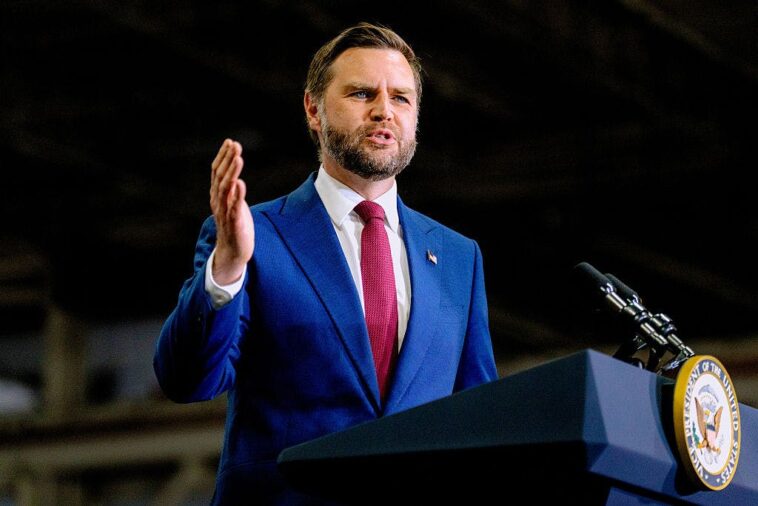
Vice President JD Vance discussed his faith, the Trump administration’s policies on energy and trade, national security, the U.S.-Israel alliance, antisemitism, and group-identity politics during a conversation with Republican Jewish Coalition National Chairman Norm Coleman at the RJC’s National Leadership Summit in Las Vegas on Monday night.
The conversation was held off the record and closed to the press, but The Daily Wire obtained a full recording of the event. Here is a full transcript of their conversation.
Norm Coleman: I’d like to remind everyone in the audience that this chat has rules, and that we prefer that folks do not take out… This is a conversation among a few close personal friends, right? A conversation among friends. And you have front-row seats to this conversation. So keep your phones in your pockets and that… We’re going to have a great conversation. But before we begin, a point of personal privilege. I want to thank you for being the 51st vote for the Secretary of War nomination. Thank you.
I was humbled to serve as a sherpa for the Secretary, and and I had Vice President, who was who was critical in that nomination, and what a good choice it was. I mean, took out Badawi without a single casualty. That’s a great choice. Thank you for your leadership and thank you for making that 51st vote.
JD Vance: Well, look, since you brought it up, I have to say, first of all, I love Pete. A very, very dear friend and a good guy. And you know, it wasn’t just the yes on the 51st vote, that was a lot of work. And in hindsight, I think it was a lot of work because the people who wanted bad to prevail knew that that was a very, very important vote. And we fought for it, we didn’t give up, and we succeeded. And that’s a great lesson.
Norm Coleman: I always tell people, we’re still in Washington, it’s not known how to count. We have a count to 50. But the Vice President really helped me, and even on our team, sometimes you have folks that go astray. Vice President really made the difference. Thank you. So I appreciate it. Thank you. Absolutely.
Now, you’ve been on the campaign trail, and today was a day in Michigan.
JD Vance: Mike Rogers, next senator.
Norm Coleman: Running against El-Sayed, right? This campaign bus buddy is Hassan Piker, who said that America deserved 9/11. El-Sayed is his… can’t condemn an attack on a Michigan synagogue and says that hurt people do hurt things. What what is the… Tell us, what does that race mean in terms of the Senate, in terms of the state, and what it says about America?
JD Vance: So, first of all, I know there are a lot of people here who care about our country, love our country, and want to support good candidates. Mike Rogers is, in my view, maybe the single most important candidate right now in this midterm election.
I hate doing this, but I love when people are shameless on my behalf. Please get out your checkbooks and support Mike Rogers’ campaign. Am I allowed to say that? Did I violate some campaign law? Thank you, Mike. The one person giving a standing ovation was Mike Rogers.
But look, I I think that there are a few things I’d say about this. First of all, I actually met not just the rabbi of the synagogue in Israel, who’s the the the synagogue in this really quiet, wonderful Michigan community where this psychopath was going was going to kill hundreds, dozens, at least, of innocent Jewish children. One of the worst attempted antisemitic terrorist attacks that we’ve ever seen. And when I say attempted, he actually was stopped by a couple of very brave security guards. And I met those heroes, too. So I met the rabbi and I met the heroes as well.
And I just, you know, here’s here’s… You learn a lot about a person by what they focus on and what really inspires passion. And when I think, okay, you have a person who wants to murder a lot of innocent children… Was to murder them because they’re Jewish, but they’re innocent children. And when your response to that is to say to empathize with the person who’s going to commit this heinous act of violence, and not with the kids who almost lost their lives at the place that they should be safest in the entire world, the response to that is you’re a disgraceful human being. And we know that El-Sayed is one of the worst disgraces running in the history of the American political process.
It’s not just what he said, it’s what he didn’t say. Importantly, it’s the motivation and the passion behind it. So that’s number one. I I think that a lot of us are worried. I think it’s good for America for for Republicans politically, but it’s actually bad for America when we have people on the other side who are that unhinged and that divorced from reality. And so one of the messages that Mike Rogers will send when he wins—and Mike Rogers will be the next senator from the state—it actually sends a message to Michiganders, but to the entire country, stop sending us crazy people. And again, while that may make Republicans’ jobs a little bit harder politically, in a way the Republican Jewish Coalition, some of us want those easy candidates, but it actually is bad for the country when you have a person like that running.
And let let me say just one other thing. I was trying to understand, you know, like ideologically, philosophically, what is going on in El-Sayed’s head, okay? Because he apologized for the motivations of the killer who almost, I should say, thank God, almost killed a lot of Jewish children. He campaigns around with this guy who defended the 9/11 massacre, which of course was almost 25 years ago, we’re going to commemorate that soon. And then I I sort of think, well, he also was he got into this obsessive woke DEI thing back in the late 2010s and the early 2020s. And what I what I realized is this is a guy, unlike literally every Jewish person I know, every American I know with with a few very, very obvious exceptions, this is a guy who looks at you and says, “You’re a good person if you belong to this ethnicity, and you’re a bad person if you belong to that ethnicity.” And the purpose of politics is to punish the bad guys and to reward, in his view, the good guys.
And I think that’s a really despicable way to look at your fellow Americans. You don’t see a bunch of innocent Jewish kids who almost lose their lives and empathize with the killer unless you see those people as less than human. And that’s a very, very ugly and nasty thing. And thank God we have a guy who’s going to send him packing. But it’s a very important message to send to the country. It’s not just about having a better senator in Michigan. If a guy like El-Sayed is in that place for the next six years, it’s going to send a very, very bad message. We’re going to have a very bad vote. And it’s going to, frankly, inspire a lot of copycats. And what we should be inspiring is the Democratic Party to wake up and stop sending crazy people to the ballot box.
Norm Coleman: I wish we could re-endorse you, Republican Jewish Coalition. Israel is very important to us. The Trump-Vance administration have been the best friends that Israel has ever had in the White House. We’ve had some good friends. The best, the best! The best friend that the Jewish people have had in the White House. Leading this fight against antisemitism that we’ve had in in the in the White House. You had Ron Dermer, former ambassador, Ron, somewhere, speaking glowing words about you today. You had Ambassador Lighter also speaking very kind words.
But on the other hand, you have said that, you know, sometimes the Israel interest and US interest don’t always align. Sure. But you have also said Israel is is an ally, not a vassal state. Okay? And your detractors would say, they don’t align, is somehow what does that mean about your position on Israel? Tell us about your position on on the Israeli-US relationship and is it important to America’s national security?
JD Vance: Well, certainly it’s extremely important to America’s national security. It’s obviously, you know, I I would say one of our most important alliances in the world and certainly our most important regional alliance. Here Here’s what I would say, and I think this is important because, you know, you guys know, obviously, a big part of my job is to support the policies of the administration. I think, obviously, I’m biased, but I think we’re doing an amazing job. I think what the President…
What the President has said on this is exactly right, which is number one, the Israelis have been a great partner for a number of things, whether it’s Midnight Hammer or intelligence collection, technology sharing, they’ve been a great partner. However, sometimes we do have different um different views on certain things. And you know, there are a couple of different ways that I put this. So, first of all, I wouldn’t say that it’s purely transactional, in the same way that I wouldn’t say that our alliance with the UK is purely transactional. I’m very much a foreign policy realist. I think that one government has to pursue its interest, another government has to pursue its its interest. But look, there are a few countries—Israel, the UK—where there’s a much deeper cultural symbiosis and harmony than than exists with most other countries. Like, I I I like a lot of nations, but like I don’t feel the same way when I walk through the streets of, let’s say, you know, Berlin, that I do when I walk through the streets of Jerusalem. I’m a Christian and and it it means something different for me, in the same way that I think that there’s a cultural alignment between the United States and the UK.
But that said, for example, the the UK, just to crystallize this a little bit, is very worried about Europe, and rightfully so. Israel is very worried about the Middle East, and rightfully so. That is their home. That’s the region of the world that determines whether they they quite literally live or die, because as you know, they’re surrounded by a lot of enemies. I think in some cases our attitude is that 20 years ago, maybe American foreign policy was a little too focused on the Middle East. So that’s just a natural place in which Israel is going to look at these things slightly different than the United States of America. But we’re going to work together. We’re going to continue to work work together. And again, I think the most important thing is to say that there are alignments of interest across a whole host of issues.
And let me just make a a final political point. I mean, to, you know, address some of the obvious elephants in the room, Norm, that that there is a growing suspicion among, I would call it under-40s, of the US-Israel relationship. And I think my view is what we have to do is articulate why this is in the best interest of the United States of America, and actually get out there and talk about the ways in which it is in the best interest of the United States of America. So, like to take a very obvious example, we’re working with the Israelis on some extremely top-secret technology that is very, very important for the North American Missile Defense Shield. Because I love my kids, because all of you in in in this room, we love our kids, we love our grandkids, we want to make sure that if God forbid a bad country shoots a missile at the United States of America, we are safe.
But we also want to change the economics of missile defense, because it doesn’t make sense to shoot a $5 million missile interceptor at a $10,000 rocket. We are working in an incredibly productive way with the Israelis to try to find the kinds of missile defense technology that can change both the economics and also the industrial side of that. That’s just one very concrete example. And I think that that is the way that at least, look, I’m not giving anybody else advice, I can only speak for myself here, but I think it’s very, very important to talk about the concrete alignment of interest, and to hook the relationship on that, rather than something that may have made a lot of sense rhetorically 30 or 40 years ago, but just doesn’t have purchase with the same uh it doesn’t have the same purchase as it did 30 or 40 years ago, because the country is different, and because young people are looking at this in a different way.
Norm Coleman: So you mention young people. We were the loud… they were the loudest voice back there, I know. So I want to ask you to speak to young people from two perspectives. First, for uh young Jewish kids who after October 7th uh uh worried about wearing a Star of David walking on a college campus, and being assaulted, and being harassed, worried about… You talked about the Democratic Party has gone crazy, and then the rise of antisemitism in the Democratic Party, it’s just unbelievable. You cannot stand as a Democrat candidate as an anti-semite, they’ll throw you right out. They’ll probably assault you. Yeah.
So so, on the one hand, uh I want you to talk to young Jewish Americans about how do we deal with that? How do we deal with that issue of antisemitism? Again, this administration has been absolutely unbelievable on that. And it’s going to be a two-part question, so I can… But on on there’s also on the right, we had a candidate in Florida uh who’s uh antisemitic, and uh campaign with with uh Nick Fuentes, Nazi, right? He won the college precincts in his race against Mario Díaz-Balart, something in the 70s percent, right? So we’re we’re losing young people. So talk to me about this wide, this interesting topic you talk about, young people and what they’re facing, what Jewish kids are facing, and kind of what we have to do to kind of turn all this around.
JD Vance: Yeah. So that’s that’s a very big question. Let let me just say, first of all, somebody said something to me in the in the photo line earlier that I didn’t I wasn’t really thinking about, at least not in in such a personal and concrete way, but when somebody you like and admire gives you a hug and tells you something, it kind of stays with you. And he said, “You know, we’re proud Americans, we love our country, we’re proud of our Jewish faith and heritage. And, you know, my daughter is worried about sending her kid to school with a kippah or with any kind of insignia of Judaism.” And and he said, “You know, we love this country. Sometimes it don’t always feel like the country loves us back.”
And so let me just say, as the Vice President of the United States, and with all recognition that the Abdul El-Sayeds of the world are out there, of course America loves our Jewish citizens and respects the contributions of our Jewish citizens. And I hope that everybody here knows that from the top of this administration to the Vice President on down, we love you guys, we appreciate you guys, and you will very much always be on the team so long as I have any say in it.
So, we could we could probably talk about the antisemitism thing all night, because I know it’s on the minds of a lot of people. And I I just say like I remember just so concretely, I had a conversation probably 11 or 12 years ago. And it was a sort of well-known conservative intellectual, and I’m not going to give his name, but he said, “You know, I think we’re going to see a rise of antisemitism.” And I was like, “Huh, that’s interesting. Really?” Like that’s, you know, 11, 12 years ago, at least to me, that seemed so far afield from where the country was. And he said, “Yeah, I think that what we’ve done is that we’ve normalized saying because this group as a group, not as an individual, but because this group has more than another group, we can cast down the group that has more and attack them.” And he said, “That kind of group-based thinking, where you try to segment people into good or bad groups based on their ethnic heritage,” he said, “that game always ends bad for the Jewish people.”
And I was like, “Huh,” and I kind of filed it away, and I’ve thought a lot about that, because I think there is a very deep connection, Norm, between woke politics, between an obsession with group identity, and the rising antisemitism that we see all across the United States of America. And I guess my my solution to that… I’m trying to get this out quickly because there’s a lot I want to say on this, but two other quick things.
My solution to this, and, you know, I’m hardly an expert on the Jewish faith, but I I I believe that Jews and Christians, one of the critical things that we agree on is this concept of Imago Dei, that we are all made in the image of God. It says it right there in the Hebrew Bible in the book of Genesis. And what I what I say to the people, like the root of anti-semitism, the core of antisemitism to me, is the idea of blood libel. The idea that because of your genetics, because of your blood, because of your ancestry, you are guilty of a crime that you never committed. And I think that blood libel, which is at the root of antisemitism, is the exact opposite of the Christian gospel. And because of that, I believe the gospel is actually the solution to this.
And when I see, you know, you’re right that that that Fishback won one college educated, or he did not college educated, but he won some of the college precincts.
Norm Coleman: University precincts.
JD Vance: I guess my response to that is I I say that you cannot be a Christian, and I would say, you know, you know better than I would, but I don’t think that you can be a Jew either if you engage in this idea of blood guilt against people. And I think the antidote to antisemitism is the rejection of this idea of blood guilt. And I would tell any young man who claims to be a Christian that you this is super corrosive for the soul. And this brings me to my my final point.
So, we’re about to commemorate the 25-year anniversary of September 11th, but of course that day will now always have a transformed meaning for me, because I was supposed to go to the 9/11 memorial service last year, but I ended up going to Arizona to take Erika and Charlie Kirk—Charlie Kirk had just been killed—from Utah to Arizona, where Charlie of course was buried. And Charlie, who by the way, like had disagreements with our foreign policy in the Trump administration, had criticisms of the Israeli foreign policy, he was not a person who was always perfectly politically aligned, he was a free-thinking guy, he loved Israel, but he also said something that I just keep on returning to, which is that Jew hatred is corrosive to the soul.
And I think that that’s the important point. Charlie’s message that you cannot be a good human being, you cannot have a good soul if you engage in Jew hatred, that to me is the antidote to what we see out there. And I and I and I’ll say, actually this is my final point. Some of this, it’s very uncomfortable, but we have to talk about immigration. Because some of the antisemitism that we see rising in the United States of America is actually coming from people who are bringing ancient ethnic hatreds into the United States.
Now, I I remember getting into some trouble, not from the President of course, but from the media, when I actually asked my staff, I said, “Look, try try to look at polling that we have on antisemitism, and compare, let’s say, a white American in 2025 compared to a white American in 1985. And how much more antisemitic or less antisemitic are people across that 40-year period?” And what what I found was very interesting, which is that the rising antisemitism you see, and I’m not saying you don’t see it among some podcasters, you obviously do, I mean, you know, the the Fuentes character who, you know, really does hate Jews, and also by the way really hates me and my family, so you’re in good company, right? He like that is real, but it’s not common among most of our fellow citizens. And what you see is the worst antisemitism grows up when you allow the importation of large groups of people who bring their ethnic rivalries into the United States. And so my view, this should be our immigration policy, but I think it goes to the antisemitic issue too, is if you want to bring your ethnic hatreds anywhere, don’t come to the United States of America, you’re not welcome.
Norm Coleman: So Jew hatred has been a big topic of conversation. I just want to have one more kind of touch on that issue, and then we’re going to talk about some other things. Great. Great. But, you know, you mentioned Fuentes, podcasters. A few names: Tucker Carlson, Megyn Kelly, Joe Rogan, Nick Fuentes. They have platformed anti-semites. How do you how do you draw a line in terms of… because they’re powerful. Those podcasters, they they touch a lot of voices. How do you draw the line in terms of of whether you fight with the platforms that you appear on and you podcast? How do you how do you do that today?
JD Vance: Yeah. I mean, look, and I recognize that not everyone in this room is going to agree with me on this, but I I take two basic approaches to it. One one area where I really do draw the line is on people who engage in what I call this blood libel attitude. And like I recognize a lot of people in this room might disagree with things that Tucker Carlson or Megyn Kelly or Joe Rogan has said, but I I think just to hone in on Fuentes and Rogan, I think these are two very, very different categories of people, both with their within their reach, but also within the ideas that are in their in their actual head.
I’m biased, I like Joe Rogan, and and but I think it’s a mistake to sort of say we’re going to write Joe Rogan off because he said something that we don’t like. I think the best approach is to actually go in there, and talk to him, and make the arguments as best as you can. We did an interesting thing, Norm. We actually tried to understand the podcast universe and how it affected mid-term elections. We care a lot, of course, about Mike’s race, but also a lot of other races across the country. And we actually looked at, you know, what Mike Rogers… excuse me, what what Joe Rogan… What is his audience among the people that we want to vote for Mike Rogers? And what we found is that if you look at all the other podcasters, their reach was 5 to 10% of what we would call persuadable voters, those voters in the middle who really are gettable. With Rogan, it’s something like 35 to 40%.
And so I I think that there, one, I do not think that Joe Rogan and Nick Fuentes are the same, just substantively, but as a political matter, I think that we have got to be willing to go everywhere and bring our message anywhere and to any person. And and that means sometimes going into a podcast where you’re going to talk… last time I was on Joe Rogan, we talked about UFOs for like an hour, right? But you got to meet people where they are and make the arguments as best as you can, and that is I think ultimately how you win the political debate. It’s not by shunning people, and that’s the approach that I try to take. Talk to as many people as possible, but obviously I’m not going to go talk to a guy who’s attacked my wife or who’s said that Hitler was a good guy. But outside of of some pretty bright lines, I try to talk to as many people as I can. Thanks.
Norm Coleman: Next is next topic. Venezuela. I’m actually heading to Caracas uh this week. Big deal. Big auto deal, huge. Joe Biden and the Democrats, Green New Deal, they they destroyed the American economy. They they destroyed auto uh auto industry, I think American technology, everything kind of tied into green green economy, on on windmills, you know, guess what. Talk to us a little bit about then this again this administration is kind of way out in the world. So talk to us about energy policy, tell us what is happening in Venezuela, tell us about kind of the changes and how that’s going to impact folks in this room and of course this country.
JD Vance: So, the Venezuela thing really is, I think, the marquee foreign policy success of the Trump administration. I’m not saying we haven’t done great things in the Middle East or great things in Europe, great things all over the world. But here here’s what’s happened in Venezuela. So first of all, the world’s largest reserves of petroleum, 300 billion barrels. To give you some sense of that, you could run the the world uses about 100 million barrels a day. So, you know, Venezuela has like 3,000 times that amount, if I did my math correctly there. Somebody check me. Is that right, Norm? Okay. Just in their country.
And simultaneously, it was being underdeveloped, underexplored. Of course, the the people there were suffering a great deal. And again, I think our foreign policy, as much as we love people all over the world, has to be focused on America’s interest first. I think what the President saw, and really the entire team—Marco and Pete and all of us saw—was an opportunity to radically increase the world’s accessible supply of petroleum. Now, that’s good in its own right. That means Americans pay lower energy prices, especially over the long term. It means our Strategic Petroleum Reserve, which had been drained by the Biden administration, we actually have a kind of strategic petroleum reserve in Venezuela much closer to home. But it’s also one of the reasons why the energy piece of Operation Epic Fury in Iran has not been as bad as it could have been.
Now, people always say, “Well, did you know, were you guys caught off guard by what the Iranians have done in the Strait of Hormuz?” I always find that conversation so absurd because we had so many conversations about exactly what the Iranians would do in the Strait of Hormuz. We complete all of us agreed they would do their best to close it. I I think what we actually most of us were wrong about is we thought energy prices, and and I don’t mean to belittle this because a lot of Americans absolutely care a great deal, rightfully so, about low energy, but we thought they would go higher, at least in the initial days of the conflict. And part of the reason why they haven’t is because the long-term picture for oil and gas has been stabilized, the supply has been stabilized by what’s happening in Venezuela. So I think people always underestimate and underappreciate how much the President is engaged in kind of a long-term chess match. And I think that what happened in Iran would have been much harder had it not been for the success in Venezuela.
Norm Coleman: Talking about UFOs, did he tell you anything? Is could you tell us if why amongst those objects or friends, are they real?
JD Vance: We’ll get into that later. Once once I fully identified what the backstory is, trust me, you guys are going to know.
Norm Coleman: Let’s let’s stay on on domestic politics, you know, and I know it’s going to happen at the RJC. Antisemitism and UFOs, energy policy.
JD Vance: It’s a broad group.
Norm Coleman: Every election is in the end it’s about the economy, stupid, right? It’s about jobs, right? I I ran campaigns for Rudy Giuliani, I know. I tell you, some some of the scenes that I saw that that that broke my heart, I I was in towns that I I was I grew up in an urban center, I grew up in New York. But I saw pieces of America that day, and I and I got the same answer: what happened here? The factory that was here moved to China. Everything and and it and it it was in it was heartbreaking.
JD Vance: Yeah.
Norm Coleman: Talk to me about this administration has been transformational on the economy, bringing jobs back. You don’t get credit in the media. But the change is real. Tell us about kind of what what what you’ve done, what we’ve done, and tell us about what we’ll do in the future.
JD Vance: Well, of course, you you saw a lot of that, of course, in in in Minnesota. And by the way, the the first major Republican politician to have an election stolen from him was Norm Coleman. Okay. The the young… okay, so so the young people, I won’t say kids, I don’t mean to insult you guys, but you guys need to go and read about the Norm Coleman-Al Franken election. That election was 100% stolen.
Norm Coleman: I won on election night, I won when the machines re-counted, but I lost nine months later in the post-board count. I went to ask President Bush about his election before before me. And he said to me, he said, “You know,” he said, “my big…” he said, “my biggest fear,” he said, “the Democrats would keep counting until they won.” That’s what they did.
JD Vance: That’s exact That’s exactly right. That’s exactly right.
So, here here’s all right. My view is that the Trump administration, the President’s focus, I would even say obsession, rightfully so, on re-industrializing the United States of America will go down as the thing that this administration is most well remembered for. And I’m very proud of it.
And look, you know, everything almost that you see in the news today connects in some ways to the fact that we allowed our industrial base to be shipped overseas. Anytime you see the opioid talk talk about the opioid addiction problem. Now the cartels exacerbate it and made it worse, but where did the opioid problem first start taking root? It was in the factory towns that lost the jobs. The parents were completely, you know, devoid of work, financial instability set in, divorce set in, misery set in. There’s a very clear economic connection between the factory disappearing and the opioid epidemic. But it’s also it matters for our national security. You do not have national security if you need to manufacture something for your military and you can’t do it because the supply chain has been shipped to a country partially that’s your adversary, or at least your competitor.
And so what the President is trying to do is not just to ensure good jobs for American citizens, he’s not just trying to ensure that we make things and are self-reliant in the United States of America, he’s trying to ensure that if God forbid we have to send an American servicemember into harm’s way, they’re carrying a weapon that’s made by their fellow Americans and not by a foreign adversary. And that is national security, and it perfectly encapsulates economic security is national security. And Norm, this is going to save towns, it’s going to save communities, and I think it’s going to save the United States of America.
We It was a lie that existed in this country. And if I’m being honest and self-critical, it wasn’t just on the Democratic side. Republicans came into this, too. The idea that you could have an economy that was all technology, all services, all finance, it was a huge, huge, huge mistake. Hundreds of thousands of our fellow citizens, millions of our fellow citizens lost their livelihoods because of it. But I think in some ways more importantly, we lost our self-reliance as a nation.
Like all of us have a COVID story, okay? All of us remember that crazy time in 2020. But the thing that I just remember thinking, how in God’s name did we ever get here, was when hospitals were cancelling surgeries because they didn’t have enough hospital gowns and hospital masks, because all of that stuff was made in China. It is a disgrace that we ever let this happen, and Donald J. Trump is the first person to really do something about it.
Norm Coleman: I want to end on a personal note. In your in Communion, you speak about wrote about how your end of life, which had helped bring you back to Christianity.
JD Vance: Yeah.
Norm Coleman: I’m married I’m married to a Catholic girl. By the way, my my wife made made better chicken soup than my mother of blessed memory, I got to tell you. Not balls, and they don’t sink like rocks, but the soup is really, really good. Hey, everybody got to eat. Now, just on let’s let’s let’s end on faith, because I know it’s really important to you, so I want to end on kind of how shared family spiritual values, the challenges that you have, challenges with the kids. Just give us a little uh preach before we leave, okay?
JD Vance: Yeah, well, I I appreciate that. It’s interesting, first of all, just to connect it to the RJC a little bit. So, it is it’s funny. The first time that I ever noticed the Jewish custom, I hope I’m not insulting it by calling it a custom, but of of washing your hands before dinner, I like it hit me that this ceremonial washing was incredibly similar to the way that priests in Catholic Mass prepared the Blessed Host, prepared the sacrament. I don’t know if you’ve made that connection before. As a as a as a guy married Jewish guy married to a Catholic.
But I I remember thinking like there there are just, and I, you know, had friends, I mean, my former chief of staff, Jacob Reses, who I adore, was an Orthodox Jew and, you know, I I I did a reading at his at his wedding. And there were all these liturgical similarities between Judaism and Catholicism that are very fascinating to me. Just the way that the service is actually done, those harmonies and those parallels. And of course, as a Christian, you recognize this not as just an accident of history, but, you know, because the patrimony of the faith goes back to Abraham, you see those liturgical connections. And I think that’s just a very cool thing, and something that I didn’t notice until I was first at an RJC event, and saw people going out there and washing and being like, “Huh, I’ve seen that before.” That was a very interesting thing.
But, you know, Usha and I, it’s it’s funny, because Hinduism is, and I’m not an expert, so any Hindu uh forgive me if if I butcher this, but it’s less of a, I would call it, a proselytizing faith than the Abrahamic faiths. It’s um it’s very comfortable with just it’s it’s it’s a philosophy. Nirendra Modi actually explained this to me. He said it’s very much a philosophy of understanding religious texts and understanding the way the world works, of understanding the relationship between man and woman, between God and man.
And I think because of of that, Usha and I of course have very interesting conversations. And and, you know, she’s always just been very supportive of my return to Christian faith. She never saw it in some ways as, you know, an insult to her, or in some way, you know, uh taking away from anything that that she believes in or cares about. And and there are two things, I mean, just to get a little sentimental here, but, you know, I I turned 42 years old, I always have to think about that now, I’m getting to the age where I I I just had a birthday and I forget how old I am. I’m 42 years old, so I grew up in an era where, like, millennials, I would say, were pretty jaded about love and romance. And I remember when I first fell in love with Usha and met her, I remember thinking to myself, “There’s actually something sacred about this feeling that I have for this person.” And that was like the first inkling that maybe this sort of highly secular set of values that I had developed as, you know, an ambitious young kid, that wasn’t really what I was into, that wasn’t really what was going to make me a good person.
And the way that we do it in in our house is, so we raise the kids Catholic, in part just because Usha doesn’t want them to be confused. But of course they’re conscious that they’re of Indian heritage, we have a very open conversation about these things. But, you know, Usha once told me that she she said, “This business of becoming a Christian again made you a better person.” Because I was so obsessed with how much money I was making, and where I went to school, and how prestigious my job was. It’s kind of crazy to say that sitting here now as the Vice President of the United States, but I think this is something that Christians and Jews very, very much believe in and share. No one is going to care how much money you made, no one is going to care how prestigious your job was, they’re going to care about whether you were a good husband, a good father, a good mom, a good sister, a good brother. And these are the things that actually matter, and thank God we have the word of the Lord to remind us of these things. Amen.
Norm Coleman: Amen. Amen. You’re a good man. You’re a great Vice President. I’ll just say, I amen to what you just said. Ladies and gentlemen, a big round of applause. Thank you. Thank you.