

The Gateway Pundit’s Patty McMurray, Brian Lupo, and Jim Hoft have published several reports over the past few years warning about the dangers of non-citizens voting in US elections through the Uniformed and Overseas Citizens Absentee Voting Act (UOCAVA).
That is about to change in the 2026 midterm election.
For years, Americans living overseas could use the federal government’s Federal Post Card Application (FPCA) to register to vote and request an absentee ballot.
The old form contained an odd checkbox option that said, “I am a U.S. citizen living outside the country; I have never lived in the United States.”
The new form removes this line and does more.
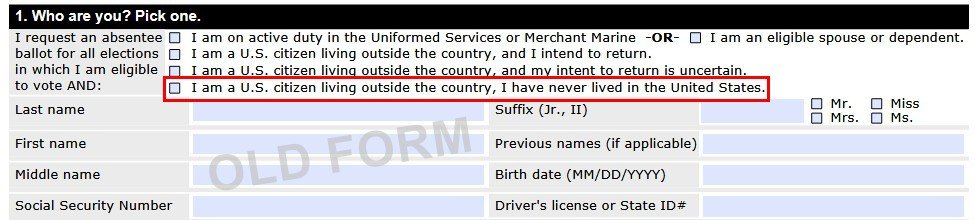
On August 13th, the Department of War issued an Emergency Revision Request letter to eliminate this line.
It also restructures ID questions. It now asks detailed questions, if they’ve ever been issued a valid Driver’s License or State ID, then prove it? Ever been issued a Social Security card, prove it. And so on.

The Office of Management and Budget (OMB) approved the changes on Aug. 28th, and the new form became official on September 1st, 2026. The checkboxes now list only overseas citizens who intend to return to the United States, or whose intent to return is uncertain.
The “never lived in the U.S.” checkbox didn’t accurately reflect the laws governing overseas voting. In the Uniformed and Overseas Citizens Absentee Voting Act (UOCAVA), a civilian living overseas generally votes through the last place they “domiciled” in the U.S before leaving the country.
The DoW (DoD) called the old provision an “inaccurate eligibility checkbox for citizens who have never lived in the U.S.” and said it needed to be removed so the form would comply with UOCAVA.
Non-military individuals, like birth tourists, who have never resided in the United States are not a class of voters specifically defined by UOCAVA. Therefore, they “may not be able” to use the FPCA/FWAB form.
There have been numerous controversies in States like MI, NC, and PA where FPCA applications had little verification. In a 2022 Pennsylvania hearing, Deputy Secretary for Elections Jonathan Marks said: “There’s no systemic verification.”
Eliminating the checkbox is meant to reduce confusion and prevent people outside UOCAVA’s scope from believing they are eligible to vote.
The distinction between U.S. citizenship and a U.S. voting residence is important. They are not the same thing. A citizen living in another country may have every right of citizenship but still needs a state or voting jurisdiction through which to cast a ballot.
The old form appeared to recognize “never lived in the United States” as a separate category of overseas voter. The new form no longer does. It requires an applicant to provide the U.S. address in the state or territory where the person claims the right to register and vote.
The change does not mean that every citizen who never lived in the United States is barred from voting. States retain some authority over voter qualifications. Some states have laws allowing certain citizens who were born or raised abroad to use a parent’s former voting residence.
For those born abroad, 24 States allow full ballot voting. 13 States allow only federal office voting. Another 13 deny eligibility to vote. In Oregon, you are eligible with “conditions”.
FPCA — Federal Post Card Application: Standard Form 76. It’s used to register to vote and request an absentee ballot from the voter’s state or local election office.
FWAB — Federal Write-In Absentee Ballot: Standard Form 186. It’s used as an emergency backup ballot if the regular absentee ballot has not arrived in time
OMB Justification Letter – August 28, 2026
Ad block users: Some site features may not work correctly while an ad blocker is enabled, because they break scripts and content this website depends on. If you can’t see comments below, for example, please disable your ad blocker.