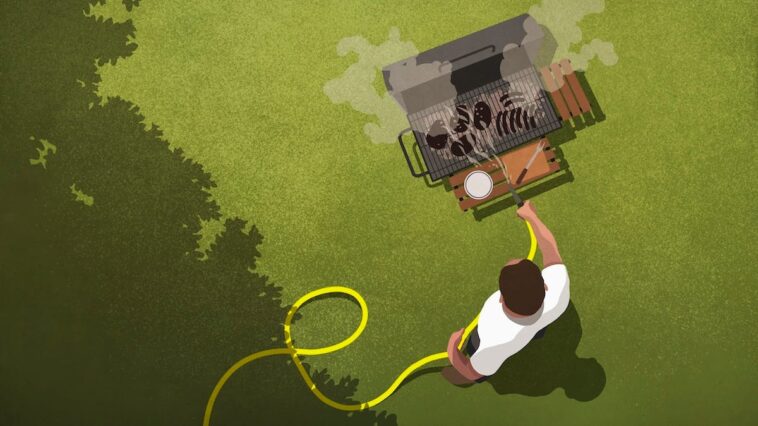
There is a scene in the British animated movie “Chicken Run” where mass panic overtakes the film’s otherwise plucky protagonists. At precisely 7 p.m. on Friday, August 14, a somewhat similar scene occurred throughout the United Kingdom when a piercing alarm suddenly screeched from every mobile phone in the nation. And the reason — I kid you not — was a government warning about the dangers posed by disposable barbecues after a summer marked by hot weather and little rain.
My phone, which permanently lives on silent, emitted such a piercing wail that I nearly fell off my chair. Fortunately, I was at home at the time so could settle my frazzled nerves with a restorative cup of tea. Others were not so fortunate. There were numerous accounts of near misses on motorways as drivers swerved or braked at the sudden noise. Restaurants emptied as fleeing diners assumed a major fire had broken out in the kitchen. Concerts were interrupted, and a vicar friend of mine was conducting Mass when his congregation upped and fled, assuming the smoke alarm had been triggered. Even the BBC was caught unawares.
After we had gotten over the shock of the alarm, those of us living in England, Scotland, or Northern Ireland (three of the four “nations” that make up the United Kingdom — I know, it confuses us too sometimes) were able to find our phones and read the government message warning, essentially, that fire could be dangerous, especially when the grass and trees were dry. Spare a thought, though, for the poor residents of Wales. In a cringeworthy attempt to pander to the handful of people who speak only Welsh, officials sent out the accompanying text in Welsh alone. For the vast majority there who speak only English, the next few minutes involved some hasty use of Google translate to find out whether Russia had just fired a nuclear missile at us.
As you might imagine, the alert spawned countless hilarious memes. Yet aside from those who treated the event like the farce it was, there were some who took the message seriously. Fire and police departments across the country were inundated by people ringing in to report their neighbors for having safe and completely innocent backyard barbecues, an act reminiscent of those dark days when COVID-19 snitch lines encouraged people to report their neighbors for flouting “social distancing” rules during the pandemic. In addition to emergency services being flooded with unnecessary calls about barbecues, domestic abuse charities warned that those vulnerable to domestic violence would have been put in danger if the alert exposed the location of secret and otherwise silent “lifeline” phones.
Rather than admit to a mistake, as was the case in 2018 after residents of Hawaii received the rather sobering message that North Korea may have fired a ballistic missile at them, or in 2023 when an alert was accidentally triggered in Florida at 4:45 a.m., the U.K. government defended its use of the alert as “entirely appropriate.” Yet one wonders if such a forceful use of this piece of state control was partly employed by our new prime minister, Andy Burnham, mere weeks into his tenure to demonstrate how different he is from his dithering and ineffectual predecessor, Sir Keir Starmer, hounded out of office by his own party.
Well, whatever the government’s reasoning, such tactics won’t work for me next time. Thanks to a helpful page on the government website (how refreshing that my taxes pay both for the triggering of frivolous alerts and for the government to tell me how to deactivate them) I have, along with countless fellow Brits, switched all future alerts off. So, in the event of an actual nuclear strike or the zombie apocalypse, I will be left in peaceful ignorance.
Yet looking beyond the absurdity of this event, such government-sponsored psychological manipulation seems to echo M. Night Shyamalan’s 2004 film “The Village,” where a community’s elders manufacture constant dread about unseen, monstrous threats in the surrounding woods to keep the population compliant and constrained. Under the guise of absolute safety, the leadership fosters an environment of hyper-vigilance so intense that the villagers end up policing one another.
The government’s impulse to weaponize state alerts for mundane behaviors relies on this sinister trade-off. Frightening a populace into obedience is a tempting shortcut for a government lacking authority and the trust of its people because fear unquestionably works as an immediate lever of control. Yet, this strategy carries catastrophic costs. In the short term, it erodes social trust, turning neighbors into informants and needlessly disrupting public life. In the long term, it instills a permanent baseline of anxiety while eroding the public’s instinct for self-reliance — leaving citizens both fundamentally controlled and dangerously unprepared when a real crisis finally arrives. It is worth remembering that in the early days of World War II, when it seemed inevitable that Germany would invade and overrun Britain, the official government advice was to “Keep Calm and Carry On,” a sentiment today found only on greetings cards and tea towels.
The modern impulse to treat the citizenry like hyper-vigilant children is part of a broader cultural shift toward what social psychologist Jonathan Haidt terms “safetyism” — the belief that safety is an absolute virtue overriding all other priorities. In his book “The Anxious Generation,” Haidt documents how overprotecting children from managed risk has warped their emotional development. Interestingly, one of the studies Haidt cites lists, among examples of healthy “risky play” children need to experience to develop into functional adults, playing with fire (the others being heights, dangerous tools such as hammers or drills, rough-and-tumble play, doing things at high speed, and disappearing or hiding). Such a finding must surely horrify whichever government official sanctioned that wildfire alert.
Haidt argues that healthy human brains develop systems that can adapt to two kinds of situations, “discover mode” (or the behavioral activation system) and “defend mode” (the behavioral inhibition system). Essentially, we need balanced brains that know how to switch between the former mode, such as when we might explore new territories and undertake risky challenges, and the latter mode, when we must know how to respond to danger. As he puts it: “If we want to help young people thrive — at home, in school, and in the workplace — shifting them into discover mode may be the most effective change we can make.” It is not hard to suspect that a government whose knee-jerk reaction is to send alert messages about barbecues would prefer “defend mode” to be our default setting, regardless of the cost both to young people’s mental health and to their eventual workplace productivity.
The state now seems to be exporting this overprotective logic to adult citizenship. By deploying apocalyptic push notifications to warn us about the risks posed by barbecues and fireworks, the government appears to be actively training the public to distrust its own judgment. This in turn fosters an infantilized society where everyday risk assessment must be outsourced to a digital state nanny.
The suspicion that the U.K.’s recent alert was more about the government flexing its high-tech muscles than trying to make its citizens’ lives easier is reinforced by the software itself. The system is sufficiently sophisticated to be used in targeted areas for localized weather threats, yet despite genuinely risky wildfires being confined to only a few parts of the U.K. at the time, the alarm was sent indiscriminately to the whole country.
Area-specific alarms have been used to good effect in the U.K. in the past — such as during the localized flooding in Cumbria in 2024 or Leicestershire in 2025. Similarly, in the U.S., tornado warnings are routinely restricted to the specific areas most at risk. But imagine if the entire American population were alerted every time a weather event occurred in a state hundreds of miles away. Might frequent exposure to distant threats or overuse of the system leave people feeling that normal life is simply too risky, conditioning them to expect disaster at every turn?
Another danger of this trend is not just that it is annoying, intrusive, and indicative of a government ill-equipped to, well, govern, but that it actively undermines genuine emergency responses, or sometimes leaves people too over-reliant on government alerts to take unilateral action when perhaps they should. Consider the devastating Central Texas floods of July 2025, where official warnings either never arrived, or came too late for many caught in rapidly rising waters, with truly heartbreaking results. When real crises strike, technological warnings are never a guarantee of safety.
Maybe, back in the U.K., this absurd little episode will remind us of something Britain used to be rather good at: keeping calm, carrying on, and keeping a stiff upper lip. If the government insists on treating us like incompetent children, perhaps the most grown-up thing to do is simply decline to play along.
***
Bridget Riley studied modern history at Oxford and completed a Ph.D. in medieval history at the University of Reading. She writes on history, culture, and the philosophy of religion.
This article is part of Upstream, The Daily Wire’s new home for culture and lifestyle. Real human insight and human stories — from our featured writers to you.