
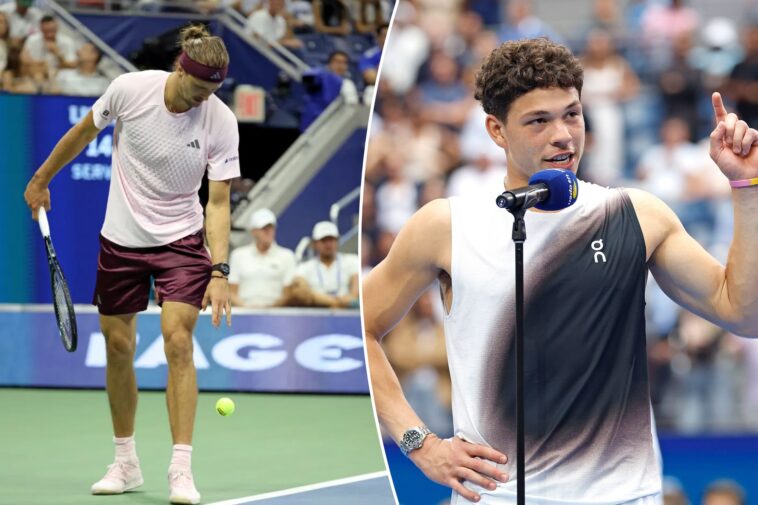

Alexander Zverev’s bouncing grew old on Ben Shelton too.
Throughout the US Open, the top-seeded men’s singles player bounced the tennis ball numerous times before serving — both first and second serves — which left opponents guessing on when to set their feet and be ready to return.
The discussion around it grew throughout the two-week hard court slam and after Shelton fell to the German in the men’s final 6-3, 7-6 (2), 5-7, 6-2 at Arthur Ashe Stadium on Sunday, the young American suggested a rule be made.
“For a first serve you should be able to do whatever you want and use the full 25 seconds every time,” Shelton said during this post-match press conference. “I think there should be some sort of rule — I’m not sure exactly how you would do it — limiting time on 2nd serves. You shouldn’t have unlimited time. I think for our sport, for the fans. I think it’s tough to be sitting there that long for the next play, the next action to happen. I’m sure at some point it’ll be something these tournaments look at just because there is such a delay in play in some matches.”

During the final, the ABC broadcast displayed a graphic that detailed humorous statistics regarding Zverev’s habit.
It read the two-time Grand Slam champion spent an average of 10 seconds ball-bouncing per serve of his 899 serves hit during the tournament, which totaled about 2 hours and 30 mins of ball-bouncing out of his 19 hours and 38 minutes spent on the court in Queens.
Before a first serve, there is a 25-second clock to put it in play. Before second serves, players have as much time as they want and the 29-year-old did just that.
Zverev had about 12,000 ball bounces across his first five matches at the U.S. Open. He said he wasn’t aware of it and wasn’t counting to hit a certain number.
“I’m not doing it on purpose,” he said after his semifinal win over Karen Khachanov. “I saw the stat: like, I bounced it 12,000 times or something like that. That’s quite funny.”

“I don’t know why it increased so much,” Zverev said. “I saw it before the semifinal, so I was, like,‘ OK, it’s got to go less’. Then I forget about it every once in a while, and then it goes up to I don’t know what number it is.”
Starting in the late 2010s, tennis started experimenting with a serve clock before making it a permanent element of the sport to speed up the pace of play.
Shelton’s criticism wasn’t the first to be vocalized to the public. Khachanov spoke up as well.
“It annoys not only me, of course. A lot of players. Because it takes so much time, really. You don’t know how to prepare for the serve,” he said after Zverev beat him. “You are, like, ready, and then it’s another 12 bounces, y’know, so you again do split step. You kind of try yourself, but every point (is) like that. At the end of the day, if it’s within the rules with the time between points…”
Zverev was called for a time violation against both Shelton and Khachanov.
Zverev told the chair umpire on Sunday, “I was at the line 30 seconds ago.”

However, Shelton said the ball-bouncing and waiting didn’t have anything to do with his lack of spark on Sunday. He admitted he was “tired before I got to the court” ahead of his first Grand Slam final.
“Finals of a slam. Played almost 30 sets, something like that over the last two weeks,” he said. So, I wouldn’t say my tiredness had to do with standing there and waiting. Just cumulative for the tournament. Something that I could continue to work, to improve. But, obviously [it is] my first time that I’ve been here in this position. The most tennis that I’ve played in two weeks.”
Shelton had the chance to be the first American man to win a Grand Slam since Andy Roddick took home the US Open title in 2003.
Taylor Fritz couldn’t deliver either against Jannik Sinner in the 2024 US Open final.
Zverev isn’t alone in his excessive ball bouncing. Novak Djokovic is known to do so along with many others.
The US Open has left the sport with a ball bouncing debate to consider.