
President Trump is right: improving higher education requires ending the monopoly enjoyed by certain “accreditors,” which have the power to determine which schools are “qualified” to receive federal student loans. But too many accreditors define “qualified” to advance the woke agenda that millions of Americans elected this administration to repeal, one that undermines merit and public trust. One major university accreditor defines student success as a “focus on equity.” With such a warped and dangerous framing of success, it’s no wonder half of recent graduates assess their college degrees as worthless — and more than half of college graduates take jobs that don’t require a college degree at all.
These schools, and these accreditors, are a problem. Armed with decades of bad federal policy that essentially guaranteed them free money, they created the $1.9 trillion student loan crisis. What’s worse, that money has disproportionately gone toward molding young American minds to hate their country and value victimhood and grievance culture above resiliency and academic success.
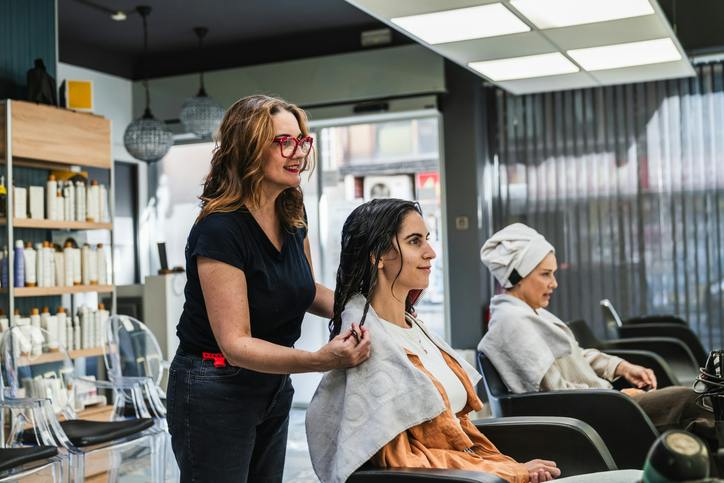
Fortunately, some programs receiving loans have not fallen into this trap: vocational schools have largely stuck to their actual mission. So why is the Trump administration being asked to penalize beauty schools and their accreditor? By October, the Trump administration must decide whether or not to eliminate the primary beauty school accreditor, imperiling loan access for nearly all women seeking to become beauty professionals.
This is what was recommended in a 9–3 vote by the National Advisory Committee on Institutional Quality (NACIQI), the administration’s advisory board that recommends which institutions receive recognition (and therefore which institutions’ students receive federal financial aid). However, while the NACIQI can make recommendations, it has no legal authority to decide which accreditors are approved; that ultimately lies with the Department of Education. The winners would be colleges and universities, who’ll get to pretend cosmetologists have contributed to the student loan crisis on anywhere near the same level as higher education bureaucrats. The losers will be low-income women and mothers seeking flexible career paths.
In other words, for the Trump administration to go after beauty schools would distract from the real issues facing higher education — certainly a convenient one for at least one NACIQI member, Zakiya Smith Ellis, an Obama education official. Smith Ellis has directly defended DEI on the NACIQI, as an official policy statement she made makes clear, having essentially claimed there is no such thing as “illegal DEI.” She seems to have no consistent position on which accreditors should be further regulated. Despite wanting to tighten controls over beauty school regulators, she criticized the Department of Education’s plans to ensure university accreditors make universities follow state law — because, among other concerns, this could mean a university is restricted in terms of “what can be taught about gender and sexuality.” In many ways, it’s a continuation of the Obama and Biden legacy of penalizing trade schools, instead funding and advocating for the expansion of so-called “non-profit” colleges that mire young people in debt and all too often leave them without fulfilling career prospects that actually require a degree.
The accreditation advisory board focused its concerns on “low earnings” for beauty professionals, even though the beauty school accreditor has not been authorized to evaluate earnings. The beauty school accreditor is authorized to evaluate student achievement based on graduation, job placement, and state licensure rates. The question is whether the accreditor appropriately policed that standard, not some invented new one. Earnings are not part of the student success metric today, though they may be in the future. Dinging the beauty school accreditor for an invented earnings metric is like putting a person in jail for something that isn’t currently a crime (but might be someday).
Not that earnings should be the relevant success metric for beauty school anyway. For one, the average cosmetology graduate only works 26 hours a week. Not exactly overtime. Women in beauty are very often working mothers seeking a job they love with the flexibility they need. Closing doors to this choice is protectionist, which would be more understandable if we needed to protect, say, the public fiscal interest. But cosmetology graduates own less than 1% of the student loan debt. This loan portfolio doesn’t move the needle, nor does it target the biggest offenders in the education marketplace.
The Trump administration has a better path available. The beauty school accreditor should be required to improve any areas of weakness during a year of federal scrutiny and oversight. During this year, the beauty school accreditor would have its share of paperwork improvements — for instance, the accreditor currently has a slightly different definition of what a “branch campus” means than the Department, and can align itself better with federal guidance. By choosing one-year of federal oversight with specific mandates, the administration can avoid throwing beauty schools — and the women who rely on them — into a tailspin to find a new accreditor immediately, which could take up to two years and tens of thousands of dollars (if not more) for schools that are often small and community-based. Better yet, the administration can spend the next year improving the accreditor’s oversight function and establishing more accountability for the schools themselves.
There is plenty of work to be done to remove the equity-obsessed accreditors from power who were creating the sorts of racially and ideologically biased outcomes that millions of Americans elected President Trump to address. Hard-working women seeking flexible careers in the trades, however, have little to do with these problems, and they should not have the rug pulled out from under them.
***
Neeraja Deshpande is a policy analyst at Independent Women.