
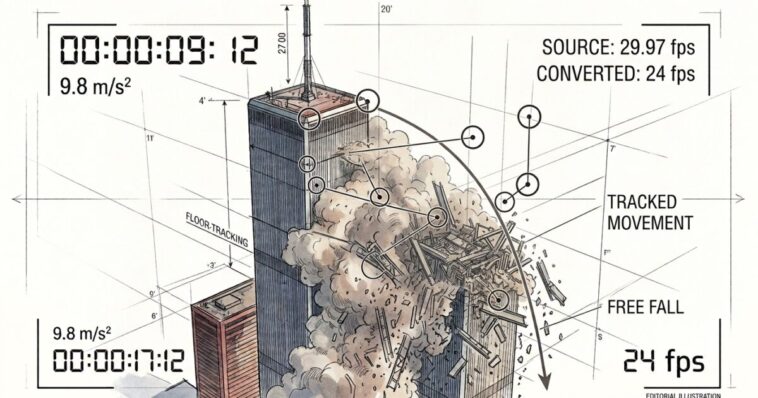

One of the most persistent 9/11 conspiracy theories holds that the World Trade Center towers were brought down not by the impact of hijacked airliners and the resulting fires, but by a controlled demolition, an inside job carried out with foreknowledge by parties other than al-Qaeda.
Proponents point to the buildings’ collapse speed as their central piece of evidence, arguing that the Twin Towers and WTC 7 fell at “free-fall speed.” Their argument follows a specific logic: In a standard structural collapse, the floors below the initial damage would resist the descent of the floors above, producing a fall slower than free fall.
If a building falls at or near free-fall acceleration, they argue, that resistance must have been eliminated in advance by explosives placed to sever support columns simultaneously throughout the structure.
The Gateway Pundit previously addressed this claim, explaining that preparing the towers for a controlled demolition would have required months of work. Crews would have needed to remove concrete and steel supports to weaken the buildings, extract tons of material, and install tons of explosives. Such work could not have been conducted secretly, with trucks, workers, and power tools operating throughout the buildings. The towers also would have been unsafe and unusable during the process.
Proponents of the free-fall claim reject this premise and instead cite video clips with superimposed timers and the National Institute of Standards and Technology’s (NIST) finding that WTC 7’s facade fell at near-gravitational acceleration for approximately 2.25 seconds. This claim is the theory’s evidentiary anchor, and it is also its weakest point.
The World Trade Center towers did not collapse at free-fall speed. In physics, free fall has a specific definition: an object accelerating solely under gravity at 9.8 m/s², with no opposing resistance. In a theoretical vacuum, an object dropped from the roof of the Twin Towers would hit the ground in approximately 9.2 seconds.
The actual collapses of WTC 1 and WTC 2 took between 12 and 15 seconds. The upper section of each tower crushed through dozens of intact lower floors, whose structural resistance absorbed energy and slowed the collapse well below free-fall speed.
The 2.25-second interval concerned WTC 7, which conspiracy claims often conflate with the Twin Towers. WTC 7 collapsed separately after burning uncontrollably for more than seven hours. According to NIST, internal column failures had already hollowed out the building’s interior, leaving the exterior curtain wall momentarily unsupported. Outside that interval, the facade fell significantly slower than free fall.
NIST’s final report divides the WTC 7 collapse into three stages rather than a single, uniform fall. In NIST’s analysis, Stage 1 covers the buckling of exterior columns in the lower stories, producing a descent slower than free fall. Stage 2 is the 2.25-second interval in which the north face fell at essentially true free-fall acceleration, which NIST attributes to those columns losing their capacity to support the load above them. In Stage 3, the acceleration decreases again as the upper section meets resistance from the collapsing structure and debris below.
Claims that the buildings fell at free-fall speed rely on faulty methods, including placing timers over uncalibrated video clips without accounting for playback frame rates, camera distance, or optical illusions. Online videos are frequently re-encoded and converted between frame rates, such as from a 29.97 fps broadcast to 24 or 30 fps, which can speed up or slow down playback.
If a video runs even 10 percent faster or slower than the original recording, a superimposed clock proves nothing about real-world velocity unless the footage is checked against the raw broadcast metadata and known timecodes.
These clips are also subject to optical illusions. What viewers see falling fastest is often not the building itself, but heavy steel debris ejected outward by air pressure. This debris falls at close to free-fall speed through open air, creating the impression that the entire structure is descending just as quickly.
Without a fixed coordinate system for tracking specific floor lines, viewers can easily mistake dust clouds or fast-moving debris for the main roofline. Zoomed-in telephoto lenses also flatten depth, making it difficult to determine whether falling material is near the camera, within the dust cloud, or part of the core structure.
Forensic analysts measure collapse velocity differently. Photogrammetry maps known architectural dimensions, such as floor heights and column spacing, onto video frames. Fixed features such as corner lines and roof edges then serve as physical rulers for calculating velocity and acceleration using verified timecodes.
Lamont-Doherty seismic monitors operated by Columbia University provided independent confirmation by recording ground shock waves that established the collapses’ start times and durations, which were significantly longer than a free-fall trajectory.
The free-fall claim persists because uncalibrated video can easily be manipulated to support a narrative. Properly anchored analysis using photogrammetry, verified timecodes, and seismic data shows that the towers’ descent encountered structural resistance rather than occurring in free fall.
Ad block users: Some site features may not work correctly while an ad blocker is enabled, because they break scripts and content this website depends on. If you can’t see comments below, for example, please disable your ad blocker.