
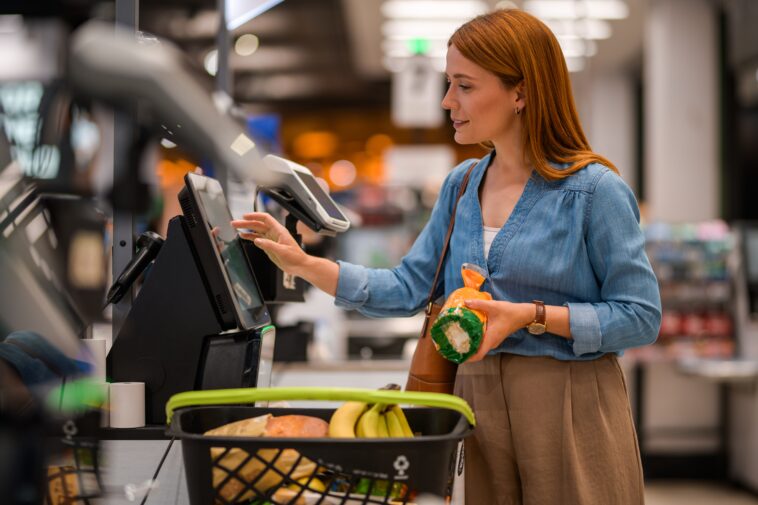

San Jose could become the first Bay Area city to enforce self-checkout regulations in grocery stores and drug stores across the area, as the industry continues push the technology.
The Silicon Valley city is looking to add regulations to the logistics of self-checkout areas with the hope of improving working conditions, enhancing public convenience and curbing retail theft.
San Jose loses up to $400,000 in sales tax revenue each year due to retail theft, according to city officials. Understaffed self-checkout zones are also a reason for degrading work conditions and heightened safety risks for store employees, officials added.
Sign up for the California Morning Report newsletter
The biggest news, opinion and culture shaping California right now.
Thanks for signing up!


The San Jose City Council’s rules committee met Wednesday to discuss the new potential regulations.
The regulations included a mandated ratio of one employee for every three kiosks, limiting self-checkout transactions to 15 items or less and keeping one employee-staffed checkout lane open any time self-checkout machines are open.
While Southern California cities, including Costa Mesa, Long Beach and Santa Ana, have already enacted self-checkout regulations, San Jose would be the first Bay Area city to restrict customer self-checkout, if passed.
Some Safeway and Target locations in San Francisco have quietly disabled their self-checkout machines due to retail theft.
Download The California Post App, follow us on social, and subscribe to our newsletters
California Post News: Facebook, Instagram, TikTok, X, YouTube, WhatsApp, LinkedIn
California Post Sports Facebook, Instagram, TikTok, YouTube, X
California Post Opinion
California Post Newsletters: Sign up here!
California Post App: Download here!
Home delivery: Sign up here!
Page Six Hollywood: Sign up here!
The new regulations could raise grocery prices, create longer lines and put workers in danger without stopping crime, Nate Rose, a spokesperson for the California Grocers Association, told The Mercury News.
Rhode Island passed a statewide bill in June mandating the 1:3 grocery worker to self-checkout machine ratio, set to take action in January 2027.
The United Food and Commercial Workers union (UFCW) Local 5 — which represents a “highly diverse group of laborers in Northern California — created a petition in support of self-checkout regulations. The petition has gained over 1,400 signatures and includes a letter template that residents and retail employees in San Jose can send to City Council.

Senate bill (SB 442) — which passed the First Chamber but is still in the Committee review stage — details the potential requirement for keeping human-staffed lanes open in retail stores.
The bill would require these establishments to include self-service checkout in the “employers illness and prevention program, as required by regulations of the Division of Occupational Safety and Health.”

The bill would also require retail grocery and drug stores to notify workers at least 60 days in advance of self-checkout service implementation. Employers who violate the bill’s provisions could be subject to a civil penalty of $1,000 per violation per day, up to an aggregate penalty of $200,000.
The UFCW has displayed data showing self-checkout loss rates as high as 3.5% compared to just 0.21% for employee-staffed lanes. These loss rates are driven by administrative errors, damages and tactics like “short-ringing” items, in which people may skip over ringing items in their cart.