
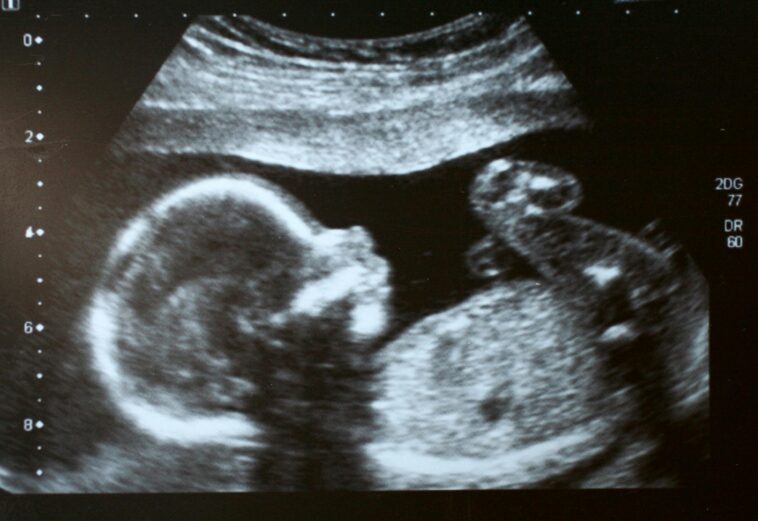
Last week, The New Yorker published Apoorva Tadepalli’s essay “The Unsettling Ambiguity of Early Pregnancy.” Pregnancy tests, she writes, draw a “misleading, somewhat arbitrary, binary” between pregnant and not pregnant. “You can be kind of pregnant, a little bit pregnant, almost pregnant, or maybe pregnant,” she says, “and still test positive.” The essay treats implantation, the human embryo’s attachment to the uterus, after which a home test can detect hCG, as the snapshot from which we merely invent the beginning of pregnancy.
Commentators and readers recoiled from a claim that still sounds like a joke: that a woman can be “a little bit pregnant.” The outrage is reasonable. The idea is not new.
If you think “pregnancy” begins at implantation rather than fertilization, you have already accepted the false premise the magazine is now selling: a living human being can be physically present in a woman’s body while she is simultaneously defined as not pregnant — “almost pregnant.” And it has been written into federal regulation and obstetric terminology for more than half a century.
A new human being begins to exist at fertilization. That is Carnegie Stage 1, the first stage of the gold-standard system that documents the first 56 days of human life — the Carnegie Stages of Human Embryonic Development. The new human being, called an embryo, is not a “potential,” not a “maybe,” not a “possible.” He or she is a whole, individual, living, self-directing human organism with a unique genome. For about a week after fertilization, that human being develops and travels from the fallopian tube to the uterus before implantation even starts. Implantation is a change of location. It is not the origin of that human life.
Call the gap what you like. The result is the same: A living human being who does not count in regulation or on the label. You cannot be “a little bit pregnant.” Either a new human being is present or it is not. In ordinary human sexual reproduction, fertilization answers that. Implantation, or any later developmental milestone, does not.
Pregnancy is the presence of a new human being, not a human being who has implanted, produced enough hormone for a drugstore test, or reached some later biomarker. As the human embryologist Bruce Carlson writes in a standard medical-school textbook, “Human pregnancy begins with the fusion of an egg and a sperm.”
The New Yorker did not invent this “almost pregnant” doctrine. In 1965, the American College of Obstetricians and Gynecologists (ACOG) issued Terminology Bulletin No. 1 and redefined “conception” as “the implantation of a fertilized ovum.” The college’s 1972 terminology volume was blunter: conception, it said, “is not synonymous with fertilization,” and the synonym it assigned was implantation. That was a change in the glossary, not a finding in the lab.
The British reproductive biologist A. S. Parkes of Cambridge was among those who, in mid-century reproductive biology, suggested the simple revision. Equate conception, he said, “with the time of implantation rather than the time of fertilization — a difference of only a few days.” In this way, a product that can act after a new human being exists, but before implantation, can be sold as contraception rather than as a grave intervention that can end a human life.
The U.S. Department of Health and Human Services codified the same start line. When it issued Subpart B of the human-subjects research regulations in 1975, pregnancy was defined from implantation. The current text, 45 CFR 46, still says pregnancy “encompasses the period of time from implantation until delivery,” and defines “fetus” as “the product of conception from implantation until delivery.” It misdefines pregnancy and fetus, and it omits “embryo” altogether. The embryonic period, the first eight weeks of a human being’s life, is missing from the definitions written to protect human subjects.
The abortion industry, drugmakers, IVF clinics, and human-embryo researchers all benefit from the false definition. In 2005, the Guttmacher Institute, Planned Parenthood’s research arm, wrote that the implantation definition of pregnancy is “critical to distinguishing between a contraceptive that prevents pregnancy and an abortifacient that terminates it.” If implantation is when pregnancy starts, action against a living human being beforehand is contraception by definition. That is not a scientific conclusion. It is a useful one.
The New Yorker widens the gap the implantation rule created. It makes the official line feel too slight to bear the weight we put on it. If a positive test is only a “somewhat arbitrary” snapshot (a pregnancy, she writes, not a baby), then implantation is merely the first official maybe, and what counts is whether someone is willing to say a child is there.
HHS can correct the false definitions it wrote. Rewrite 45 CFR 46 to reflect scientific reality: pregnancy begins when a human life starts, at fertilization, and “embryo” names the human being during the embryonic period. Labels and research rules should describe what is present, not what is convenient to exclude — and they should do so before still more children disappear under the banners of “contraception” and “tissue.”
***
Brooke Stanton is the co-author of “The First 56 Days of You: How Your Human Journey Begins” and the chief executive officer of Contend Projects, a registered 501(c)(3) education organization spreading the basic, accurate scientific facts about when a human life starts and the biological science of human embryology.