
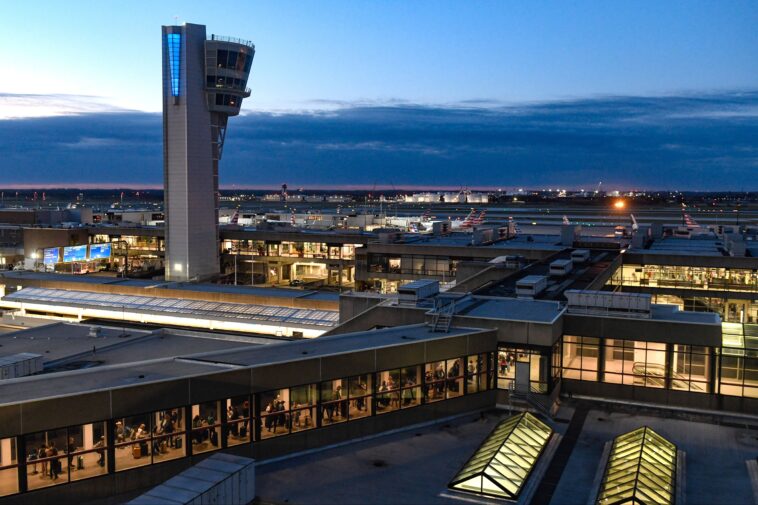

Health officials warned of a new measles exposure at a bustling Pennsylvania airport — marking the second recent exposure to the highly contagious virus in the state’s largest city.
A person infected with measles passed through Philadelphia International Airport from Sept. 13 at 7:25 p.m. to 12:05 a.m. on Sept. 14, the Philadelphia Department of Public Health announced on Friday.
The measles-carrying individual traveled through the airport’s terminals B and F and used areas connected to terminals C, D, and E, the department said.

“The individual with measles was traveling through Philadelphia and did not leave the airport,” health officials wrote in the statement.
The warning was announced just days after a separate measles exposure at the Children’s Hospital of Philadelphia.
Various parts of the hospital were exposed to measles, including parts of the NICU, on Sept. 11, the department said in an advisory last week.
Travelers at the Philly airport during the exposure time who are not immune to measles, are unsure of their vaccination status, are an infant, are pregnant and not immune, or are immunocompromised should contact a health provider “as soon as possible,” authorities urged.
Anyone who was in the airport areas during the listed times should check whether they are immune to measles.

“The Health Department is encouraging people who were exposed to check their vaccination status and watch for symptoms,” the statement said.
As of Sunday, Pennsylvania has had 792 measles cases, including 155 hospitalizations and four deaths, according to the state’s data.
There have been a whopping 3,471 measles cases in the US this year — with CDC data revealing just 92.4% of kindergartners received the MMR vaccine in the 2025-2026 school year.
Vaccination rates have fallen compared to the 95.2% seen in the 2019 to 2020 school year.
The highly contagious virus spreads through the air when infected people cough, sneeze, or talk, and can infect an unvaccinated person up to two hours after someone with the illness leaves a room or airspace.

Early symptoms include fever, runny nose, cough, and red, watery eyes, followed by a rash. If the terrifying virus progresses, it can lead to pneumonia, brain infection, and death.
The CDC recommends two doses of the MMR vaccine — the first administered at ages 12 to 15 months and the second between 4 and 6 years old.
“This week’s measles exposures are a reminder of how important it is for all of us to be up to date on our vaccinations,” Philadelphia Health Commissioner Dr. Palak Raval-Nelson said in a statement.
“Every Philadelphian who is fully vaccinated has little to fear from the situation at CHOP and the airport. Even more importantly, every one of those people is doing their part to help protect our most vulnerable from measles,” Raval-Nelson added.
“With outbreaks continuing in Pennsylvania and other places, this is even more important. I encourage everyone to visit phila.gov/measles to learn more about measles, the MMR vaccine, and what they can do to keep themselves, their families, and their community safe.”