

The Weekly Wrap: People Are Worried About Diesel Prices and AI Crowding Out Everything
Welcome back to Friday!
The 10-year Treasury yield hit its highest point since 2002. This is actually a sign of economic strength, but the financial press insists it means doom because Donald Trump is president, and the First Rule of Trump Era Financial Media is that everything is bad and always getting worse as long as the Bad Man is in White House. The minutes of the Fed’s last meeting showed most officials expect another rate hike by year-end. But not this month! Markets now put roughly 17 percent odds on an October hike. The December move now enjoys 80 percent odds. Jobless claims fell to 197,000, which is near levels rarely seen since 1969. The S&P 500 closed at 7,818.93 on Tuesday, the highest on record. But everyone says they hate the economy, so the University of Michigan’s gauge of current conditions sank to a record low.
For this week’s wrap, we’re mostly just going to ignore all that so we can talk about trucks and AI. Vroom! Vroom!
Let’s go!
People Are Worried About Diesel Prices
The financial press in recent weeks has been full of stories about calamitous commercial consequences arising from what everyone keeps calling record-high diesel prices. These grabbed our attention because, as we explained earlier this week, diesel prices are not at a record high after you adjust for inflation. This makes it unlikely that things are becoming unglued across the economy because of the price of diesel.
Let’s back up and start with the problem with the “record-high” narrative. The Energy Information Administration’s on-highway average hit $6.53 a gallon the week of September 21, which is the highest weekly reading since the series began in 1994. But the dollar’s purchasing power has declined sharply in recent years; and once you adjust for inflation, we’re not paying top dollar for diesel. The June 2008 peak of $4.764 a gallon comes to about $7.20 in August 2026 dollars. In June 2022, the nominal diesel price hit $5.81, which is $6.57 in today’s dollars. The nominal price is now around $6.28 a gallon, which is the equivalent of $4.12 in 2008 and $5.55 in 2022.
Yet the business press has become obsessed with the idea that trucking companies are being thrown into bankruptcy by these prices. “High Diesel Prices Bankrupted 16 Trucking Companies in Just 30 Days,” announced the typically sober auto news site The Drive on October 5. Just in case you didn’t get the message, the subhead declared: “Expensive diesel fuel isn’t just driving up costs—it’s driving trucking companies out of business.”
According to multiple sources, the rising cost of diesel fuel was the straw that broke the camel’s back for 16 freight operators that filed for either Chapter 7 or Chapter 11 bankruptcy protection in late August and early September. Some were small, single-operator outfits. Others were larger, operating dozens of vehicles.
So what are these sources? The Drive links to a story on Inc.’s website: “A Wave of Trucking Companies Rolled Into Bankruptcy Court in the Wake of Record Diesel Prices.” Notice the subtle shift. Inc.’s story did not actually say diesel prices bankrupted trucking companies. It said the bankruptcies occurred “in the wake” of high prices. The causal factor was introduced by The Drive.
The Inc. story was based entirely on a September 22 story by FreightWaves, which happens to be the second of the three “multiple sources” that The Drive cited. The third source was a story in TheStreet.com that was also based on FreightWaves. So, in reality, it’s just one source: FreightWaves.
So what did that story say? FreightWaves reporter Noi Mahoney tallied federal dockets and carrier records and found at least 16 trucking, delivery, and transportation companies entering Chapter 7 or Chapter 11 between late August and September 21. Eight were reorganizations, and eight were liquidations. “The filings come as trucking companies continue navigating a freight environment marked by rising diesel fuel prices and other elevated operating costs,” Mahoney wrote.
Note that Mahoney also did not say diesel was “the straw that broke the camel’s back” or anything like that. We’re sure that the not-quite record-high diesel prices aren’t helping truckers, especially the small ones. But typically longer-term shipping contracts allow truck companies to pass through fuel costs to their customers, greatly alleviating the pressure from the pump. They are also dealing with a tight labor market and the loss of many illegal alien drivers due to the Trump administration’s decision to start enforcing U.S. immigration law after the long Biden free-for-all. Insurance prices have also jumped higher, creating financial pressure.
But this did not stop the Daily Mirror from citing The Drive’s version in a story that went further, saying the diesel price hike “sparked by the Iran war” had put the firms out of business. You get the picture. Somehow this is all Trump’s fault and really, really, really bad.
Beyond the thin and repetitive sourcing and the drift into causality, another problem with these stories is that they lack a baseline. Is 16 bankruptcies a lot or a little? How many trucking companies normally declare bankruptcy in a given month?
Mahoney, who is the only one who did the original reporting on these bankruptcies, published similar dispatches earlier this year: about a dozen filings in mid-to-late April, more than 20 in the 30 days through May 28, and at least 21 transportation and logistics cases from July 27 to August 25. So there wasn’t really a spike at all in September, when diesel prices hit the nominal record.
These filings are also a vanishingly small share of a larger population. FTR Transportation Intelligence puts authorized for-hire carriers at about 345,000, which is roughly a third above the pre-pandemic level. Several of the 16 companies on the FreightWaves list had one truck.
In other words, there’s no epidemic of trucking bankruptcy due to record-high prices because prices aren’t at a record high and there aren’t all that many bankruptcies.
People Are Worried That AI Is Eating All the Investment Dollars
Investment booms tend to also create a bull market for the idea that the non-booming parts of the economy are being starved for funds. The idea is that the trendy expanding sector is “crowding out” investment in other sectors.
The most recent version of this centers around growth in construction spending. There’s been a lot of it for data centers and some in power, but everything else has seen a contraction.

Seems bad! We’re growing data center construction so much that we cannot afford to grow anything else! Data centers aren’t just using up all our water and electricity—they’re gobbling up all our construction financing as well.
Look, we’re very much aware of the fact that the economy can go kind of crazy and devote way too much financing to one part while neglecting others. This is what happens in manias such as the housing bubble of two decades ago. (Yes, the housing bubble was two decades ago. We hate it too. We’re all so old now.) But there’s not much evidence of it happening now.
The first thing to notice is that these are growth levels. If you only glance at the chart, it might seem like power and data centers are the only places we’re spending money to build. But that’s not true. It’s just that that’s where the growth is.
If you want to know what the spending looks like, here you go:
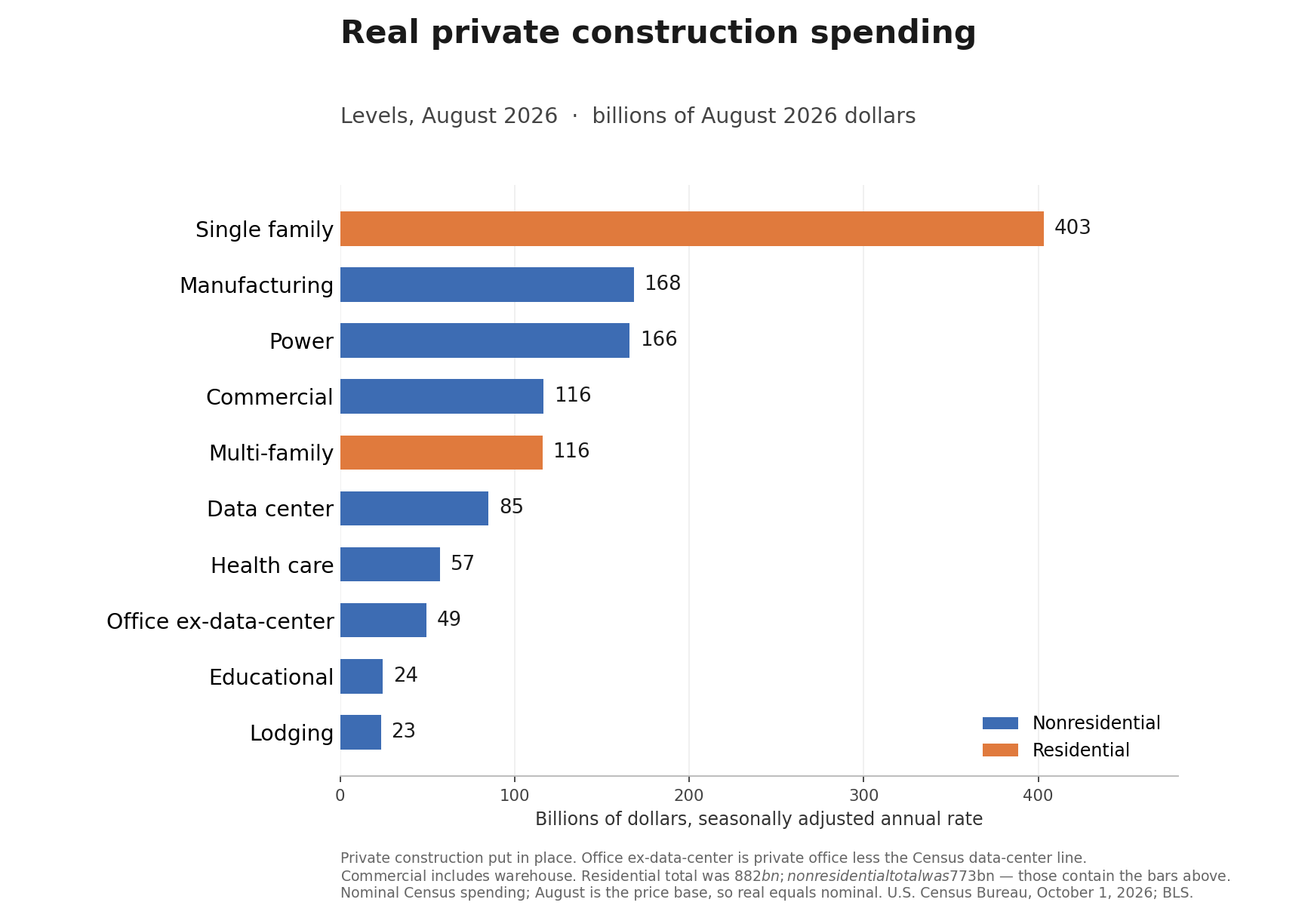
Notice that single-family construction is by far the biggest category. Manufacturing is second. Power comes in third place, followed by commercial and multi-family residential. In August, construction spending in the above categories ran at an annualized rate of around $1.2 trillion. Data center construction is around seven percent of that.
And there are good reasons for construction in many of those categories to slow down even if we’re having a data center building boom. Interest rates are high and holding back the housing market, so you would expect residential construction spending to slump. The number of students in the U.S. has peaked, at least temporarily, with smaller enrollments expected in the future. So educational construction should be shrinking. Biden-era subsidies pulled forward a lot of manufacturing construction, which meant that a contraction was inevitable. Shopping centers aren’t exactly going to be a big growth area anytime soon thanks to the never-ending rise of online shopping. Regular office construction? Does anyone think that should be growing amid remote work and a labor force that isn’t growing?
So why are the financial press and economic pundits so excited about this faulty crowding-out narrative? Because that’s what the First Rule of Trump Era Financial Media requires.
Breitbart Business History: The Dot Com Bear Market Hits Bottom
Twenty-four years ago today, the dot-com bust finally hit rock bottom.
On October 9, 2002, the S&P 500 closed at 776.76, marking the bottom of the bear market that followed the bursting of the dot-com bubble. The index had lost roughly 49 percent from its March 2000 peak.
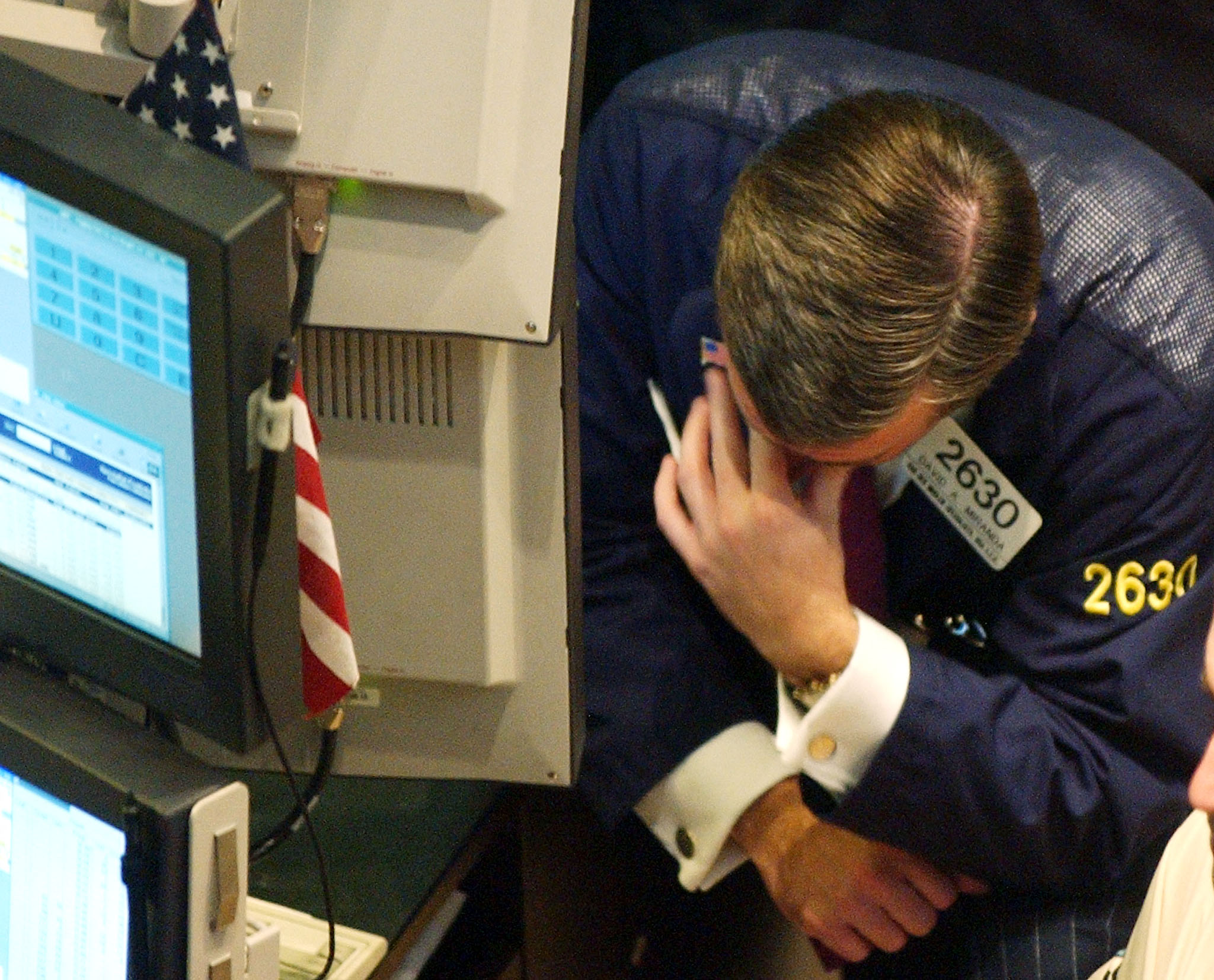
A trader on the floor of the New York Stock Exchange reacts to news late in the trading day on October 9, 2002, as the Dow Jones Industrial Average fell 215.22 points, closing at 7286.27 and wiping out all of the previous day’s gains, and then some. (HENNY RAY ABRAMS/AFP via Getty Images)
The internet really would have revolutionary consequences for commerce, communications, and everyday life. But that did surprisingly little for shareholders in companies whose business plans consisted of losing money faster than their competitors. Just because a technology does the disruptive transformation everyone expects doesn’t mean the expected returns to investors show up. We’re not sure, but that seems like something that might be relevant today. If you can think of something, drop us a line.
Of course, nobody rang a bell that afternoon announcing the bottom. Buying required stepping into a market that had spent more than two years teaching investors that yesterday’s bargain could become tomorrow’s expensive mistake. You had to run against the grain of overwhelmingly bearish investor sentiment.
Exactly five years later, on October 9, 2007, the S&P 500 closed at 1,565.15, its peak before the financial crisis.