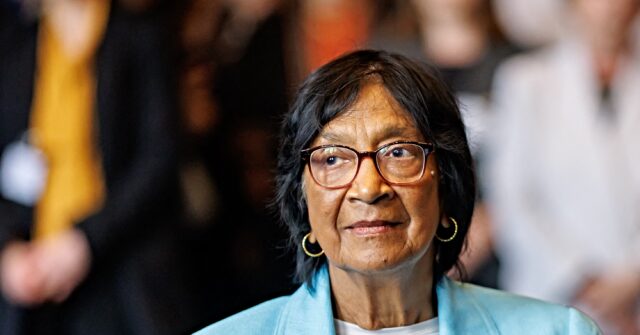
Multiple human rights activists accused 2026 Nobel Peace Prize laureate Navi Pillay, a former U.N. high commissioner for human rights, this weekend of having used her position at the global agency to help China persecute Uyghur people.
Dolkun Isa, the president of the Uyghur Center for Democracy & Human Rights and former president of the World Uyghur Congress, revealed in a public statement that Pillay had shared information about him with the Chinese government, potentially endangering him and his family. The non-governmental organization U.N. Watch also shared accusations that Pillay used her position at the U.N. to identify Uyghur activists and share information with China that could facilitate their persecution by the communist regime.
The Nobel Committee announced on Friday that it had chosen Pillay as the 2026 recipient of the Peace Prize to honor her “commitment to universal legal principles and her firm moral compass.” Pillay began her career as a judge in South Africa, later serving at the United Nations, on the International Criminal Court (ICC), and currently at the International Court of Justice (ICJ). The Nobel Committee emphasized that the prize was intended to “remind the world that the rule of law – national and international – underpins the system we have set up to ensure peace and resolve conflicts non-violently” – an apparent dig at the United States, which recently sanctioned the ICC for its disproportionate attempts to prosecute Israeli politicians in the aftermath of the October 7, 2023, Hamas massacre.
While much of the criticism of Pillay focused on her years of anti-Israel advocacy, those aware of China’s ongoing genocide of Uyghur and other Turkic people in occupied East Turkistan lamented Pillay’s alleged record of support for the Communist Party’s genocidal policies, including allegedly aiding transnational repression.
Isa, the former World Uyghur Congress head, observed in a public statement this weekend that the United Nations placed “serious obstacles to accreditation and access” to him and his group during her time running the human rights office there. More egregiously, he wrote, “I later learned that the office she led had shared information about my participation, and that of other human rights defenders, with the Chinese government without our consent.”
“For me, this was a profound betrayal of trust by an institution that should have protected us. The responsibility for this practice still demands a full and transparent accounting,” he lamented. “I acknowledge Pillay’s achievements and courage in other areas. But those achievements cannot erase the failure to protect our rights and safety during her leadership. Nor have I seen from her the strong, unequivocal solidarity that I expected in the face of the Uyghur genocide.”
“A Nobel Peace Prize does not place anyone beyond accountability,” Isa concluded. “I want answers: Why was information about human rights defenders shared with China? Who authorised it? And why did those entrusted with our protection fail us?”
The Chinese government has been engaging in genocidal activity against the Uyghur, Kazakh, Kyrgyz, and other indigenous people of East Turkistan since at least 2017, when communist dictator Xi Jinping ordered policies to eliminate Uyghur culture, the local Islamic religion, and other hallmarks such as local architecture and replace them with sterilized Han communism. Leaked documents show that high-ranking Communist Party officials commanded underlings to “break the lineages” of Uyghur families, a task reportedly executed through the imprisoning of millions of people in concentration camps, mass forced sterilization, and live organ harvesting, according to reports by human rights experts and journalists. China has aggressively denied that it has engaged in any genocidal activity.
Isa was joined by U.N. whistleblower Emma Reilly, who responded to the news of Pillay’s award by similarly recalling that Pillay allegedly used her position at the United Nations to aid the persecution of Uyghur people. Reilly reportedly accused Pillay of being “complicit in the Uyghur genocide” and recalled other actions that Pillay took in apparent solidarity with communist China, such as failing to attend the Nobel ceremony honoring 2010 Peace Prize laureate Liu Xiaobo, an anti-communist political prisoner who died in Chinese custody.
RELATED FLASHBACK: Uyghur Concentration Camp Survivor — NBC “Supports Genocide” by Airing Olympics
“Navi Pillay oversaw the communication of names of over 50 dissidents to China. Families of the dissidents testified in court,” Reilly accused. “They testified, under oath, to their family members being intimidated, arbitrarily detained, tortured, disappeared, and even killed in concentration camps. This is an absolute travesty of ‘peace.”
UN Watch Executive Director Hillel Neuer issued a statement following the revelations about Pillay urging the Nobel Committee to explain how Pillay’s alleged behavior supporting Beijing.
“The Nobel committee owes an explanation to the dissidents whose names were handed to China,” Neuer wrote. “Emma Reilly has raised devastating allegations of complicity in genocide against the woman they have chosen to honor. Where was the scrutiny? Where was the concern for the victims and their families?”
Neuer added that Pillay has remained publicly silent about a host of countries known to egregiously violate human rights, including Cuba and North Korea, as well as not speaking out about human rights abuses in Iran.