Britain on Monday blamed Iran’s Islamic Revolutionary Guard Corps (IRGC) for a suspected terror plot targeting RAF Fairford, the British airbase used by American bombers to strike Iran, following a security threat that prompted the United States to withdraw all 12 B-1 bombers stationed there.
Prime Minister Andy Burnham told Parliament that British intelligence assessed the September 27 incident was “highly likely to have been coordinated in Iran, almost certainly directed by Iran’s Islamic Revolutionary Guard [Corps].”
The announcement marked Britain’s strongest public attribution yet of the suspected operation, which triggered a major security response near the base and preceded an extraordinary American military withdrawal amid intelligence warnings of a possible Iranian attack.
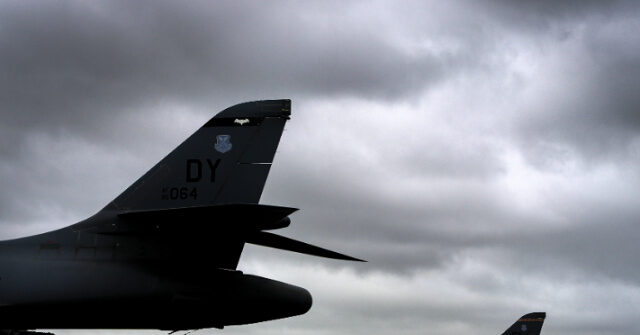
RAF Fairford, roughly 100 miles west of London, has served as a staging ground for American bombing operations against Iran during Operation Epic Fury. The Pentagon withdrew all 12 B-1 bombers from the base this month amid intelligence warnings of a potential Iranian drone attack, as first reported by the Wall Street Journal and subsequently detailed by the New York Times, citing U.S. and British officials.
The withdrawal was so urgent that some bombers departed while aerial refueling aircraft were still being deployed to support their flights back to the United States, according to the report. Such a rapid evacuation from an allied airbase thousands of miles from the combat zone was highly unusual.
American commanders had received warnings as early as mid-September that Fairford could face an Iran-backed attack. New intelligence heightened the urgency in early October, prompting the sudden withdrawal.
U.S. and British officials described the suspected operation as a complex, multipronged plot to destroy American aircraft and kill U.S. personnel stationed at the base. Some officials believed it may have been loosely modeled on Ukraine’s 2025 operation against Russian airbases, in which drones concealed in trucks were used to strike military aircraft.
The security concerns intensified on September 27, when British police arrested five men traveling in vans near Fairford, evacuated 85 nearby homes and deployed a bomb-disposal robot to inspect the vehicles. Authorities found no explosives. Two additional suspects were subsequently arrested, bringing the total to seven; all were released on bail, and none has been charged.
It remains unclear whether the suspects arrested near Fairford were connected to the suspected drone operation or were preparing a separate attack, as Axios previously reported.
The suspected Iranian threat also extended beyond Britain. According to the Times, Israel warned Germany that American military installations there faced heightened risks, specifically identifying Ramstein and Spangdahlem airbases.
The IRGC had warned in July that Britain’s decision to allow American forces to use its bases for strikes against Iran made London responsible for U.S. military actions.
“Any base used to launch attacks on Iranian territory,” the group declared, “is a legitimate target for our forces.”
Trump acknowledged the threat last week, telling reporters that the bombers had been withdrawn because of security concerns rather than a routine military rotation.
“There were some threats,” Trump said at the time. “Why should we leave them there?”
“They didn’t fly out by accident,” he added.
Asked whether Iran was responsible for bringing combat drones into Britain, Trump said he could not confirm the allegation but warned that Tehran would “suffer greatly” if it had done so.
Vice President JD Vance separately said War Secretary Pete Hegseth had ordered the bombers withdrawn “out of an abundance of caution” to protect American personnel. Vance said the administration believed “with some confidence” that Iran was pursuing attacks against U.S. interests.
Britain’s new assessment on Monday brought the suspected operation into sharper focus, with Burnham declaring that London would respond to Iranian threats on British soil.
“We will not tolerate these threats on our soil,” the prime minister said.
“We will crack down on Iran’s use of criminal networks, using our full range of powers to target them and their funding streams, and we will bring further sanctions to restrict the capacity of Iran and the IRGC to do us harm.”
Home Secretary Shabana Mahmood said authorities believed the suspected operation was likely coordinated by a known individual based in Iran, although officials have not publicly identified that person.
Britain also announced sanctions against two Iranian nationals accused of involvement in separate hostile operations: Ruhollah Bazghandi, identified as an IRGC counterespionage official, and Shahram Ali Reza Tamarzadeh Jakki, who has been linked to the Zindashti Network.
The measures include asset freezes, travel bans, and restrictions on serving as company directors. The sanctions were not presented as evidence that either man directed the Fairford incident.
Foreign Secretary Ed Miliband summoned Iranian Ambassador Seyed Ali Mousavi over the allegations, condemning Tehran’s alleged use of criminal networks and proxy groups to threaten Britain and its allies.
The United States joined Britain and 27 other countries in condemning Iranian hostile operations, including suspected plots involving violence, sabotage, and attacks carried out through covert networks.
In a joint statement describing the Fairford incident as an attempted terrorist attack, the governments acknowledged Britain’s attribution of Iranian involvement and warned against Tehran’s use of covert networks and proxy actors to conduct hostile operations beyond its borders.
“The UK has also concluded this event demonstrates the IRGC’s continued willingness to project hostile activity beyond its borders through covert networks and proxy actors,” the statement said.
The governments pledged to identify, investigate, and prosecute those responsible for hostile activities conducted on Iran’s behalf.
Secretary of State Marco Rubio also spoke with Miliband on Monday about holding Iran accountable and continuing cooperation to protect American assets in Britain.
Asked outside the White House on Monday whether Washington would take action against Iran following Britain’s attribution, Trump replied, “We’re going to see.”
“There’s plenty of action,” he added, referring to Iran’s military losses in the ongoing war. “They have no Navy. They have no air force.”
The president did not announce any additional military action in response to Britain’s findings.
Iran rejected the British accusations as baseless, accusing London of making allegations without presenting evidence and seeking to deflect attention from its support for the U.S.-Israeli military campaign against Tehran.
The Iranian Foreign Ministry specifically challenged Britain’s use of the phrases “highly likely” and “almost certainly,” insisting that such assessments did not substantiate the allegations.
Monday’s attribution nevertheless marked a significant escalation in the diplomatic fallout from the Fairford incident, as Britain publicly identified the IRGC as the likely force behind a suspected operation that had already prompted one of the most unusual emergency withdrawals of American strategic bombers from an allied base.
Joshua Klein is a reporter for Breitbart News. Email him at jklein@breitbart.com. Follow him on Twitter @JoshuaKlein.